SpaceX carried NASA's whole $4.3bn Roman telescope on a single Falcon Heavy
Every dollar of the $4.3bn observatory rode one vehicle from one provider, which is the concentration number to carry into any space-sector position, whatever the science eventually turns out to be worth.
The Investor · Invest desk
What happened
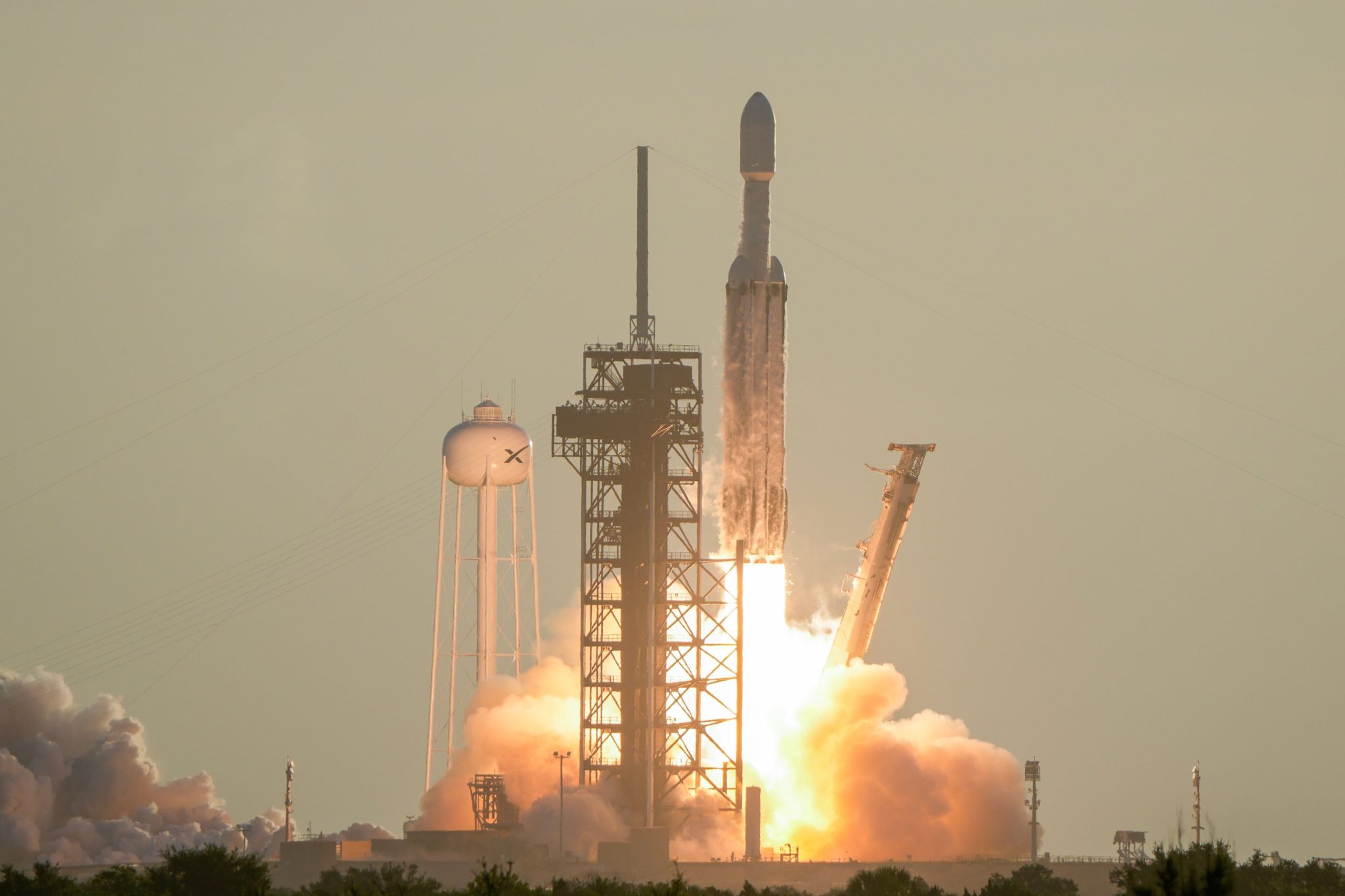
- SpaceX launched the $4.3 billion Roman Space Telescope shortly after daybreak on Sunday aboard a Falcon Heavy rocket from Kennedy Space Center.
- The vehicle's two reusable side boosters came back tail-first to Cape Canaveral several minutes after liftoff, landing with sharp sonic booms over the Cape.
- The telescope then separated successfully from the rocket's upper stage, which ground controllers greeted with applause.
- Roman is now bound for an observation point a million miles out, the same region Webb occupies, and needs more than three months of cruise to arrive.
- Its field of view is more than 100 times wider than Hubble's, the observatory that has been returning images for 36 years.
Why it matters
- exposure A single flight carried the full $4.3bn appropriation, so the downside case for the federal science budget was concentrated on one vehicle on one morning rather than spread across two launches or two dates.
- capability Boosters that fly home to the Cape can be quoted again, so the cost basis for the next heavy-lift science mission is now set by hardware that has demonstrated return and reuse on a flagship payload.
- constraint Roman's survey value is designed to be realised alongside Hubble, Webb, ESA's Euclid and the NSF's Rubin Observatory, which leaves part of the return hostage to instruments funded and operated by other agencies.
- precedent A flagship delivered nearly a year early and within budget changes what appropriators are entitled to demand of the next multibillion-dollar observatory, and hands NASA a defence it did not previously have.
Roman flew with a fuel port, or rather with the assumption that something will eventually arrive to use it: the telescope is designed to be refuelled, and the framing NASA offered on launch day was that a robotic tanker becoming available in the coming decade could extend its life [13]. That is an option written into a $4.3bn asset [1] with no counterparty, no price and no delivery date, which is a strange thing to find on the books of a government science program and a very ordinary thing to find in a venture portfolio. Build the port, assume a servicing market shows up. If it does not, the mass and volume given over to it were spent for nothing.
One launch measures no market share, and I am not going to pretend otherwise. What the flight record establishes is narrower and, for underwriting purposes, enough: the account of the launch names SpaceX and Falcon Heavy and no competing vehicle in the class [18], and the moment the payload separated from the upper stage [6] is the moment the risk on the entire appropriation transferred. Two readings price differently. If several qualified vehicles could have flown this mass to that point and NASA chose one, the dependency is a procurement preference and reversible. If only one could, then the launch line on the next flagship is quoted by a party with no reference competitor, and every dollar of restraint in that quote is a courtesy rather than a market outcome.
The science throughput deserves the same reading as a vendor spec sheet. Senior project scientist Julie McEnery's comparison, that a month of Milky Way observing by Roman would take Hubble a century [9], works out to roughly 1,200 Hubble-months per Roman month [15], while the wide-field infrared camera is specified at 1,000 times Hubble's speed at matching sensitivity [10]. The 20 percent gap [16] is nothing to an astronomer and everything to anyone who has priced a throughput claim before. Run the same rate the other way and Hubble's whole 36 years of orbit compresses to something near four and a half months of Roman survey time [19], which is the number that tells you why the agency accepted the concentration risk in the first place.
This is probably wrong, but I read the fuel port as the more consequential term than the rocket. A launch dependency is a single transaction with a known loss case; a servicing dependency is recurring revenue for whoever owns the tanker, and it arrives attached to an asset the government has already declared it wants to keep alive. The thesis fails if the tanker never gets funded, in which case Roman is simply a well-built instrument that runs out of propellant on its original schedule, and it fails differently if a second provider flies comparable mass to the same region before the servicing market exists, which would show the concentration was a timing artifact rather than a structure. The money is already spent; the number I want next is whatever a tanker costs.
What to watch
- Disclosure of what NASA paid for this launch, which sets the reference price for the next flagship in the same mass class.
- Any funded and dated commitment to a robotic refuelling tanker, without which Roman's servicing design carries no residual value.
- Whether early Roman data supports the 1,000x camera specification or the higher survey rate implied on launch day.
Clarity's read
What the record supports and how the coverage leans. The claims behind it follow.
Reality
- Evidence63
- Adoption52
- Hype gap+15
- Incentives68
- Confidence58
Claim ledger
Ranked by verification strength, evidence, and original report placement.
- [1]
SpaceX launched the $4.3 billion Roman Space Telescope shortly after daybreak on Sunday aboard a Falcon Heavy rocket from Kennedy Space Center.
- [2]
The bus-sized telescope is named after the late Nancy Grace Roman, NASA's first chief astronomer.
- [3]
Roman is headed for an observation point 1 million miles (1.6 million kilometres) away that is also home to the Webb Space Telescope, and will take more than three months to reach it.
- [4]
NASA science mission director Nicky Fox said Roman is going to find thousands of supernovae, tens of thousands of planets, billions of galaxies and tens of billions of stars.
- [5]
Several minutes after launch the rocket's two reusable side boosters descended tail-first and landed back at Cape Canaveral, producing sharp sonic booms.
- [6]
Soon after booster landing, the telescope separated successfully from the rocket's upper stage, drawing applause from ground controllers.
- [7]
NASA Administrator Jared Isaacman was in a news conference a couple of hours after launch when President Donald Trump called to offer congratulations.
- [8]
Roman's field of view is more than 100 times wider than that of NASA's Hubble Space Telescope, which is still operating after 36 years in orbit.
- [9]
Senior project scientist Julie McEnery said a month of Milky Way observations by Roman would take Hubble a century to complete.
- [10]
Roman carries a wide-field infrared camera that matches Hubble's sensitivity but is 1,000 times faster, plus an experimental coronagraph that blocks starlight to directly image faint planets.
- [11]
Roman will work alongside Hubble, Webb, the European Space Agency's Euclid spacecraft and the National Science Foundation's Vera C. Rubin Observatory in Chile.
- [12]
Roman launched nearly a year ahead of schedule and within budget, and is NASA's first space telescope to be named after a woman.
- [13]
The telescope is designed to be refuelled, meaning that if a robotic tanker becomes available in the coming decade it could extend Roman's life.
- [14]
Roman is not designed to search for life, but Fox said it will pave the way for future observatories addressing whether another Earth exists.
- [15]
McEnery's month-for-century comparison implies roughly 1,200 months of Hubble survey work per month of Roman survey work.
- [16]
The implied 1,200x survey throughput sits about 20 percent above the 1,000x camera speed specification quoted for Roman.
- [17]
The launch account names only one launch provider and vehicle for Roman, SpaceX and Falcon Heavy, and identifies no competing vehicle or bid in the same lift class.
- [18]
The launch account names SpaceX and Falcon Heavy as the provider and vehicle and no competing vehicle in the class.
- [19]
At the survey rate implied by the month-for-century comparison, Hubble's 36 years in orbit correspond to roughly four and a half months of Roman survey time.
Get this ledger inside ChatGPT. Ask about any of our stories and the answer brings its figure, each claim’s verdict and the sources. Free, no account.
Sources
1 independent publisher whose own reporting we read for this story.
Topics and entities
Follow any of these and your For You feed starts watching them — no settings page required.
Topics
- NASA Science ProgramsFollow
- Dark Energy and Dark MatterFollow
- Exoplanet DetectionFollow
- Space TelescopesFollow
- Launch Provider ConcentrationFollow
- Heavy-Lift LaunchFollow
Entities
- SpaceXFollow
- Falcon HeavyFollow
- NASAFollow
- Hubble Space TelescopeFollow
- James Webb Space TelescopeFollow
- EuclidFollow
- Vera C. Rubin ObservatoryFollow
- Nancy Grace RomanFollow
- Nicky FoxFollow
- Julie McEneryFollow
- Jared IsaacmanFollow
- Donald TrumpFollow
- Ed WeilerFollow
- National Reconnaissance OfficeFollow
- Kennedy Space CenterFollow
- European Space AgencyFollow
- National Science FoundationFollow
- Nancy Grace Roman Space TelescopeFollow