Science2 publishers2 min readPublished
Sixteen days after launch, Roman's 300-megapixel camera read out its first unfocused stars
NASA says the Wide Field Instrument and the coronagraph are both working in space. The two published accounts of the milestone disagree about when science observations start and how long the mission runs.
The Scientist · Science desk
What happened
- NASA activated Roman's 300-megapixel Wide Field Instrument on September 11, after the newly launched spacecraft spent ten days drying out to protect its highly sensitive systems.
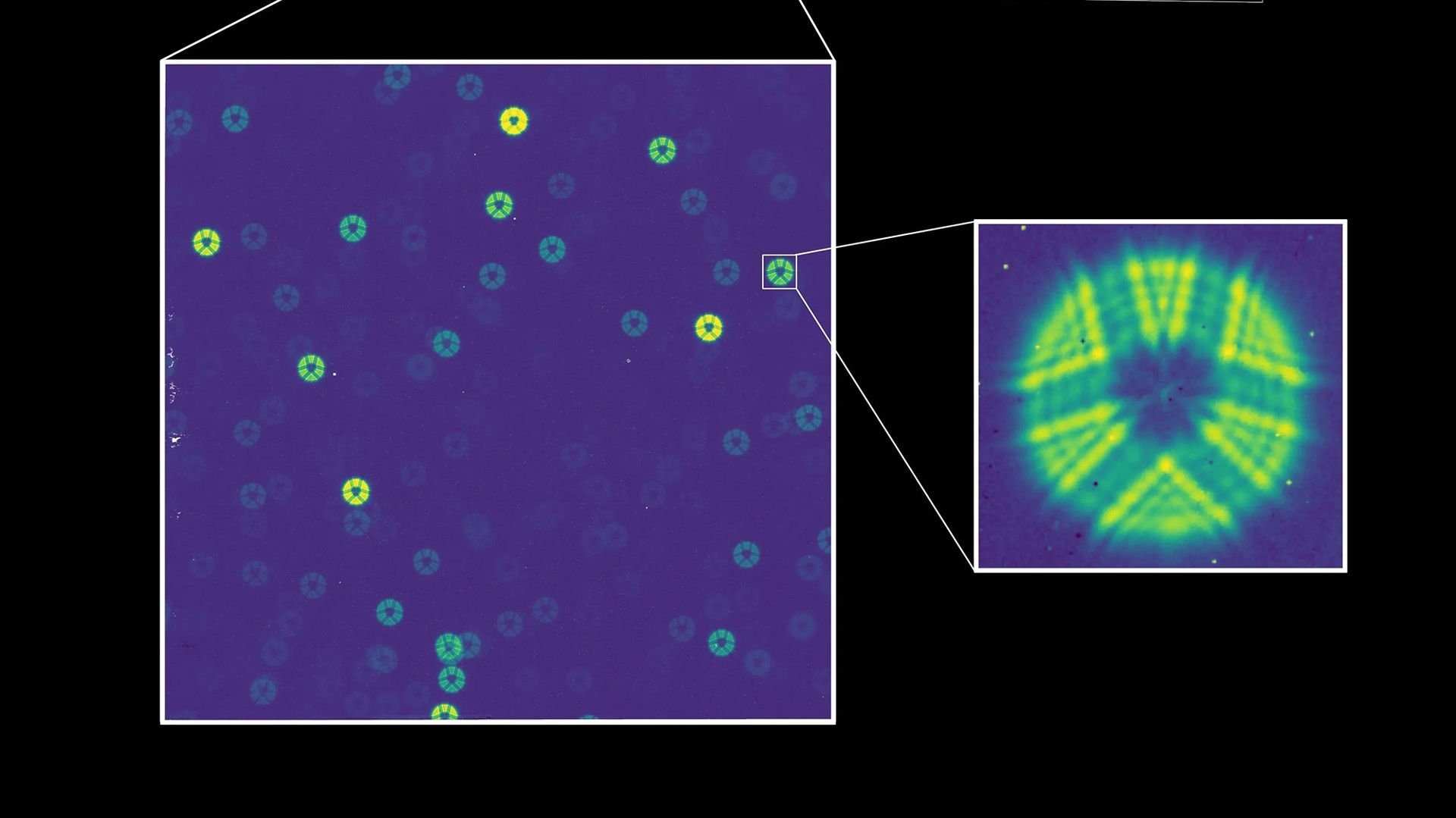
- The first test image, shared on September 15, shows hundreds of stars as lime-colored loops because the camera has not been fully focused yet.
- The 18 infrared detectors could only be switched on once the heaters were off and the instrument reached minus 143 degrees Celsius, and cooling continued toward minus 183.
- Engineers also checked out Roman's coronagraph, the instrument that blocks starlight so exoplanets can be observed without stellar glare.
- NASA says a successful thruster burn plus bonus fuel loaded at launch may leave Roman with 22 years worth of power instead of the planned 10.
Compiled by The ScientistSomething wrong?How this is made
Why it matters
- contradiction The two accounts put the arrival of usable frames months apart, so a team staffing an analysis pipeline has to pick between a holiday-season delivery and an early-2027 one before NASA reconciles them.
- constraint About 511 terabytes a year sets the sizing problem for the ground archive and the calibration chain, and the checks reported so far are instrument checks on the spacecraft.
- capability Dark-energy and microlensing survey plans were written against an instrument proven on a test stand; confirmation that it reads out in space moves the leading risk from hardware to schedule.
- precedent If the propellant margin holds, NASA will be allocating time on an observatory that outlives the survey plans written for it. Deciding who gets that time is a competition among science teams.
Live Science describes Roman as partway through a months-long commissioning process with all systems working as they should [22], and Scientific American reports the same status in the same week [23]. Neither account includes a dated pre-launch milestone list [28], so whether any of this is early or late stays open. The activation came about two days after the ten-day dry-out window closed [26], and the image was public four days after the activation [27].
The two publishers do differ on when usable data starts. Live Science puts Roman's first full science images in early 2027 [12]. Scientific American says the first images are expected around the holiday season, with science operations scheduled for January [14]. They also describe different primary missions: five years of operation in Scientific American [16], ten years in Live Science [17].
The green rings are expected at this stage. The camera has not been fully focused, so each star appears as a lime-colored loop [6]. Scientific American reports that the focus mechanism, the calibration system and the light filtering devices all came on for the first time during the same activation, with the calibration system put through some testing [7]. The wavy rows of squares in the frame are the 18 detectors themselves, translating photons into electrical signals [9].
Scientists are preparing for roughly 1.4 terabytes of data a day from the spacecraft [10]. At 365 days, that is about 511 terabytes a year [11]. That figure counts what comes down the link. The ground system still has to turn those bits into calibrated frames a survey team can use.
"After years of effort to build and test the instrument on the ground, we now have confirmation that it is operational in space. This is a huge milestone," Josh Schlieder, chief scientist for the Wide Field Instrument at NASA's Goddard Space Flight Center, said in a NASA statement [18]. He added: "There is much to do, but we are on our way to groundbreaking science." [19]
The survey case rests on area. Each Roman image will cover a patch of sky roughly the size of a full moon [15], about 100 times the area of a Hubble frame at comparable sharpness [13]. Scientific American frames the same advantage differently, putting Roman's five planned years of observing at more than 50 times the sky Hubble has covered in 30 [16].
Live Science reports that NASA attributes the possible 22-year lifetime to a successful thruster burn combined with bonus fuel loaded onto the spacecraft at launch [24].
What to watch
- A published commissioning milestone chart from NASA would settle whether Roman's timeline is holding or slipping.
- Whether the first focused WFI frames arrive in the holiday-season window Scientific American describes or closer to the early-2027 date Live Science gives.
- Whether NASA converts the reported propellant margin into a formal extended-mission plan beyond the primary survey years.