Simulations trained only on gas-phase clusters find anion-free lithium clusters in battery electrolyte
A Nature paper reports clusters of several Li+ ions with no bound anions in lithium-ion battery electrolyte, coordinated only by ethylene carbonate. The authors say these clusters reduce unusually easily and explain why ethylene carbonate blends work.
The Scientist · Science desk
What happened
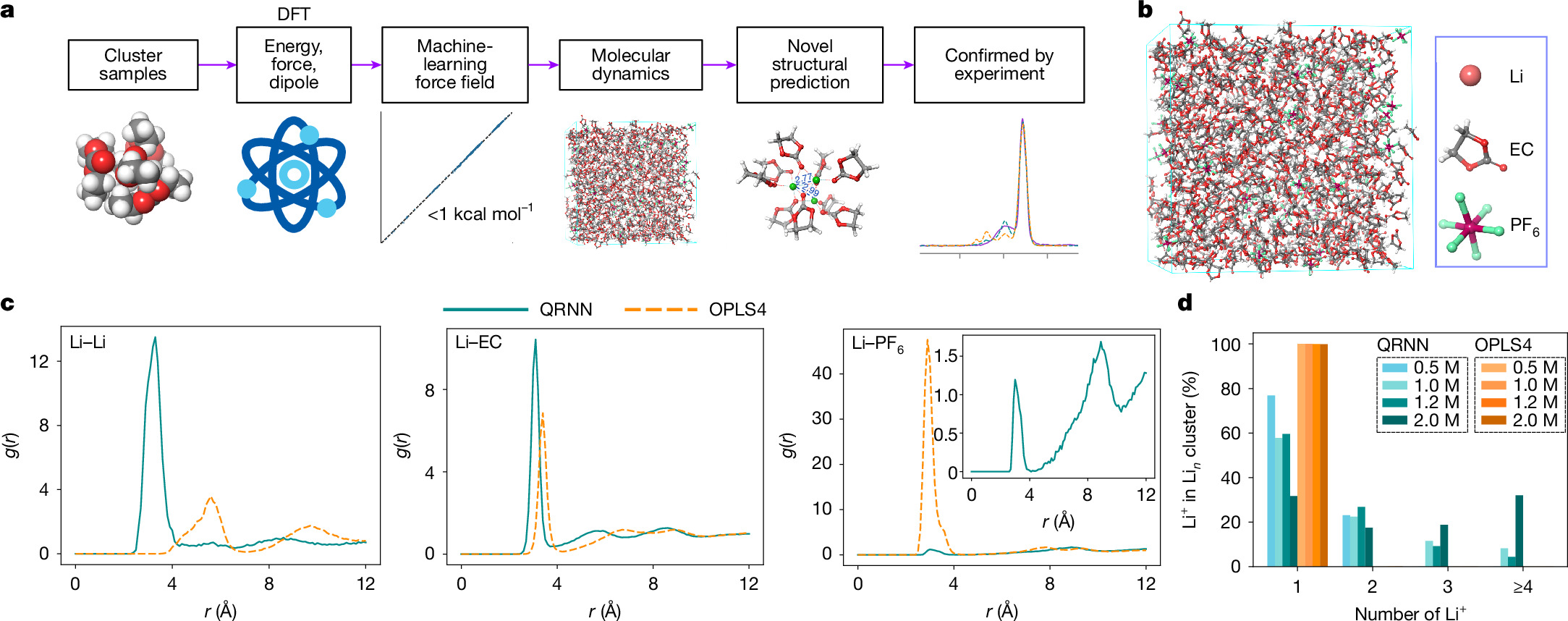
- The team combined machine-learned atomistic simulations, NMR spectroscopy, electrochemical data and quantum-chemical calculations to study electrolyte structure.
- The machine-learned force field was parameterized only to gas-phase quantum-chemical cluster calculations, yet the authors say it reproduces a wide range of condensed-phase experiments.
- An earlier study with the same charge-recursive neural network model had seen complexes of several Li+ ions as close as 3 angstroms with no direct counterion coordination.
- Per energy evaluation the model costs two to three orders of magnitude more than a classical force field such as OPLS4, and many orders less than ab initio molecular dynamics.
Why it matters
- capability Solvation structure sets conductivity, viscosity and the stability window but is hard to resolve by experiment alone, so a simulation that matches NMR gives designers an atomic-scale picture to work from.
- decision Electrolyte developers get a structural question to ask of any blend: does it allow or suppress anion-free Li+ clusters, and does that track how easily the electrolyte is reduced.
- constraint The abstract reports no cell-level test of a formulation built around these clusters, so rational design is a stated aim and the ethylene carbonate account is still an explanation after the fact.
The design is the part worth checking first. The force field is a charge-recursive neural network, QRNN, and it was parameterized only to quantum-chemical calculations on gas-phase clusters [c5, c3]. The condensed-phase comparisons, solid-state NMR among them, were therefore not fitting targets [c3, c6]. In our view that makes the agreement a real test.
The authors argue that classical force fields may not suit this chemistry, since Li+ solvation in concentrated polar organic electrolytes differs vastly from that of aqueous biomolecular species [9]. Ab initio molecular dynamics is the alternative, and it is limited in system size, timescale and the accuracy of the DFT functional [7]. The machine-learned model sits between the two, at roughly 100 to 1,000 times the cost of a classical force field per energy evaluation [10]. That is a run-time figure. The thing it does not tell you is what it cost to generate the quantum-chemical training set.
The ethylene carbonate link is an explanation reached after the winner was known. Mixtures containing EC were chosen empirically, and the clusters are offered as the reason they work [2]. An account built around a known result is weaker evidence than a prediction made in advance. Clusters coordinated only by EC fit an empirical preference for EC [6], and that remains a correlation until someone designs a formulation from the clusters and tests it.
The excerpt of the paper available to us stops before the results sections, so cluster populations, NMR shifts and reduction energies are not in what we reviewed.
The authors write that the simulations "provide a compelling demonstration that machine-learning force-field-based models developed from first principles can robustly represent a complex chemical system to atomic resolution" [11]. We would state it more narrowly. The abstract tests the model on lithium-ion battery electrolytes, and other chemistries are outside what it checks.
What to watch
- Whether the results sections give cluster populations, NMR shifts and reduction energies that support the claim of unusually easy reduction.
- Cell-level tests of electrolytes formulated to favor or suppress anion-free Li+ clusters.
- Independent groups running a comparable machine-learned force field on other solvent mixtures and salts.
Clarity's read
What the record supports and how the coverage leans. The claims behind it follow.
Reality
- Evidence68
- Adoption
- Insufficient
- Hype gap+15
- Incentives
- Insufficient
- Confidence60
Claim ledger
Ranked by verification strength, evidence, and original report placement.
- [1]
The authors combine machine-learning-enabled atomistic simulations, nuclear magnetic resonance spectroscopy, electrochemical data and quantum-chemical calculations to reveal previously unstudied multi-Li+ complexes without bound anions that are uniquely facile for reduction.
- [2]
The authors say the insight explains the success of empirically chosen ethylene-carbonate-containing solvent mixtures and provides a foundation for the rational design of improved electrolytes.
- [3]
The machine-learning force-field electrolyte simulations accurately reproduce a wide range of condensed-phase experiments despite being parameterized only to quantum-chemical gas-phase cluster calculations.
- [4]
The computational cost of the MLFF is two to three orders of magnitude more expensive per energy evaluation than a traditional pairwise additive molecular mechanics force field such as OPLS4, but still many orders of magnitude less expensive than a purely quantum-chemical approach such as AIMD.
- [5]
In an initial study of lithium-ion battery electrolytes with a high-dimensional, charge-recursive neural network (QRNN) MLFF, molecular complexes containing multiple Li+ ions at short distances (as small as 3 angstroms) were observed without direct coordination with counterions.
- [6]
The present work reports a theoretical analysis of a refined QRNN-based MLFF electrolyte model coupled with comparison with solid-state NMR spectroscopy; the authors say the results strongly support the computational discovery of multi-Li+ species exclusively coordinated by ethylene carbonate solvent molecules.
- [7]
Ab initio molecular dynamics approaches suffer from severe limitations in the system sizes, simulation timescales and accuracy of the density functional theory functional that can be accessed.
- [8]
The bulk solvation structure of the electrolyte is a major determinant of properties such as conductivity, viscosity, salt dissociation, reactivity and the electrochemical stability window, and elucidating it at atomic detail has been challenging via a purely experimental approach.
- [9]
Traditional molecular mechanics force fields may not be well suited to describing lithium-ion battery chemistry, because the physical chemistry of Li+ solvation and dynamics in concentrated, polar organic electrolytes is vastly different from that of aqueous biomolecular species.
- [10]
The QRNN model costs roughly 100 to 1,000 times a classical force field per energy evaluation.
- [11]
The authors write that their simulations "provide a compelling demonstration that machine-learning force-field-based models developed from first principles can robustly represent a complex chemical system to atomic resolution".
Get this ledger inside ChatGPT. Ask about any of our stories and the answer brings its figure, each claim’s verdict and the sources. Free, no account.
Sources
1 independent publisher whose own reporting we read for this story.
- nature.comEvidence for multi-Li<sup>+</sup> clustering in lithium-ion battery electrolytes
1 article · October 13, 2026
Topics and entities
Follow any of these and your For You feed starts watching them — no settings page required.