USTC team cuts a topological crystal into a microscope tip to probe altermagnetism in KV2Se2O
USTC-led researchers shaped alpha-Bi4Br4 crystals into scanning tunneling microscope tips and report converging evidence of 2D d-wave altermagnetism on KV2Se2O. The tip's spin sensitivity can change with bias polarity, so one kind of probe can tie atomic structure to spin response.
The Scientist · Science desk
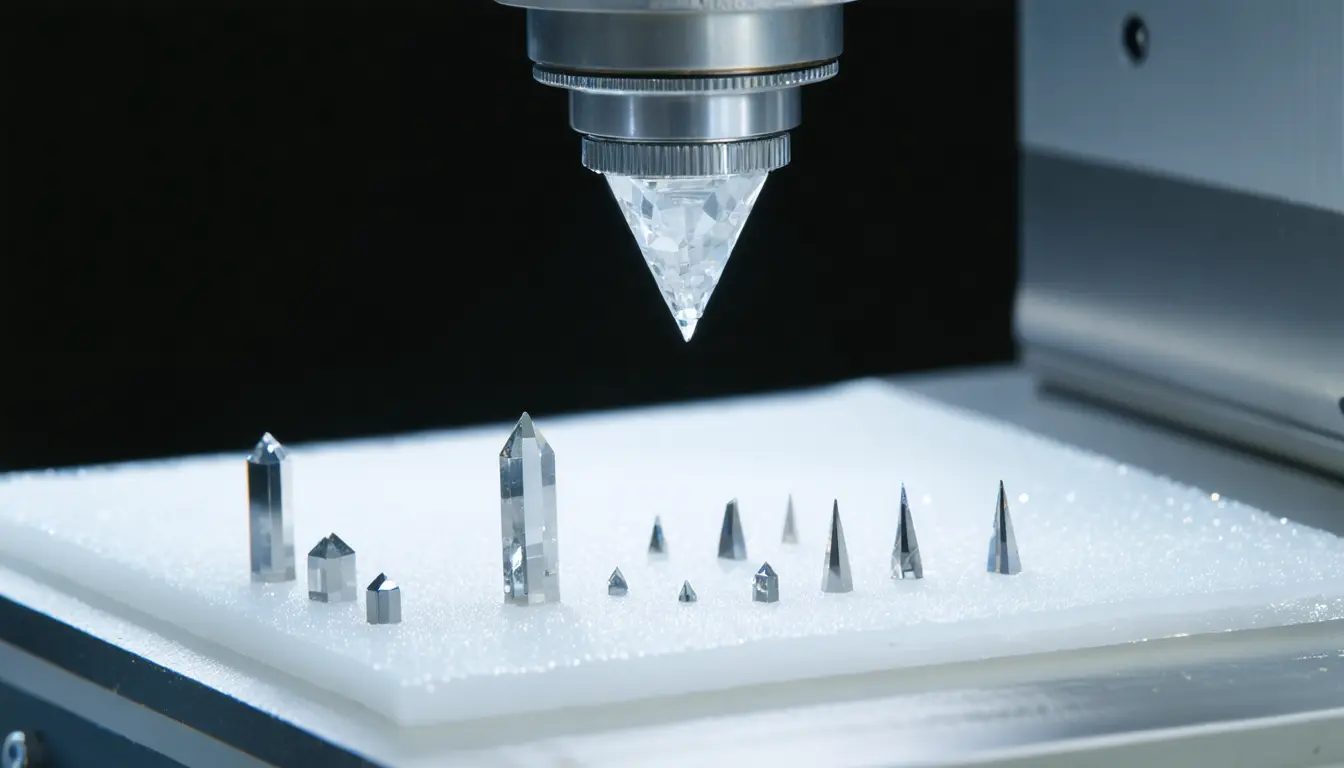
What happened
- Chen Xianhui and Wang Zhenyu led the work at USTC, with Liu Junwei of the Hong Kong University of Science and Technology among the collaborators, and Nature published it online on Oct. 13.
- The tip idea follows the same group's earlier observation of robust, weakly coupled helical edge states at steps in the related material alpha-Bi4I4.
- Before turning to KV2Se2O, the team checked the principle on two established magnets: stripe contrast in Fe1+xTe reversed with voltage polarity, and FeGe layer contrast changed at a spin-flop transition.
- On KV2Se2O, the dominant direction of two orthogonal scattering features rotated by 90 degrees when bias polarity was reversed, and conventional nonmagnetic tips showed no comparable reversal.
- Control measurements indicated that structural anisotropy, local strain or orbital selectivity alone could not readily account for the observations.
Why it matters
- constraint The claim is for the surface layer of KV2Se2O and the authors word it as converging evidence. The result does not speak to layers below the surface.
- cost The tips are cut from alpha-Bi4Br4 single crystals by focused-ion-beam nanofabrication. We'd expect labs without both the crystals and the fabrication line to depend on those that have them.
- precedent The authors name other 2D and moire materials as targets for the same approach. In our view each new system will need its own check against known magnets and nonmagnetic tips before a spin assignment holds.
Altermagnets are hard to identify directly. They have zero net magnetization, yet the defining symmetry connects opposite-spin sublattices in real space and alternates spin polarization across momentum space [5]. The paper's abstract calls the needed measurement, atomic-scale and spin-sensitive in both spaces, "an experimental milestone yet to be achieved" [9].
The tip answers that with an edge channel. Along an edge of a quantum spin Hall insulator, electrons traveling in opposite directions have opposite spin expectation values [15]. When such a channel dominates tunneling, reversing the sample-bias polarity changes the direction in which electrons enter or leave the tip, and therefore can change its spin sensitivity [16]. The fabricated tips still resolve individual atoms and keep spectral features consistent with helical edge states [4].
On KV2Se2O the team ran three kinds of measurement [19]. Images taken at opposite voltage polarities gave a real-space pattern consistent with checkerboard antiferromagnetism [6]. Field spectroscopy found defect-associated excitations along two orthogonal directions shifting in opposite ways, a pattern the researchers say supports opposite spin polarizations [7]. The abstract adds a predominantly out-of-plane magnetic response [10]. The third leg, quasiparticle interference imaging, is the momentum-space one, and the abstract describes it as a bias-reversing d-wave anisotropy between the symmetry-paired X and Y valleys [11].
The wording throughout is graded: "consistent with," "supporting," "converging" [6][7][14]. We think that is the right grade. All three legs rest on the same probe, the helical edge modes of alpha-Bi4Br4 [13], so a flaw in how that tip reads spin would touch every one of them, and agreement among the legs does not remove it. The nonmagnetic-tip comparison and the strain, anisotropy and orbital controls are the parts of the design that speak to that risk.
The thing this doesn't tell you is the denominator. The summaries do not say how many tips or samples stand behind the images and spectra.
What to watch
- Whether another group, using a different spin-sensitive probe, reaches the same d-wave assignment for KV2Se2O.
- Whether alpha-Bi4Br4 tips are used on other 2D or moire materials, as the authors suggest, and what controls those papers report.
- Whether the supplementary data show how many tips and samples were measured and how often the bias-reversal result reproduced.
Clarity's read
What the record supports and how the coverage leans. The claims behind it follow.
Reality
- Evidence68
- Adoption
- Insufficient
- Hype gap+15
- Incentives
- Insufficient
- Confidence65
Claim ledger
Ranked by verification strength, evidence, and original report placement.
- [1]
Researchers fashioned a layered topological material into a scanning tunneling microscope tip that senses spin-related electronic states at atomic resolution, and used it to obtain converging evidence for two-dimensional d-wave altermagnetic order on the surface of KV2Se2O.
- [2]
The team was led by Chen Xianhui and Wang Zhenyu of USTC, together with Xiang Bin of USTC, Liu Junwei of the Hong Kong University of Science and Technology and other collaborators; the study was published online in Nature on Oct. 13.
- [3]
The researchers used focused-ion-beam nanofabrication to shape alpha-Bi4Br4 single crystals into STM tips.
- [4]
The fabricated tips can resolve individual atoms while retaining spectral features consistent with helical edge states.
- [5]
Altermagnets simultaneously have momentum-dependent nonrelativistic spin splitting and zero net magnetization; their defining crystalline symmetry connects opposite-spin sublattices in real space and imposes alternating spin polarization on symmetry-related electronic states in momentum space.
- [6]
On the KV2Se2O surface, atomic imaging revealed a density-wave-related lattice modulation and different symmetry-related vanadium sites, and images acquired at opposite voltage polarities yielded a real-space pattern consistent with checkerboard antiferromagnetism.
- [7]
Magnetic-field spectroscopy showed that the energies of defect-associated excitations extending along two orthogonal crystal directions shifted in opposite ways, supporting opposite spin polarizations.
- [8]
With the alpha-Bi4Br4 tips, the dominant direction of two orthogonal scattering features in quasiparticle interference images rotated by 90 degrees when the bias polarity was reversed; conventional nonmagnetic tips showed no comparable reversal.
- [9]
The abstract says identifying altermagnetic order calls for atomic-scale spin-sensitive measurements in both real and momentum space, "an experimental milestone yet to be achieved."
- [10]
Field-dependent spectroscopy found opposite energy shifts of unidirectional quasiparticle excitations along two orthogonal crystal axes and a predominantly out-of-plane magnetic response.
- [11]
In momentum space, spin-sensitive quasiparticle interference imaging reveals a bias-reversing d-wave anisotropy between the symmetry-paired X and Y valleys.
- [12]
In earlier work, the USTC team observed robust, weakly coupled helical edge states at steps in the related material alpha-Bi4I4.
- [13]
The abstract says the helical edge modes of the higher-order topological insulator alpha-Bi4Br4 serve as the spin-selective scanning tunnelling microscopy probe of the d-wave altermagnetic order in the surface layer of KV2Se2O.
- [14]
The abstract says the results provide converging evidence for two-dimensional d-wave altermagnetism on the surface of KV2Se2O, with the probe addressing order in the surface layer.
- [15]
Along an edge of a quantum spin Hall insulator, electrons traveling in opposite directions have opposite spin expectation values.
- [16]
When an edge channel dominates electron tunneling, reversing the sample-bias polarity changes the direction in which electrons enter or leave the tip and therefore can change its spin sensitivity.
- [17]
To test the principle on two established magnets, the researchers found that in Fe1+xTe the magnetic-stripe contrast reversed with voltage polarity, and in FeGe the contrast between adjacent unit-cell layers changed markedly when an external magnetic field induced a spin-flop transition.
- [18]
Further control measurements indicated that structural anisotropy, local strain or orbital selectivity alone could not readily account for the observations.
- [19]
On KV2Se2O the team reports three kinds of measurement: atomic imaging at opposite polarities, field-dependent spectroscopy, and quasiparticle interference imaging.
- [20]
The study demonstrates how topological edge states can become functional components of atomic-scale instruments, with potential applications to other two-dimensional and moire materials.
Sources
2 independent publishers whose own reporting we read for this story.
- nature.comAtomic-scale spin sensing of a 2D d-wave altermagnet <i>via</i> helical tunneling
1 article · October 12, 2026
- phys.orgNew topological microscope tip reveals evidence of 2D altermagnetism
1 article · October 13, 2026
Topics and entities
Follow any of these and your For You feed starts watching them — no settings page required.