ProductNot yet confirmed elsewhere1 publisher2 min readPublished
Raytheon wins Navy research contract to improve SPY-6 detection range in software
Raytheon holds an Office of Naval Research contract, running through 2031, to improve SPY-6 radar detection range in software. Laboratory and field tests will help decide whether the upgrades are ready to deploy.
The Product Desk
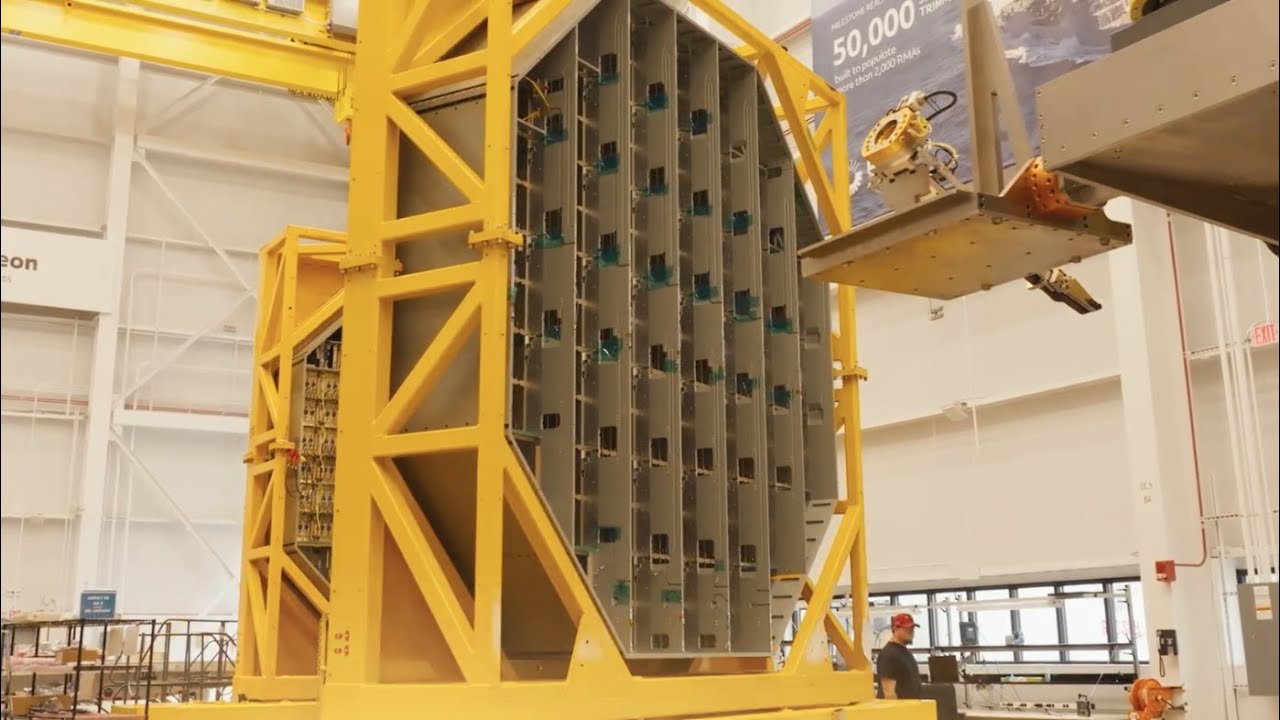
Office of Naval Research contract: Raytheon software upgrades intended for the SPY-6 family and future systems. SPY-6(V)2: rotating array, amphibious assault ships, Nimitz-class carriers. SPY-6(V)3: three fixed arrays, Ford-class carriers, frigates. Tests come before deployment; no numeric target.
- decision Office of Naval Research Awarded Raytheon a contract for naval radar software upgrades, claim 1
- exposure Raytheon's SPY-6 family The upgrades are intended for the SPY-6 family of naval radars and other future systems, claim 5
- capability SPY-6(V)2 Uses a rotating antenna array; designed for amphibious assault ships and Nimitz-class carriers, claim 9
- capability SPY-6(V)3 Uses three fixed antenna arrays; intended for Ford-class carriers and guided-missile frigates, claim 9
- constraint Laboratory and field tests Will help determine whether the upgrades deliver the intended improvements before deployment, claim 7
- constraint Performance targets The account states no contract value or numeric detection-range or classification-speed target, claim 13
| Who | How | Kind | Claim |
|---|---|---|---|
| Office of Naval Research | Awarded Raytheon a contract for naval radar software upgrades | decision | 1 |
| Raytheon's SPY-6 family | The upgrades are intended for the SPY-6 family of naval radars and other future systems | exposure | 5 |
| SPY-6(V)2 | Uses a rotating antenna array; designed for amphibious assault ships and Nimitz-class carriers | capability | 9 |
| SPY-6(V)3 | Uses three fixed antenna arrays; intended for Ford-class carriers and guided-missile frigates | capability | 9 |
| Laboratory and field tests | Will help determine whether the upgrades deliver the intended improvements before deployment | constraint | 7 |
| Performance targets | The account states no contract value or numeric detection-range or classification-speed target | constraint | 13 |
What happened
- The program centers on signal- and data-processing algorithms meant to help radars detect smaller objects at greater distances and classify targets more quickly.
- The upgrades are intended for the SPY-6 family of naval radars and for other future systems.
- Development and testing will take place at Raytheon facilities in Portsmouth, Rhode Island, and Andover, Massachusetts.
- The contract builds on Raytheon's software-defined aperture work and draws on earlier ONR initiatives, including ASPIRE and STORM.
Why it matters
- decision A program office choosing between a radar refresh and a software path has nothing measured to compare until the laboratory and field tests report.
- capability If the tests confirm the gains, ships already carrying SPY-6 could get longer detection range and faster classification without replacing the radar hardware.
- constraint The family spans a rotating-array design and a three-fixed-array design, and we'd expect a processing gain shown on one to need its own proof on the other.
A small target far from the ship sends back a weak echo, and the radar has to tell it apart from background signals and interference [6]. Software can work on both ends of that problem. Signal processing pulls more useful information out of what the antenna received, and data processing helps interpret and classify what was detected [14].
Raytheon will do that signal- and data-processing work under the ONR contract [1]. The approach is billed as "software-first", though the coverage says it does not rely solely on hardware modifications [4] and that the planned upgrades aim to avoid a complete replacement of existing radar hardware [11]. Both phrasings leave room for some hardware change.
Colin Whelan, president of Advanced Technology at Raytheon, said in a statement: "Modernizing fielded radar systems with software-first upgrades is one of the fastest and most cost-effective ways to deliver mission-ready capability." [8] "Fastest" and "cost-effective" are comparisons. Interesting Engineering's account of the award does not state a contract value or a numeric range or speed target [13].
The record here describes a development and test program: Raytheon develops algorithms, then the Navy side gets laboratory and field results to judge them against [1][7]. Anyone who has to roll out a radar change on a ship's schedule should read the announcement that way.
For any software-first pitch, two questions sort it. The first is whether the gain is stated in a unit, such as detection range or time to classify, or only in comparatives such as "smaller" and "faster". The second is whether it runs on hardware already installed or needs a refresh.
A stated unit on installed hardware is a rollout you can schedule. A stated unit that needs new hardware is a procurement. Comparatives on installed hardware are a research result, and comparatives that need new hardware are a pitch.
On the record so far, this contract sits in the research-result cell, leaning toward installed hardware [4][11][13]. It moves to the rollout cell when a test report puts a unit on the gain.
What to watch
- The first test result from the laboratory and field trials, and whether it states a detection range or classification time in a unit.
- Whether the algorithms are demonstrated on more than one SPY-6 configuration.
- Any disclosure of the contract's value or of numeric performance targets for the work.
Clarity's read
What the record supports and how the coverage leans. The claims behind it follow.
Reality
- Evidence30
- Adoption
- Insufficient
- Hype gap+15
- Incentives60
- Confidence55
Claim ledger
Ranked by verification strength, evidence, and original report placement.
- [1]
RTX's Raytheon will develop software upgrades designed to improve the detection range, sensitivity and processing efficiency of naval radar systems under a contract awarded by the US Office of Naval Research.
- [2]
Work under the contract will continue through 2031.
- [3]
The program will focus on advanced signal- and data-processing algorithms intended to help radars detect smaller objects at greater distances and classify targets more quickly.
- [4]
The approach uses software improvements to enhance the performance of existing radar systems rather than relying solely on hardware modifications.
- [5]
The upgrades are intended for Raytheon's SPY-6 family of naval radars and other future systems.
- [6]
Detecting smaller targets at greater distances is challenging because their reflections may be weaker and harder to distinguish from background signals and other sources of interference.
- [7]
The software will undergo laboratory and field testing to evaluate its performance and establish its suitability for operational use, and the testing will help determine whether the upgrades deliver the intended improvements before they are prepared for deployment.
- [8]
"Modernizing fielded radar systems with software-first upgrades is one of the fastest and most cost-effective ways to deliver mission-ready capability," said Colin Whelan, president of Advanced Technology at Raytheon, in a statement.
ReportedSupportedSource: Colin Whelan, president of Advanced Technology at Raytheon, in a statement quoted by Interesting EngineeringView cited source - [9]
The SPY-6(V)2 uses a rotating antenna array and is designed for amphibious assault ships and Nimitz-class aircraft carriers; the SPY-6(V)3 uses three fixed antenna arrays and is intended for Ford-class aircraft carriers and guided-missile frigates.
- [10]
The contract builds on Raytheon's work in software-defined apertures and draws on technical developments from earlier ONR initiatives, including ASPIRE and STORM.
- [11]
The planned upgrades aim to improve radar capabilities without requiring a complete replacement of existing radar hardware.
- [12]
Development and testing will take place at company facilities in Portsmouth, Rhode Island, and Andover, Massachusetts.
- [13]
Interesting Engineering's account of the award does not state a contract value or a numeric detection-range or classification-speed target.
- [14]
Improvements in signal processing can help radar systems extract useful information from received signals, while data-processing algorithms can support the interpretation and classification of detected objects.
Sources
1 independent publisher whose own reporting we read for this story.
- interestingengineering.comUS Navy radars to get software upgrades to spot smaller targets at greater distances
1 article · October 13, 2026
Topics and entities
Follow any of these and your For You feed starts watching them — no settings page required.