Product1 publisher3 min readPublished
The Navy spends $3.8M to find out if an existing laser survives a flight deck
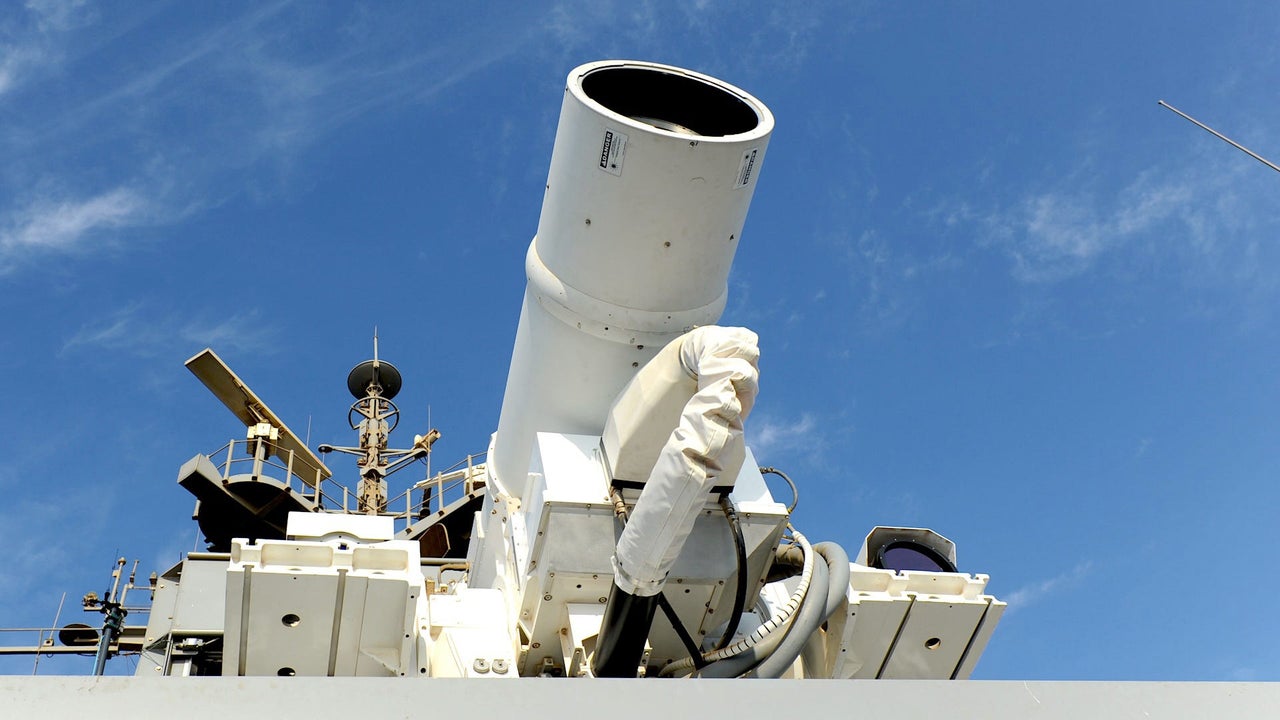
Huntington Ingalls and EO Solutions received a $3.8 million agreement in June for a marinized counter-drone laser. A defense official told Laser Wars the money is likely for experimentation with a system that already exists.
The Product Desk · Product desk
What happened
- The US Navy awarded Huntington Ingalls Industries and EO Solutions a $3.8 million Other Transaction Agreement in June for a Counter-Group 3 Marinized MOSA Laser for Navy, through the Naval Surface Technology & Innovation Consortium.
- A US defense official told Laser Wars the agreement emerged from ATLAS, a 2024 Navy solicitation for a prototype counter-drone laser weapon.
- It is HII's first known naval laser contract; its earlier laser work was a $14.82 million Army agreement in February 2025 for engineering on the Enduring High Energy Laser.
Compiled by The Product DeskSomething wrong?How this is made
Why it matters
- constraint At 7.6 percent of what the ATLAS statement of need anticipated, this award funds testing and leaves the deck question open until someone pays for an integration at program scale.
- decision With AV's LOCUST holding the Army production contract, HII's way into laser weapons runs through the hull it already builds, and the beam comes from a partner.
- cost The bill for actually fielding one falls on a later program office: the Navy's own precedent at that scale is the $150 million HELIOS contract, roughly 39 times the June award.
- precedent The Navy is now buying containerization in $2.5 million and $5 million increments. Consortium agreements are the practical entry door for suppliers with no laser record.
The statement of need for ATLAS anticipated $50 million in funding [6]. The June agreement is $3.8 million, 7.6 percent of that figure [1][1]. A US defense official familiar with the project told Laser Wars the smaller sum was likely just to support experimentation and testing with an existing system [7].
The requirement is specific about conditions. ATLAS called for a containerized laser with baseline output between 30 and 100 kilowatts, operating from the flight deck of a surface combatant [4]. It had to hold up "in a stressing naval environment for an extended period without degradation or damage," according to the statement of need obtained by Laser Wars [5]. Marinization is cooling, optics and mounting that survive salt and vibration on a working deck. That is nearer to Huntington Ingalls' day job than beam physics is.
Read the budget lines and the Navy's renewed goal of "a laser on every ship" [18] looks like a run of small container experiments. Gr3MMLN was paid for out of a $5 million congressional addition to the Navy's fiscal 2026 budget for an "enduring high energy laser" [8]. The award takes 76 percent of that addition [2]. The fiscal 2027 NDAA the House passed in late July includes $5 million for a containerized version of the 60-kilowatt HELIOS and $2.5 million for a separate Containerized Maritime High Energy Laser Weapon System [9]. That is $7.5 million together [3]. The Office of Naval Research gave Attalon a $17.1 million modification to continue work on a 400-kilowatt laser under SONGBOW [10], 4.5 times the Gr3MMLN award [5].
HII's laser record before June was Army work. In February 2025 it took $14.82 million for design, development, integration and systems engineering on the Enduring High Energy Laser effort [12], about 3.9 times the size of the new naval agreement [6]. It was followed that September by a capital investment in a new integration, production and test facility [13]. AV's LOCUST then won the Army's E-HEL production contract [14]. Laser Wars reports that with Gr3MMLN, HII appears focused on marinizing and integrating an existing EO Solutions-derived capability instead of building the directed energy system in-house [15]. EO Solutions is not Electro Optic Systems, the Australian laser weapons provider [19].
Attalon holds the high-power work [10] and AV holds the Army production award [14]. Lockheed Martin appears once, over an unnamed system its chief executive said the company was testing with the Navy in the Red Sea, and the status of that system is unclear [17].
Anyone tracking these awards can sort them by which of three jobs the money buys: making the beam, packaging it in a container, and getting it onto a ship and keeping it working. Gr3MMLN buys the third, at experiment scale. By the test Laser Wars sets out, it becomes more than a technology experiment only if HII and EO Solutions slot a system onto the bow of a surface combatant [16].
What to watch
- Whether the $7.5 million of containerization funding in the House-passed fiscal 2027 NDAA survives into an enacted appropriation.
- Whether Gr3MMLN gets a follow-on award beyond the $5 million fiscal 2026 congressional addition that paid for it.
- Any clarification of the Lockheed Martin laser its CEO said was being tested with the Navy in the Red Sea.