Science1 publisher3 min readPublished
Ball-and-socket joints let each oarfish fin ray swivel in a full circle
Cornell researchers give the first anatomical account of how each of the oarfish's hundreds of fin rays spins on its own in a full circle. A co-author plans to copy it in a quiet ocean robot whose effect on fish only a prototype can show.
The Scientist · Science desk
What happened
- Each ray attaches at its tip to the fin membrane and at its base to cartilage, a series of muscles and a ball-and-socket joint that permits the rotation.
- Because the rays turn independently, one stretch of membrane can wave toward the tail while another waves toward the head, driving the fish forward or backward.
- Ribbon-fin swimming has evolved about 10 separate times in bony fishes, and whether other ribbon-fin swimmers also have spinning rays is unknown.
Compiled by The ScientistSomething wrong?How this is made
Why it matters
- capability A machine copying this fin could reverse or split thrust along its length while its hull stays straight. That matches the forward-and-backward motion Shepherd wants from his monitoring robot.
- constraint The quiet-robot claim rests on Shepherd's stated belief and a comparison with boat noise, so it stands or falls on acoustic and fish-behaviour tests of a built machine.
- precedent Comparative dissections of other ribbon-fin swimmers now have a specific joint to look for; finding it would show the rotating ray evolved more than once.
Oarfish are hard to study because they come apart. Their bodies break into segments after death, so intact specimens are rare [8]. The two recognized species live in oceans worldwide at depths down to about 305 meters. The largest individuals are estimated at 8 meters, and the giant oarfish is the longest bony fish alive [9].
The new paper, published Sept. 30 in Ichthyology and Herpetology, is the first to describe the anatomy and muscles that let each fin ray rotate independently in a full circle, according to the Phys.org report [1]. Gabriel Afonso, now a doctoral student at the Virginia Institute of Marine Science, is first author, and Willy Bemis of Cornell is senior author [3]. With so little intact material, the team combined dissection, histology, CT scans made at Cornell, X-rays of a specimen at the Smithsonian Institution and analysis of film of the rays moving [4]. Imaging shows the skeleton without a scalpel. The film ties that structure to motion. The report does not say how many fish were dissected or which species they came from [4].
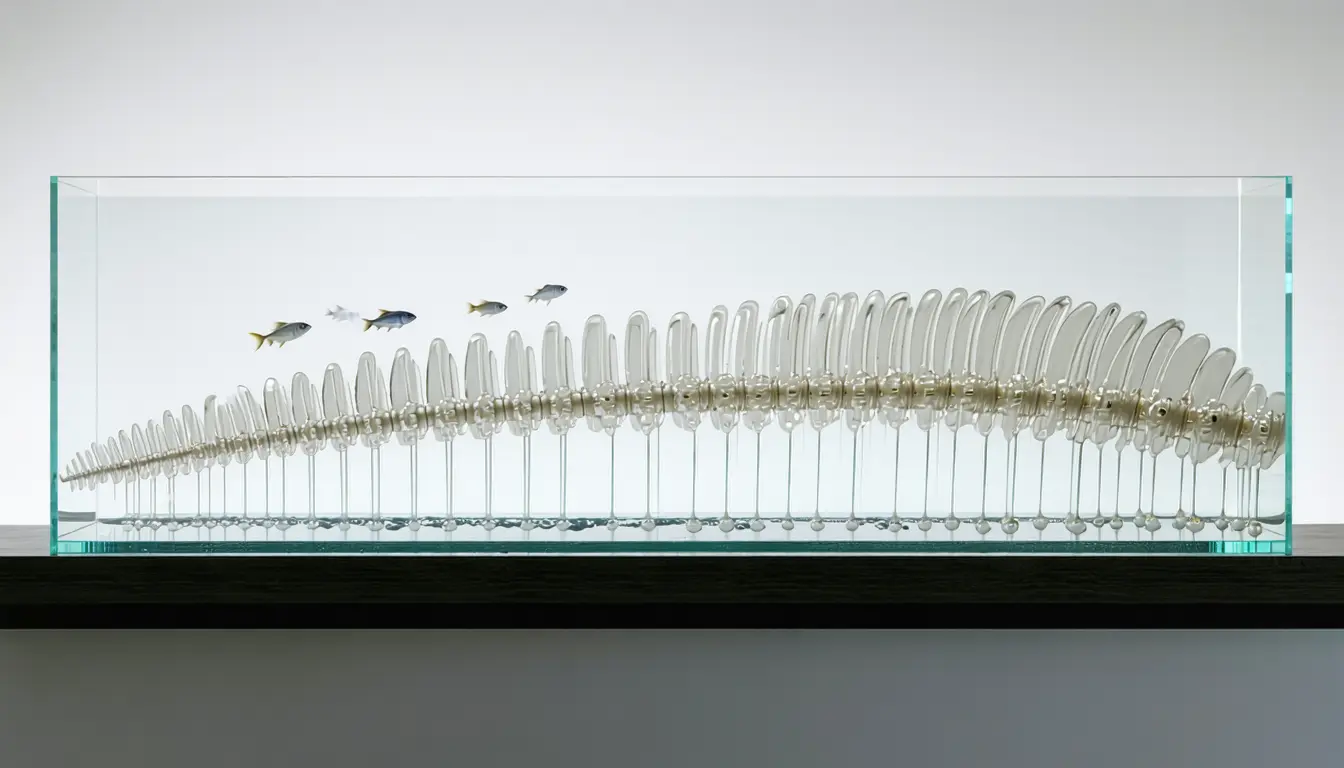
An oarfish carries hundreds of these bone-like rays along its back, joined by a membrane they drive in waves [2]. At its tip each ray meets the thin membrane. At its base it meets cartilage, a series of muscles and a ball-and-socket joint that allows the rotation [5]. Because the rays turn independently, one stretch of membrane can wave toward the tail while another waves toward the head, so the fish can move forward or backward [6]. "They're continuously able to change the pattern of those dorsal fin rays and do it very quickly," Bemis said. "The fin rays are incredibly mobile." [7]
For an engineer, the appeal is thrust from the fin while the body stays straight. "Most fishes with long bodies swim like eels," Bemis said. "They move in a series of undulations, pressing the water back and forth. And oarfish do that but also, remarkably, they use the dorsal fin to propel themselves without moving their bodies laterally." [10] According to the report, this lets oarfish stalk prey silently without hard swimming [11]. The fin also helps them hold the vertical posture they take while eating tiny crustaceans [17].
Rob Shepherd, a Cornell mechanical engineer and co-author [3], came to the fish from the robotics side. He received an Office of Naval Research grant for a large swimming machine that would carry instruments for an ocean-monitoring platform the Navy was also interested in [12]. The robot is meant to move forward and backward without scaring fish away [12]. He took the question to Bemis. "He called me and said, 'I'm interested in oarfish,' and I said, 'Me too,'" Bemis said [16].
Shepherd's case for quiet starts from boat noise. "If you swim in Cayuga Lake in the summer and a boat goes by, it's really loud," he said. "We think that a more biomimetic approach would make it better for playing along with fish." [13] "We think" is the honest verb there. I'd call the anatomy the firm result and the quiet robot a reasonable engineering bet. The thing this doesn't tell you is how loud rotating rays would be at machine scale, or how fish would react to them. Those answers need a prototype in the water with a hydrophone beside it.
Ribbon-fin swimming has evolved about 10 separate times in bony fishes, Bemis said, and no one yet knows whether the other lineages also evolved spinning rays [14]. "We're describing it here," Bemis said. "The next steps would be to go and see whether that's the case for other fishes." [15]
What to watch
- A prototype from Shepherd's Office of Naval Research project, with its noise measured against a propeller-driven platform and fish behaviour recorded around it.
- Dissections of other ribbon-fin swimmers, the next step Bemis names, to test whether full-circle rotating rays evolved in more than one lineage.