Science2 distinct publishers3 min readPublished
The effect turned up first in a bead-chain simulation with no muscles and no nervous system, which suggests the speed-up is physics rather than something the animal decides, and it points robot designers at body stiffness.
The Scientist · Science desk

Compiled by The ScientistSomething wrong?How this is made
The evidence arrived in a specific order, and that order matters. A computational model with no muscles and no nervous system, keeping only a flexible chain and a small push distributed along its length [17], was sent through two channels of equal length, one about as wide as the worm's diameter and one much wider [18]. It kept crossing the narrow one faster, a finding that caught the researchers by surprise [19]. The live-animal experiments came afterwards, designed by graduate student Paulami Sarkar in Saad Bhamla's lab [22], and the simulated worms and the real ones behaved alike [8]. A model with no sensing and no decision-making produces the same effect, showing that the wall helps the animal whether or not the animal notices the wall.
The mechanism the team reports is loss of the freedom to turn. In wider channels the worms flail about while reorienting; in a tight one they cannot reorient, so they brace against the walls and squeeze forward [10]. That compresses into a single quantity: the square of the channel width divided by the worm's stiffness [11]. Small values describe an effectively stiff body travelling almost straight; large values describe a body that wriggles and takes much longer [11]. Because width enters squared, the two terms do not trade evenly, and doubling the gap takes roughly four times the stiffness to hold the same regime [25].
Hold the scale in mind. Twice the width of a body 0.05 centimetres across is a channel about a millimetre wide [6], threaded by an animal 2.5 to 5 centimetres long, which is 50 to 100 times longer than it is wide [24]. About a minute to cross the narrow channel, against up to five times that in wider ones [4][5], puts the penalty at roughly four extra minutes [7].
What was measured is traversal time in a straight, water-filled glass channel open at both ends [3]. Rubble after an earthquake is one of the stated applications [13], and it is a different problem: this experiment used a wall that holds firm when pushed against, while rubble can give way underfoot, and a passage through rubble can simply stop. The reported result also does not speak to energy per unit distance, which is usually the number that binds a soft robot running on a battery.
The physics underneath accounts for the reversal in sign. For a passive polymer such as DNA, tighter pores slow translocation down, since there is less room to bend and change shape [20]. Blackworms drive themselves forward by contracting and bending, which puts them in the class called active matter [21], and self-propulsion appears to flip the sign of the confinement term. Raghunath Chelakkot of IIT Bombay, who was not involved, put the achievement in the right place when he noted that such a simple model captured essential features of the worm's translocation [16]. On the evidence so far I would happily design a pipe-crawler around this and wait for someone to run it in shifting grains before designing a soil machine around it.
Ranked by verification strength, evidence, and original report placement.
Researchers report July 28 in Physical Review Letters that California blackworms squeeze through a confined space much faster than they wriggle across a wide open one.
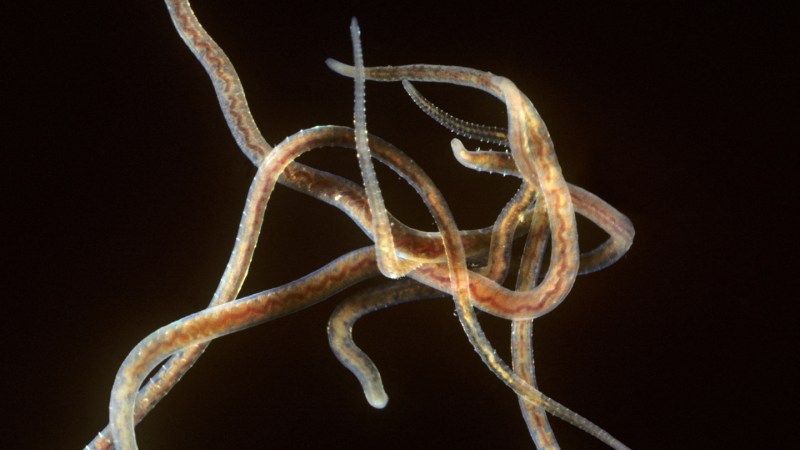
California blackworms (Lumbriculus variegatus) are slender, flexible, aquatic animals about 0.05 centimetres wide and about 2.5 to 5 centimetres long.
In the experiments the team had the worms glide through water-filled glass channels that were open on both ends.
The researchers created computer simulations of the worms as active beads-on-a-string and squeezed them through virtual channels of varying width; the model worms behaved similarly to the real ones.
Physicist K.R. Prathyusha of the University of Colorado Boulder said motion was much faster in the smallest confinement.
In a wider channel the worms flail about as they reorient themselves; a confined space restricts reorienting, and with nowhere else to go they use the walls for support and squeeze forward.
Distinct publishers with included, body-backed reporting in this cluster.
1 article · August 31, 2026
Follow any of these and your For You feed starts watching them — no settings page required.
science
Glassfish school by copying one neighbor at a time, not by averaging the crowd1 distinct publisher
science
A centuries-old Coulomb's law test could out-search accelerators for millicharged particles1 distinct publisher
science
A sensor tuned to its own noise beats the textbook entangled state by 0.698 dB1 distinct publisher
science
AI weather models cannot forecast what they never saw. A hybrid method aims at that gap.1 distinct publisher
Evidence-backed comparisons of source perspectives and observed adoption signals. Read the methodology
Which Builder, Operator, and Investor concerns the observed source mix emphasized—not a truth score.
Evidence, demonstrated adoption, hype gap, incentives, and confidence are assessed independently, each on its own current evidence. How these are measured.
Peer-reviewed and doubly demonstrated, with one number in dispute
The finding rests on a Physical Review Letters paper and, more persuasively, on two very different demonstrations agreeing — worms in glass channels and a bead chain in a computer. Science News supplies the only voices from outside the work, Hu and Chelakkot; The Conversation's account is the lab describing its own result and cannot serve as a second check. The visible crack is arithmetic: the wide-channel penalty is up to five-fold in one telling and nearly three-fold in the other, and no one reconciles them.
No adoption to measure
Nobody has picked this up. The rubble-crawling and drug-delivering robots exist as aspirations in both accounts; no engineer outside Bhamla's lab is described building, testing or funding anything, and no other group has repeated the experiment. The one concrete event is the paper appearing in Physical Review Letters, which is publication, not use.
Mild stretch, concentrated at the robot end
Both headlines describe what actually happened, and the mechanism is explained rather than mystified, which keeps this close to aligned. It tips positive for two reasons. Science News's up-to-five-times figure is nearly double the penalty the lab itself reports, and it is the more quotable number. And an earthquake-rubble robot is a long way from a worm crossing a millimetre of glass in about a minute; both outlets take that step in an opening or closing line without marking it as speculation.
Half the coverage is the lab explaining itself
One of these two accounts is written by a member of the research team, in the first person, about her own result — a legitimate format with an obvious interest in the finding landing well, and it is also the account that skips the journal, the date and any outside voice. Science News has no stake and did the thing that costs effort: it called two physicists with no involvement, one of whom produces a counter-example from his own snake work. What prevents a firmer read is that no funder, patent, commercial partner or press office appears anywhere in this reporting.
Direction solid, magnitudes and reach not
We would stand behind the effect and the mechanism: peer review, two independent demonstrations, and two outside physicists who find it credible rather than doubtful. The numbers and the applications are another matter. The timing penalty differs between accounts, the stiffness parameter that makes the result useful appears in only one of them, the institutional affiliations rest on Science News alone, and adoption cannot be scored at all.