Science1 publisher2 min readPublished
Male tokay geckos stretch their mating calls with a tenth-of-a-second breath between notes
University of Southern Denmark researchers found male tokay geckos inhale for about 0.1 seconds between call notes, then add pulses to lengthen the call. The study of seven captive males explains how a call already known to grow longer in noise does so within a limit set by breathing.
The Scientist · Science desk
Drafted by a language model from the sources cited here and checked against its claim ledger before publication. How we use AISend a correction
What happened
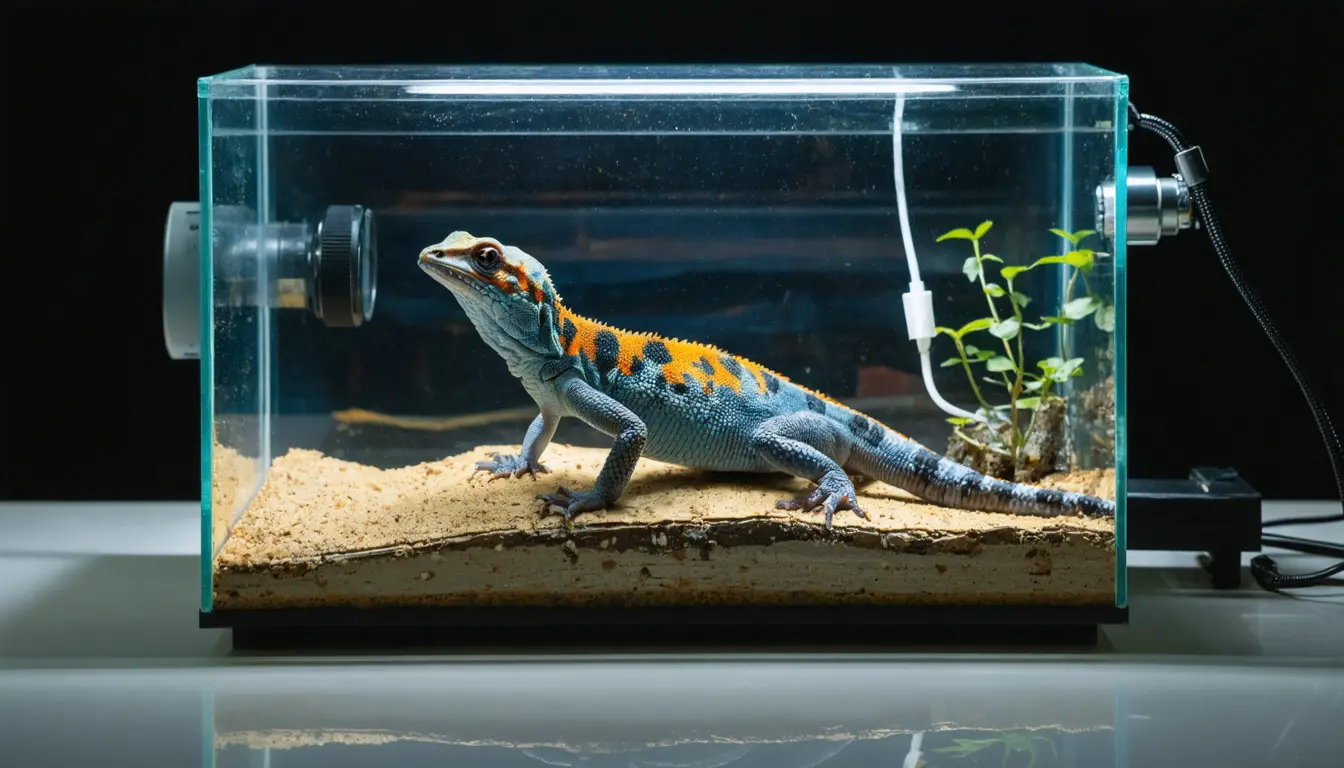
- The team analysed 16 video clips of seven captive males calling on their own, pairing acoustic analysis with deep-learning pose estimation of breathing.
- Every audible part of the call came on the out-breath at a steady rate; the authors take this as support for a breathing limit on call length.
- According to the authors, an inhalation tucked inside a two-note call had previously been associated only with songbirds.
- The added pulses carry acoustic signatures of vocal fry, a low, creaky voice register that the authors describe as air-efficient.
Compiled by The ScientistSomething wrong?How this is made
Why it matters
- capability Pose estimation on ordinary video gives researchers a way to measure breathing during natural calling, and the same setup could be taken to wild tokays, the comparison the captive data leave open.
- precedent With a songbird-style mini-breath now documented in a lizard, the trait looks less like a bird specialty, and other calling reptiles become candidates for the same check.
- decision The authors read call length as an honest signal of lung capacity; confirming that requires playback tests on females, and this study recorded only males.
Earlier work had already shown that the call can change. Past studies suggest that in noisy surroundings, male tokays produce more of the loud GE-KO notes and hold them longer [3]. The new paper starts from there. Mathilde S. Fuglsang Thastum and co-authors Danuta M. Wisniewska, Jakob Christensen-Dalsgaard and Coen P.H. Elemans wrote: "Although previously considered inflexible, male tokay geckos exhibit vocal plasticity by switching to longer, louder call types in noisy environmental conditions" [5]. The open question was how a gecko lengthens a call while it also has to breathe [3]. "However, they seem to face respiratory constraints limiting longer duration calls," they wrote [6].
Testing that needs breath timing and sound on the same clock. The team ran deep-learning pose estimation on video, tracking the back, belly and ear openings to mark when each animal breathed in and out and when its ears narrowed [8]. With both records aligned, each note can be placed on the in-breath or the out-breath directly instead of being inferred from the sound alone. The calls were spontaneous, so the experimenters did not prompt them [7]. The sample is small: 16 clips from seven males [7], or about two clips per animal [15].
I think the fair reading is that the call is flexible up to a limit set by breathing. The geckos get more sound out of each breath cycle in two ways. They top up their lungs between notes, and they finish the call in a voice register the authors describe as air-efficient [12][13].
The thing this study doesn't tell you is how much each change adds. According to phys.org's account, the mini-breath may provide more air for the call [12]. The support for that is timing, an inhalation in the right place, and the report does not describe any measurement of air volume. The vocal fry identification is also an inference, drawn from acoustic signatures [13]. Seven captive animals are a narrow base for claims about a species [7].
The ear openings closed slowly as the geckos called [1]. The authors contrast this with the reflexive dampening of hearing in birds and mammals. They describe the gecko response as tightly coordinated with breathing and vocalizing [2]. Its protective role is a hypothesis that, by phys.org's account, still needs testing [1].
What to watch
- Recordings of wild tokay geckos showing whether they use the mid-call breath and terminal pulses outside captivity.
- A measurement of air volume per call showing how much extra air the tenth-of-a-second breath actually supplies.
- An experiment testing whether the slow closure of the ear opening reduces how loud a gecko's own call is at its eardrum.