Science1 publisherNot yet confirmed elsewhere2 min readPublished
Researchers tie Antarctica's darker green snow algae to phosphate from penguin guano
Green snow algae absorbing 40% more sunlight than clean snow grow where penguin guano supplies phosphate, a West Antarctic Peninsula survey found. Its senior author says melt projections that omit this effect likely understate how fast ice-free ground will spread.
The Scientist · Science desk
Drafted by a language model from the sources cited here and checked against its claim ledger before publication. How we use AISend a correction
What happened
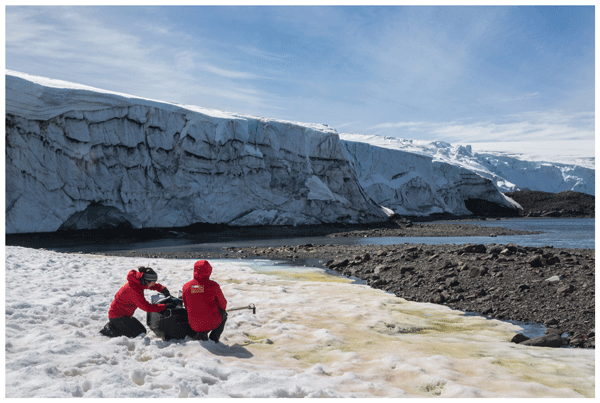
- The team sampled red and green snow along the West Antarctic Peninsula coast, spanning five degrees of latitude and sites both with and without penguin colonies.
- Red algae-tinted snow absorbs about 20% more solar energy than clean snow, half the increase reported for green snow.
- When nutrients run short or conditions turn harsh, the algae stop growing and make red, sunscreen-like pigments instead of green chlorophyll.
- Current projections of Antarctic melting do not yet include the effect of guano-fertilized snow algae.
- The phys.org account says Khan's team is the first to show a direct link between penguin guano and the algae's different-colored life stages.
Compiled by The ScientistSomething wrong?How this is made
Why it matters
- contradiction Khan's 'likely underestimating' gives melt modellers the sign of a correction with no size attached, since the study's own account says the effect cannot yet be built into peninsula projections.
- decision Forecasts of ice-free ground on the peninsula would need penguin and seabird colony locations as inputs, because the nutrient supply for green blooms comes from wildlife.
- exposure If colonies keep shifting toward the South Pole, snow that now receives little guano would be opened to green blooms and their higher sunlight absorption.
Alia Khan, a cryosphere biogeochemist at the University of Colorado Boulder, is senior author of the study in Journal of Geophysical Research: Biogeosciences [3][4]. Elise Ryan, the lead author, and others in Khan's lab counted algae cells under a microscope and extracted pigments and nutrients from each sample [6]. The lab step was needed because the eye is easily fooled near a colony. "[Penguin] poop can visually look similar to the red snow algae," Khan said [7].
Where green pigments dominated, the snow held far more phosphate than where red pigments dominated [8]. Phosphate is plentiful in guano, and penguins and skuas spread it over coastal snow after feeding at sea [8][9]. "The penguin guano acts as a fertilizer ... that fuels these dense green snow algae blooms," Khan said [10]. She also framed it more widely. "This finding links the marine food web to snow ecology," she said [16].
This is a survey, so what it shows is that phosphate and green pigment turn up together. Sampling sites with and without colonies is what connects that pattern to birds [5]. The causal reading is plausible. Well-fed algae are described as staying in a chlorophyll-rich growth phase, racing to grow through the short summer [11]. A field correlation still leaves room for other differences between sites to favour green cells. The phys.org account does not give sample counts, the size of the phosphate gap, or whether the absorption figures were measured in this study.
Colour matters for melt because of how much sunlight the snow keeps. Measured against clean snow, green snow's extra absorption is 20 percentage points larger than red snow's. A patch that flips from red to green therefore gains as much extra absorption again as red snow already has over clean snow [18]. Snow algae habitat is already expanding along the coast as Antarctica warms, according to the account [17].
Khan's projection claim runs ahead of those measurements. "Without accounting for these biological darkening effects, we are likely underestimating how rapidly coastal snowpacks are melting and how fast ice-free terrain will expand across Antarctica," she said [19]. I think the direction is right, because darker snow absorbs more energy [2]. The magnitude is still open. More data is needed before guano-driven greening can be added to snowmelt projections for the Antarctic Peninsula, according to the same account [15].
What to watch
- A snowmelt projection for the Antarctic Peninsula that includes guano-fed algae and puts a size on the underestimate Khan describes.
- A fertilisation experiment testing whether added phosphate alone turns red snow algae green.
- Mapping of how much coastal snow near colonies is green, and whether colonies moving south carry blooms with them.