Cross-hemispheric overturning outlasts North Atlantic deep-water formation by centuries in two models
Sun and Thompson report in AGU Advances that cross-hemispheric overturning could persist for centuries after North Atlantic Deep Water formation shuts down. In their models the two events are centuries apart, so the date of an AMOC collapse depends on which one is meant.
The Scientist · Science desk
What happened
- In CESM2 with carbon dioxide quadrupled, NADW formation shut down completely while the cross-hemispheric overturning transport slowed only gradually.
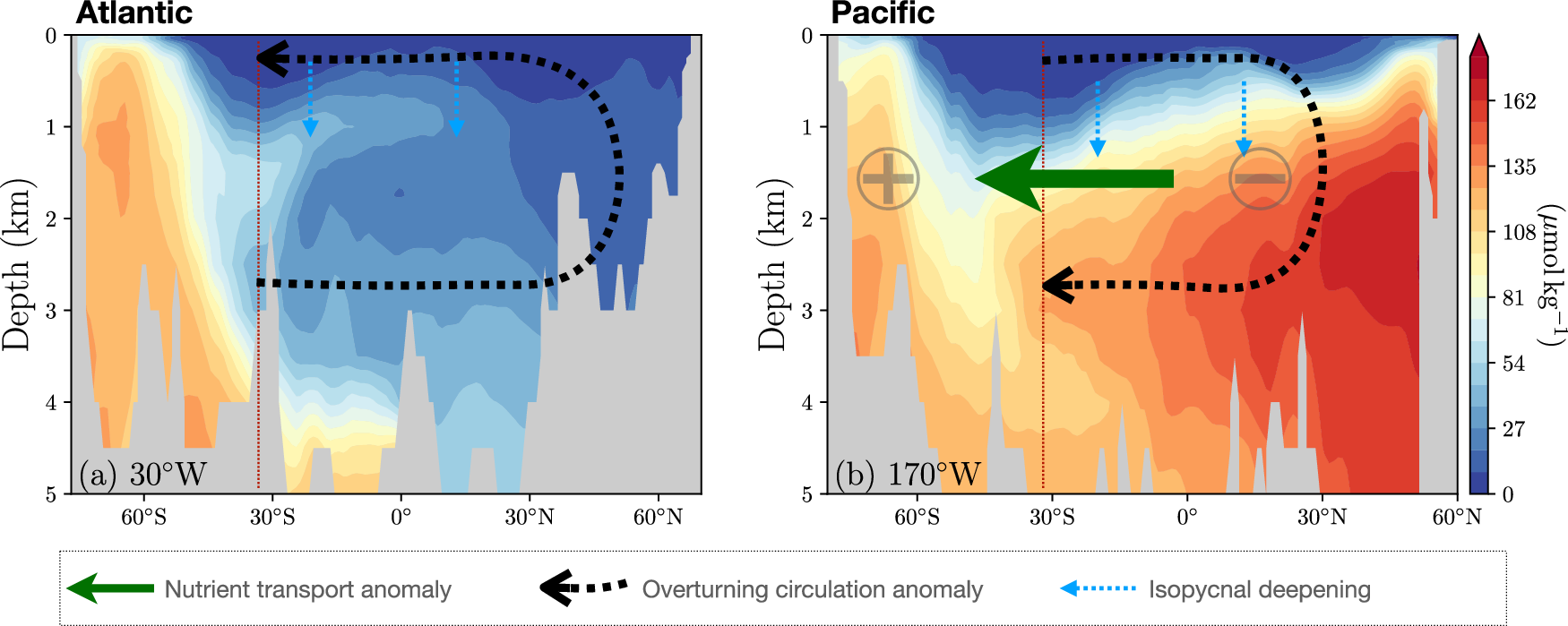
- The models also produce a clockwise overturning circulation in the Indo-Pacific Ocean as the interbasin exchange continues.
- Less nutrient-rich water would reach the upper ocean, and ventilation age is projected to rise substantially in the deep Atlantic.
Why it matters
- exposure Even with the overturning still running, the authors expect a shift in global nutrient and ventilation patterns with possible effects on ecosystems and climate.
- decision Coupled models already diverge on AMOC, so modelers now have two quantities to report side by side: NADW formation and cross-hemispheric transport.
- constraint The paper cannot be used to raise or lower collapse risk, because its authors say forecasting AMOC is difficult and outside what they attempted.
The evidence for the headline result is narrow. The coupled-model run described in the Eos summary, which phys.org republished, is one model in one scenario [14]. That model is CESM2, run with carbon dioxide at four times its starting level, and the researchers present it as an illustrative example from a hierarchy of models [3][13].
The second model is what makes the result more than a curiosity of one simulation. The idealized reduced-gravity model keeps only the key dynamics governing overturning, and it gave the same results [4]. When a stripped-down model reproduces the complicated one, the mechanism can be read from the simple system. Here, according to the authors, the continued overturning is powered by a gradual deepening of density layers, a rearrangement of the ocean's stratification, and not by a steady balance of sinking and rising water [5].
That mechanism limits how far the "less absolute collapse" reading can go. A deepening of density layers is a finite adjustment. The authors say it may sustain the circulation for several centuries, until the ocean reaches a new density distribution [6]. The paper's title uses the word "Transient" [12]. We think the supportable claim is the narrow one: in these models, the end of deep-water formation and the end of cross-hemispheric transport are separate events.
As the overturning persists, the models produce a clockwise overturning circulation in the Indo-Pacific [8]. The authors say the changed circulation could send more heat to deeper layers, keeping the surface cooler at the expense of intermediate water [9].
The summaries do not include the size of the slowdown, its timing, or the increase in ventilation age. Coupled models already diverge on AMOC's fate [1], so the CESM2 behavior is the result to test in other coupled models before it is treated as general.
What to watch
- Whether other fully coupled models, not only CESM2, show NADW formation stopping while cross-hemispheric transport slows gradually.
- Published magnitudes for the slowdown, its timing and the deep-Atlantic ventilation-age increase.
- Whether the clockwise Indo-Pacific overturning that the models produce can be tested against ocean observations.
Clarity's read
What the record supports and how the coverage leans. The claims behind it follow.
Reality
- Evidence55
- Adoption
- Insufficient
- Hype gap−5
- Incentives30
- Confidence60
Claim ledger
Ranked by verification strength, evidence, and original report placement.
- [1]
AMOC is thought to face a potentially existential threat from climate change, but attempts to model what happens to it as the oceans warm show divergent outcomes, leaving its fate unclear.
- [2]
Shantong Sun and Andrew Thompson used a hierarchy of models to show that cross-hemispheric overturning could persist for centuries even as North Atlantic Deep Water (NADW) formation shuts down.
- [3]
As an illustrative example, the researchers examined a CESM2 simulation (NCAR's fully coupled Earth system model) in a scenario with quadrupled carbon dioxide; CESM2 showed a full shutdown of NADW formation but only a gradual slowdown of the cross-hemispheric overturning transport.
- [4]
The researchers found the same results when they ran an idealized, reduced-gravity ocean model that simulates the key dynamics governing the overturning circulation.
- [5]
The reduced-gravity model indicated that the continued overturning is powered by a gradual deepening of density layers, a rearrangement of the ocean's stratification, rather than a steady balance of sinking and rising water, the authors say.
- [6]
Though the circulation appears to remain active for centuries in the models, it may not endure forever; the deepening mechanism may simply sustain it for several centuries until the ocean achieves a new density distribution.
- [7]
The authors note that attempting to predict the future of AMOC is still difficult and beyond their scope in this paper.
- [8]
One implication of the continued interbasin activity, according to the models, is the emergence of a clockwise overturning circulation in the Indo-Pacific Ocean.
- [9]
The Indo-Pacific circulation would redistribute heat, biogeochemical tracers and ventilation; it could increase heat transport to deeper layers, which would keep the surface cooler at the expense of intermediate water layers.
- [10]
Less nutrient-rich water would be found in the upper ocean, and ventilation age, the time since a water mass was last in contact with the atmosphere, is projected to increase substantially in the deep Atlantic.
- [11]
Together, these changes equate to a shift in global patterns of nutrients and ventilation that could have wide-ranging effects on ecosystems and global climate, the authors say.
- [12]
The paper is Shantong Sun et al., 'Transient Global Overturning Following the Shutdown of North Atlantic Deep Water Formation', AGU Advances (2026), DOI 10.1029/2026av002462.
- [13]
The phys.org story is republished courtesy of Eos, hosted by the American Geophysical Union.
- [14]
The coupled-model evidence described in the summary is a single fully coupled model (CESM2) in a single scenario (quadrupled carbon dioxide).
Get this ledger inside ChatGPT. Ask about any of our stories and the answer brings its figure, each claim’s verdict and the sources. Free, no account.
Sources
1 independent publisher whose own reporting we read for this story.
- eos.orgThe Ocean Circulation That Persists Even After a Key AMOC Component Fails
1 article · October 13, 2026
- phys.orgThe ocean circulation that persists even after a key AMOC component fails
1 article · October 13, 2026
Topics and entities
Follow any of these and your For You feed starts watching them — no settings page required.
Topics
- Ocean circulationFollow
- Climate Modeling and SimulationFollow
Entities
- Shantong SunFollow
- Andrew ThompsonFollow
- Atlantic Meridional Overturning CirculationFollow
- Community Earth System Model Version 2Follow
- AGU AdvancesFollow