How much dry air a rising plume swallows shapes extratropical wet-bulb extremes
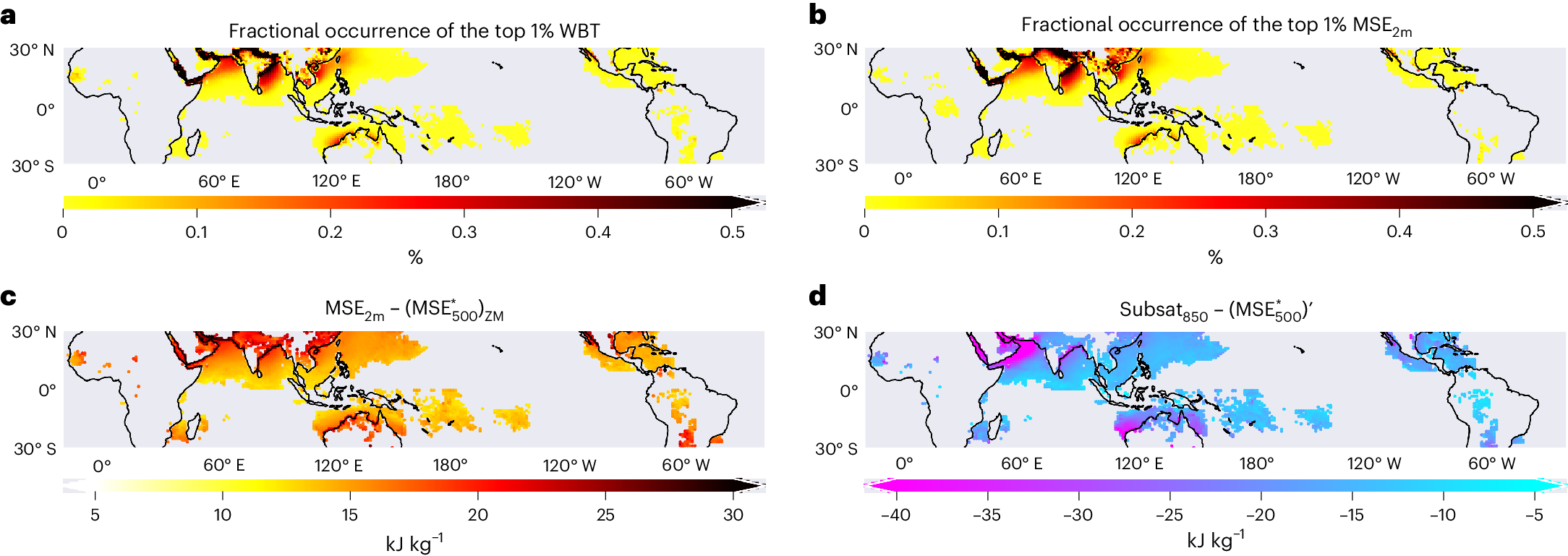
Jha and Byrne varied the rate at which dry air mixes into convective plumes across ERA5 and CESM2, and found it significantly moves moist-heat extremes outside the tropics, which means a swept parameter sits underneath the wet-bulb projection.
The Scientist · Science desk
What happened
- R. Jha and M. P. Byrne studied moist heat extremes over extratropical continents using ECMWF's ERA5 reanalysis together with the CESM2 global climate model.
- That mixing lets near-surface air become more energetic through both higher humidity and higher temperature, which is what makes a moist heat event more severe.
- In their warming simulations, a drier lower troposphere keeps the entrainment mechanism pushing surface wet-bulb temperatures upward.
Why it matters
- constraint The result is obtained by varying entrainment as an input, and the authors ask for more detailed work on how warming changes that rate, so the size of the projected wet-bulb response rests on a quantity still being pinned down.
- decision Anyone quoting a mid-latitude wet-bulb figure has to decide how much structural spread to attach to it, and the published summaries supply no rate and no degrees with which to set that width.
- exposure The amplifier sits over extratropical land, which puts mid-latitude populations in the frame for the combination of heat and humidity that is dangerous to human health.
- capability Because the framework is mechanistic rather than statistical, constraining one physical rate would tighten wet-bulb projections directly, instead of waiting for higher model resolution to settle the question.
Take the one sentence in the summary that carries the physics: entrainment alters the relationship between the energy stored in air near the ground and the energy stored higher in the troposphere [4]. Read that way, the chain is mechanical. A plume that pulls in dry surroundings on the way up loses buoyancy, so more energy has to pile up near the surface before deep convection gets going, and the near-surface air reaches a higher combination of temperature and humidity before it is mixed away [5]. Wet-bulb temperature is exactly that combination [8]. The threshold for convection and the peak of a moist-heat day turn out to be the same quantity seen from two sides.
The design is the part worth admiring. Instead of committing to one mixing rate, Jha and Byrne swept the rate for plumes rising from near the surface to the upper troposphere, and found that the choice significantly influences moist heat extremes outside the tropics [3]. Sweeping a parameter is how you learn whether a conclusion survives it. Here it does not survive untouched, and that sensitivity is the result.
The sign of the effect is consistent in their warming simulations: as the climate warms and the lower troposphere dries, entrainment keeps driving surface wet-bulb temperatures up [6]. The magnitude is where I hold back. Neither published version of the research spotlight reports an entrainment rate, a range of rates, or a wet-bulb change in degrees [12], and the authors themselves say more detailed work on how global warming is changing entrainment rates would help pin down future wet-bulb increases [11]. The paper is in Geophysical Research Letters, DOI 10.1029/2026GL122678 [7], and the numbers that matter are in it rather than in the summaries.
On sourcing: the two accounts in circulation are one text. The Eos research spotlight by Nathaniel Scharping was republished by phys.org courtesy of Eos, which the American Geophysical Union hosts [10]. Two publishers, one reading of one paper [13], so treat the corroboration as bibliographic rather than independent.
The thing this doesn't tell you is whether the swept rates were bracketed by something observable over mid-latitude land or chosen to span plausible values, and that distinction is what separates a tight wet-bulb projection from a loose one. My view, conditional on the paper's own figures: extratropical wet-bulb numbers deserve wider structural bars than the dry-bulb temperatures quoted alongside them, because they inherit a mixing rate the field is still constraining [11]. The width of that range is the open question. Its sign, in these simulations, points upward [6].
What to watch
- The Geophysical Research Letters paper's own figures: the entrainment rates tested and the wet-bulb sensitivity per unit of lower-tropospheric drying.
- Any observational constraint on entrainment rates over mid-latitude land, which would narrow the wet-bulb spread rather than just describe it.
- Whether models other than CESM2 show the same extratropical sensitivity when the entrainment sweep is repeated.
Clarity's read
What the record supports and how the coverage leans. The claims behind it follow.
Reality
- Evidence35
- Adoption
- Insufficient
- Hype gap+10
- Incentives
- Insufficient
- Confidence45
Claim ledger
Ranked by verification strength, evidence, and original report placement.
- [1]
R. Jha and M. P. Byrne examined moist heat extremes over extratropical continents using ERA5 reanalysis data, the fifth generation of reanalysis from the European Centre for Medium-Range Weather Forecasts, and the Community Earth System Model Version 2 (CESM2) global climate model.
- [2]
The authors paid special attention to how dry air mixes into plumes of warm, moist air travelling upward in convective environments, a process known as entrainment.
- [3]
The authors simulated varying rates at which dry air mixes into plumes rising from near Earth's surface to the upper troposphere, and found that entrainment exerts a significant influence on moist heat extremes outside the tropics.
- [4]
The authors say entrainment alters the relationship between the amounts of stored energy in the air near the ground and higher up in the troposphere.
- [5]
Mixing of dry air into rising plumes enables the near-surface air to become more energetic through higher humidity and temperature, leading to more severe moist heat events.
- [6]
Using simulations, the authors found that as the climate warms and the lower troposphere becomes drier, the entrainment mechanism will continue to drive up wet-bulb temperatures at the surface, potentially leading to even more severe moist heat extremes.
- [7]
The paper is R. Jha et al, "Entrainment-Based Framework for Understanding Extratropical Moist Heat Extremes," Geophysical Research Letters (2026), DOI 10.1029/2026GL122678.
- [8]
Wet-bulb temperature is a moist heat metric that combines temperature and humidity.
- [9]
Days with both high heat and high humidity are dangerous for human health, and understanding how these extreme events will change in the future is important.
- [10]
The account was written by science writer Nathaniel Scharping for Eos, which is hosted by the American Geophysical Union, and was republished by phys.org courtesy of Eos.
- [11]
The authors say future work examining in more detail how global warming is changing rates of dry-air entrainment into rising plumes will be useful to better understand how wet-bulb temperatures will increase in the future.
- [12]
Neither published version of the research spotlight reports a numerical entrainment rate, a range of simulated rates, or a quantified change in wet-bulb temperature.
- [13]
The two publisher accounts of this study are the same text from the same author, so they constitute one reading of one paper rather than two independent reports.
Get this ledger inside ChatGPT. Ask about any of our stories and the answer brings its figure, each claim’s verdict and the sources. Free, no account.
Sources
2 independent publishers whose own reporting we read for this story.
- eos.orgHow Rising Air Plumes Help Spike Moist Heat
1 article · August 27, 2026
- phys.orgHow rising air plumes help spike moist heat
1 article · August 27, 2026
Topics and entities
Follow any of these and your For You feed starts watching them — no settings page required.
Topics
- Climate modellingFollow
- Atmospheric convectionFollow
- Moist heat extremesFollow
Entities
- European Centre for Medium-Range Weather ForecastsFollow
- EosFollow
- R. JhaFollow
- M. P. ByrneFollow
- American Geophysical UnionFollow
- Geophysical Research LettersFollow
- Community Earth System Model Version 2Follow
- Nathaniel ScharpingFollow
- ERA5Follow