One week of contact with a healthy neighbor restarted recovery in bleached coral at Stanford
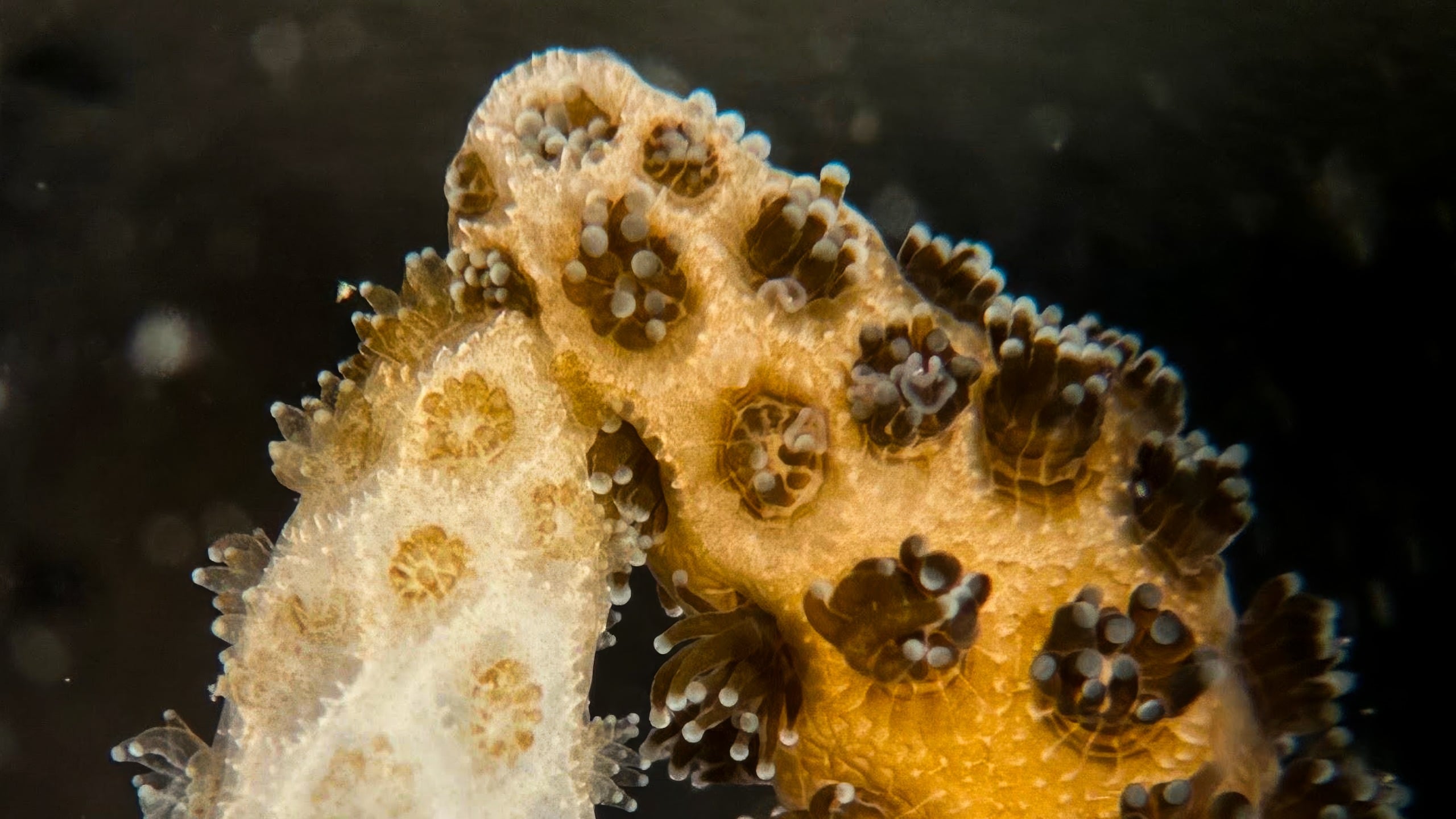
Stanford researchers found that one week touching a healthy Pocillopora damicornis fragment started full recovery in bleached ones. The tests used fragments in lab tanks, so whether the method could rescue wild reef corals is still open.
The Scientist · Science desk
What happened
- Steve Palumbi first saw the effect in a lab tank, where a healthy and a bleached Pocillopora damicornis piece from one colony had fallen onto each other and color was returning where they touched.
- According to Collins, the two corals fuse at the contact point, with tissue growing a nutrient bridge that passes algae and nutrients between the cells.
- Without help, a bleached coral's symbionts can take months to return, and ScienceAlert says the coral has often died by then.
Why it matters
- cost The one-week arm used about 14 percent of the long arm's contact time, and a field version would count that saving in donor handling.
- constraint Any field version has to place donor tissue against the patient's, because a gap of a few millimeters stopped the transfer entirely in the lab experiments.
- contradiction ScienceAlert puts wild recovery at months yet calls seven weeks an order of magnitude faster. A tenfold gap implies about 70 weeks, so the paper's comparison figures are needed.
Stanford marine scientist Danny Collins put the starting question plainly. "While bleached corals may be dying, they are not dead yet," Collins said. "The question we wanted to answer is, once a coral has bleached, what can we do?" [1]
The key comparison is between a seven-week arm and a one-week arm. Corals left touching for the full seven weeks recovered at the same rate as those separated after one week [2]. A donor that had to keep supplying algae would have left the separated fragments behind, and that did not happen. ScienceAlert concludes the algae are replicating inside the recovering coral after the first handover [2]. Collins put the practical upshot in one line: "We can take away the healthy coral, and the bleached coral can now recover itself." [3]
The research was published in Science Advances [4]. ScienceAlert's write-up of the paper does not give the number of fragments in each group, or say whether bleached fragments left alone were followed in the same tanks.
The fragments were genetically identical pieces from one colony [5]. The experiment therefore did not test contact between tissue from different colonies, and ScienceAlert says it is still unclear whether the approach would work on wild bleached reefs [5].
Marine ecologist Fiorenza Micheli, quoted by ScienceAlert, said of the findings: "They open the door to what's possible and may lead to the breakthrough we need to accelerate reef restoration." [6] ScienceAlert adds that the technique might not be practical at scale if bleaching events keep becoming more frequent, persistent and widespread [7].
What to watch
- Whether the Science Advances paper reports fragment counts per group, an untreated bleached comparison, and the wild recovery times behind the order-of-magnitude claim.
- A trial on wild bleached corals, including contact between tissue from different colonies.
- Whether donor corals tolerate the contact and whether the method can be run at the scale of repeated bleaching events.
Clarity's read
What the record supports and how the coverage leans. The claims behind it follow.
Reality
- Evidence55
- Adoption
- Insufficient
- Hype gap+15
- Incentives
- Insufficient
- Confidence50
Claim ledger
Ranked by verification strength, evidence, and original report placement.
- [1]
"While bleached corals may be dying, they are not dead yet," says Stanford marine scientist Danny Collins. "The question we wanted to answer is, once a coral has bleached, what can we do?"
- [2]
The rate of recovery was the same for corals left touching for the full seven weeks, or separated after one week, which means that after initial inoculation, the algae is replicating inside the recovering bleached corals.
- [3]
"We can take away the healthy coral, and the bleached coral can now recover itself."
- [4]
The research has been published in Science Advances.
- [5]
The technique worked in the lab with genetically identical pieces of coral sourced from the same colony, but it is still unclear whether the same approach would work in the ocean on wild, bleached reefs.
- [6]
"They open the door to what's possible and may lead to the breakthrough we need to accelerate reef restoration," says marine ecologist Fiorenza Micheli.
- [7]
The technique might not be practical at scale if bleaching events continue to become more frequent, persistent, and widespread.
- [8]
Steve Palumbi noticed in a lab tank that two pieces of Pocillopora damicornis from the same colony, one bleached and one healthy, had fallen onto each other, and color was returning to the bleached fragment where they touched.
- [9]
Collins explains that to transfer the algae, the two corals are fusing together, with tissues growing to create a nutrient bridge between the cells.
- [10]
The natural recovery of symbionts after a bleaching event can take months, by which time the coral has died.
- [11]
Just a few millimeters between the two pieces of coral was enough to totally prevent transfer, as the researchers demonstrated in lab experiments.
- [12]
One week of contact with healthy coral was enough to jump-start a complete recovery in the bleached pieces, which took up to seven weeks in total.
- [13]
The seven-week recovery is described as an order of magnitude faster than recovery times seen in wild bleached populations.
- [14]
The one-week arm used about 14 percent of the contact time of the seven-week arm.
- [15]
A tenfold gap against a seven-week recovery implies wild recovery of about 70 weeks, roughly 16 months.
Get this ledger inside ChatGPT. Ask about any of our stories and the answer brings its figure, each claim’s verdict and the sources. Free, no account.
Sources
3 independent publishers whose own reporting we read for this story.
- nature.com‘Incredible’: bleached corals thrive within days when touching healthy neighbour
1 article · October 13, 2026
- phys.orgHealthy corals restore bleached neighbors' color after five days of contact
1 article · October 14, 2026
- sciencealert.comHealthy Coral Reversed Bleaching in Its Neighbor With Just 1 Week of Contact
1 article · October 14, 2026
Topics and entities
Follow any of these and your For You feed starts watching them — no settings page required.
Topics
- Reef restorationFollow
- Marine biologyFollow
- Coral bleachingFollow
Entities
- Stanford UniversityFollow
- Science AdvancesFollow
- Pocillopora damicornisFollow
- Danny CollinsFollow
- Steve PalumbiFollow
- Fiorenza MicheliFollow