ProductIndependently confirmed2 publishers3 min readPublished
Oura wants $16bn for a $399 ring and a subscription line nobody has seen
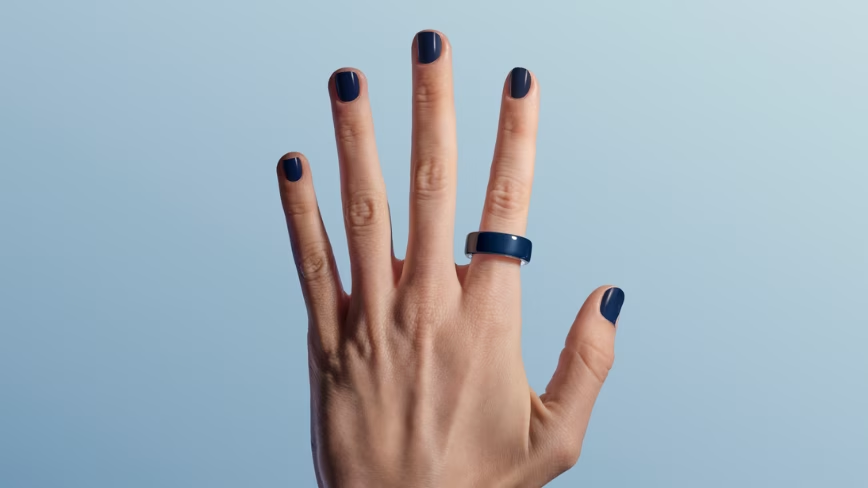
A September listing with a large secondary component would price the smart ring maker about 47% above last year's private mark. Revenue and membership numbers are still undisclosed.
The Product Desk
What happened
- Bloomberg reports Oura is aiming at a September US listing, raising up to $3bn at a valuation above $16bn.
- A major share of the offering is expected to be existing shareholders selling rather than new money into the company.
- The last private mark was $10.9bn, set by an $875mn Series E with Fidelity, ICONIQ, Whale Rock and Atreides.
- Whoop, the closest subscription rival, sits at around $10.1bn and has signalled IPO ambitions of its own.
- Oura has not confirmed the plan and no terms have been filed publicly.
Why it matters
- constraint Until the S-1 shows what share of revenue recurs, nobody outside the company can test whether this is a software price or a hardware price with a story attached.
- decision Backers are choosing partial liquidity in public rather than holding, and open-market buyers take the other side from the holders with the best data on retention.
- exposure If rings are cheap to build, the defensible asset is subscription retention and patents, which leaves the valuation exposed to Samsung's distribution and to cheaper imitators.
- precedent A clean listing gives screenless, single-purpose sensing hardware a public comparable, and makes the subscription attach rate the metric such teams get judged on.
A large secondary changes who is on which side of the trade. Existing shareholders are expected to sell a major chunk of the offering [2], so public buyers would be taking stock from holders who can read the membership file. That file is the one thing outsiders do not have: Oura has never published revenue or membership numbers, and they arrive with the S-1 [7].
At more than $16bn, the price implies a subscription business rather than a hardware one. The Ring 5 sells at $399 with a subscription for the analysis [13], and The Next Web's reading is that recurring software income is the whole difference between this valuation and a hardware multiple [19]. Against the $10.9bn mark from last September [3], the ask is roughly 47 percent higher a year on [16], while the raise itself is under a fifth of the implied cap [17]. Nothing public says whether the recurring line moved at that rate.
The form-factor case holds up on mechanism. Sleep, recovery and readiness are metrics that need the device on the body overnight, which is when a wrist wearable tends to be on its charger [21]; a ring has no screen to check and a battery measured in days rather than hours [20]. The Next Web dates the category's gains against the Apple Watch to the past two years [22]. That is an advantage of purpose over generality, and it is also the kind that copies. Samsung shipped the Galaxy Ring two years ago [8], and Oura is suing the rival ring maker Ultrahuman, litigation that The Next Web reads as a proxy for how cheap the category has become to enter [14].
Two costs sit under the multiple that pure software does not carry. Rings ship in a range of fixed sizes and cannot be adjusted after purchase, which makes sizing kits and returns a per-unit line that grows with volume [15]. And the upgrade most likely to justify a clinical-grade price is the one Oura has avoided on purpose: it sells wellness insight rather than diagnosis, and moving toward diagnosis pulls it into device regulation [11].
The nearest subscription rival is priced at $10.1bn by The Next Web's count [9] and at $10bn as of March by TechCrunch's, after Whoop added hormone tracking and blood-panel testing [10]. Either way, Oura is asking about 1.6 times its closest competitor's private mark [18]. That is the gap the prospectus has to explain, and the only material that can explain it is retention.
Worth noting where the work stays and where the money is being raised. Oura employs more than 900 people, its manufacturing and research remain in Finland, and the exchange it wants is in the United States [12]. It told the market in May that it had filed confidentially [5].
What to watch
- The primary-to-secondary split once terms are attached: how much of the $3bn actually reaches Oura's balance sheet.
- Whether Whoop converts its stated ambitions into a filing, and at what discount or premium to Oura's ask.
- Any move by Oura toward clinical claims after listing, which would pull it into device regulation.
Clarity's read
What the record supports and how the coverage leans. The claims behind it follow.
Reality
- Evidence42
- Adoption30
- Hype gap+34
- Incentives72
- Confidence55
Claim ledger
Ranked by verification strength, evidence, and original report placement.
- [1]
Oura is targeting a September US listing that would raise up to $3bn and value the company at more than $16bn, according to Bloomberg.
ReportedSupportedSource: Bloomberg, as reported by The Next Web and TechCrunch2 sources— create a free account to open themView cited source - [2]
A significant portion of the offering is expected to come from existing shareholders selling rather than from new capital; Bloomberg says investors are expected to sell a major chunk of stock.
- [3]
Oura carried a $10.9bn valuation last September.
- [4]
Oura closed an $875mn Series E last September with Fidelity, ICONIQ, Whale Rock and Atreides participating, joining earlier backers including Dexcom, The Chernin Group, Forerunner Ventures, Coatue and Temasek.
- [5]
Oura announced in May that it had filed confidentially for a US IPO.
- [6]
The listing has not been confirmed by the company, and Bloomberg's reporting describes a plan rather than a filing with terms attached.
- [7]
Neither Oura's revenue nor its membership numbers have been disclosed publicly; that information will arrive when the S-1 is made public.
- [8]
Samsung launched the Galaxy Ring two years ago, bringing a platform owner into the category.
- [9]
Whoop, which sells a screenless band on a subscription, reached a $10.1bn valuation and has signalled its own IPO ambitions.
- [10]
TechCrunch says Whoop's valuation rose to $10 billion in March after it added hormone tracking and blood-panel testing for perimenopause and thyroid health.
- [11]
Oura has been careful to sell wellness insight rather than medical diagnosis, and how far it can move towards clinical claims without triggering device regulation is a material question at this multiple.
- [12]
Oura employs more than 900 people across offices in San Francisco and Finland; it is Finnish, its manufacturing and research remain there, and the capital markets it is going to are not.
- [13]
Oura's Ring 5 launched at $399 as the smallest smart ring on the market, with a subscription charged for the analysis.
- [14]
Oura has sued the rival ring maker Ultrahuman; The Next Web treats patent litigation as a proxy for how commoditised a hardware category is becoming, noting rings are getting easier to build.
- [15]
Rings are made in a range of sizes and cannot be adjusted after purchase, which turns sizing kits and returns into a real cost line as volumes grow.
- [16]
A valuation above $16bn is about 47% higher than the $10.9bn mark carried last September.
- [17]
A raise of up to $3bn is under 19% of a $16bn valuation.
- [18]
A $16bn target is about 1.6 times Whoop's $10.1bn valuation.
- [19]
Subscription revenue is what separates a $16bn valuation from a hardware multiple, since recurring software income is priced very differently to one-off sales of a titanium ring.
ReportedInsufficientSource: The Next Web analysis2 sources— create a free account to open themView cited source - [20]
The ring has no screen to check and no notifications to dismiss, and a battery measured in days rather than hours, which The Next Web calls the reason the form factor has taken share from wrist devices.
- [21]
Sleep, recovery and readiness suit passive continuous tracking and are harder to collect from a device the wearer takes off at night to charge.
- [22]
The smart ring category has been taking ground from the Apple Watch for two years.
ReportedInsufficientSource: The Next Web2 sources— create a free account to open themView cited source
Sources
2 independent publishers whose own reporting we read for this story.
- techcrunch.comOura is reportedly eyeing a September IPO that could value it at more than $16B
1 article · August 24, 2026
- thenextweb.comOura is seeking up to $3bn in an IPO that would value it above $16bn
1 article · August 25, 2026
Topics and entities
Follow any of these and your For You feed starts watching them — no settings page required.