Product1 publisher3 min readPublished
Fitbit Air and Garmin Cirqa undercut Whoop by dropping the $199 subscription
Google's Fitbit Air arrived in May and Garmin's Cirqa in July, both sold without the yearly fee Whoop charges. IDC says sensor quality has barely moved, so the software is what these companies are actually selling.
The Product Desk · Product desk
What happened
- Google shipped the Fitbit Air in May, its own version of the screenless sensor band that Whoop built its subscription business on, according to Gizmodo.
- Garmin, known for its GPS watches, followed in July with the Cirqa, taking the same screenless form factor into its own lineup.
- Gizmodo reports that the new entrants undercut Whoop by not requiring the subscription that starts at $199 per year.
- Oura, the other origin point for screenless tracking, now has several competitors of its own, among them Samsung's Galaxy Ring.
Compiled by The Product DeskSomething wrong?How this is made
Why it matters
- decision A band with no fee and a band at $199 a year are two different purchases: one bills you for continuing software work, the other asks you to trust that firmware keeps arriving free.
- cost At $597 in fees over three years, a fee-free rival can read a wearer less well and still be the cheaper thing to own for that period.
- constraint With sensor categories stalled, the spec sheet no longer separates these devices, and vendors are left competing on algorithms and battery life.
- contradiction The screen-fatigue pitch sits badly against Gizmodo's own observation that the Whoop 5.0 sends its wearer to a phone screen to read anything it collected.
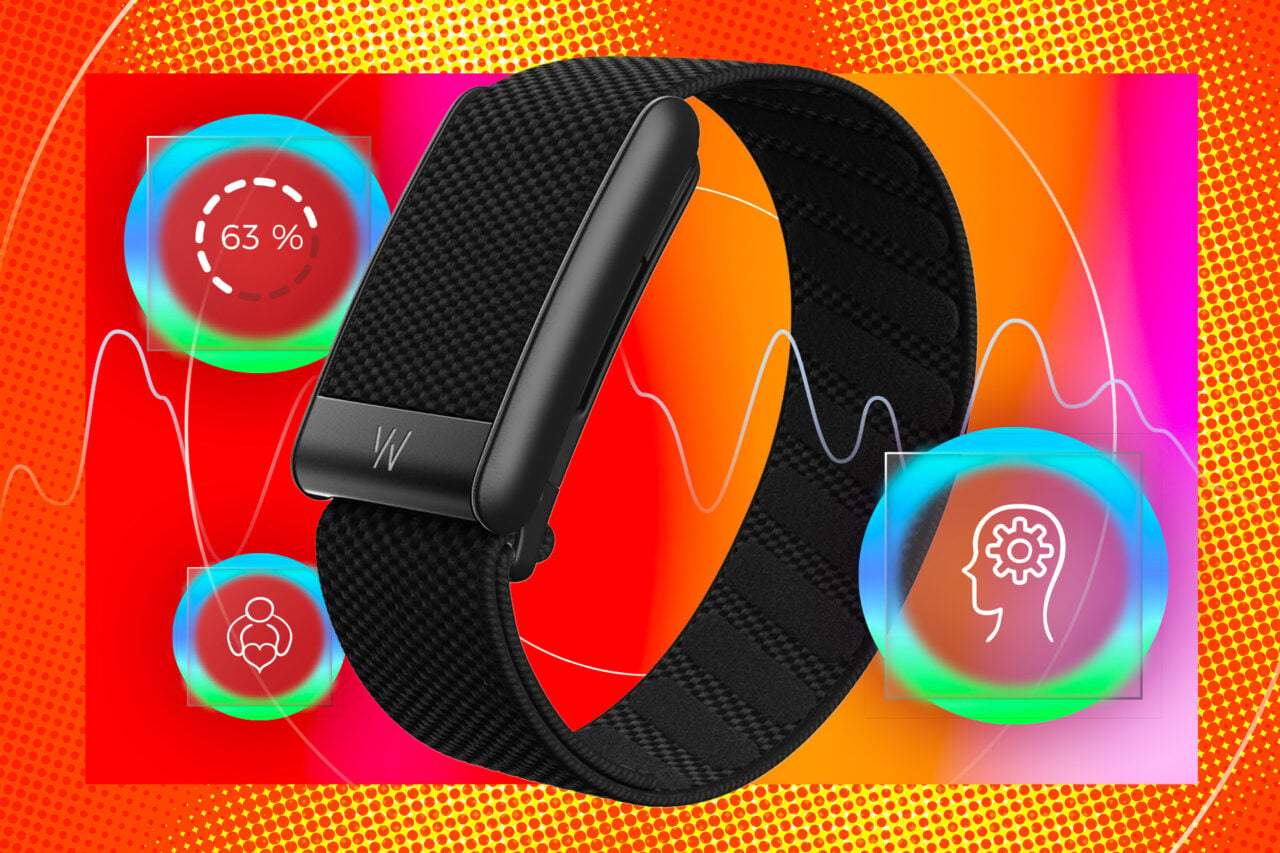
To see what the band recorded overnight, the owner of a Whoop 5.0 picks up a phone. Gizmodo puts it plainly: the absence of a screen means you spend more time on your smartphone to actually see the data the device collects [11].
The dislike of screens is real, and the clearest evidence for it concerns phones. "We have users who tell us, 'Hey, I hate smartphones. I don't want to be seen using a smartphone,'" Light co-founder Kaiwei Tang told The Verge [14]. Light followed the smartphone-shaped Light Phone 3 with the Flip partly because users did not want to be seen carrying anything that resembled a smartphone [15]. For wearables, Gizmodo offers a less flattering explanation of why people are buying bands and rings now: the screenless devices do about what a smartwatch does [12], and multiple analysts told the site that leaving the screen off extends battery life [13].
If the hardware is at parity, the difference between two bands is the code reading the same signals. "There hasn't been a significant change in sensor quality over the last few years, largely because miniaturizing new sensor types is costly and few new sensor categories have reached mass production," Jitesh Ubrani, IDC's director of worldwide device trackers, told Gizmodo [5]. Accelerometers and PPG sensors are already effectively miniaturized, and the algorithms running them are the biggest year-over-year improvement [7]. Apple's sleep apnea notifications, introduced alongside the Apple Watch Series 10, came out of that kind of work [8].
Whoop's subscription starts at $199 a year [3]. Three years at the entry tier is $597 in fees before any hardware [16]. The company was valued at more than $10 billion as of March 2026 [4]. Gizmodo did not publish hardware prices for the Fitbit Air or the Cirqa [17], so the full three-year comparison cannot be built from the reporting yet.
One test separates the two payment models for a buyer. Write down what the device told you in week one and what it tells you in week twelve. If it is the same sentence with different numbers, you bought a sensor, and the yearly fee is paying for work you never receive. If week twelve says something week one could not, the fee is buying interpretation, and interpretation is the part that improves.
In my view the fee-free device is the better buy for a fixed-window job, such as establishing a baseline or a few months of habit building, and the subscription is worth it only when the value depends on the software learning one particular person. The tradeoff on the free side is not small. With no recurring revenue, algorithm work has to be funded by selling the next unit, so no subscription is a bet on how much the vendor puts into firmware for people who already paid.
If you are handing these out to a team, the numbers to look at in week twelve are how many people still have the thing on and how many changed something because of what it said. Daily app opens will look respectable either way.
What to watch
- Whether Whoop changes the $199 entry tier or repackages hardware and fees once the fee-free rivals have a full year of sales behind them.
- Whether Apple ships the screenless wearable Gizmodo says it is reportedly exploring, and on what payment model.
- Whether Fitbit Air and Cirqa owners get meaningful algorithm upgrades in firmware, or have to buy the next device to get them.