Nonreciprocal links let a 37-unit robotic honeycomb vibrate in a single time-crystal rhythm
University of Birmingham engineers and partners built a robotic time crystal that holds one rhythm through random disturbances. The authors see a route to robots with no central controller, but the tests described are two small structures.
The Scientist · Science desk
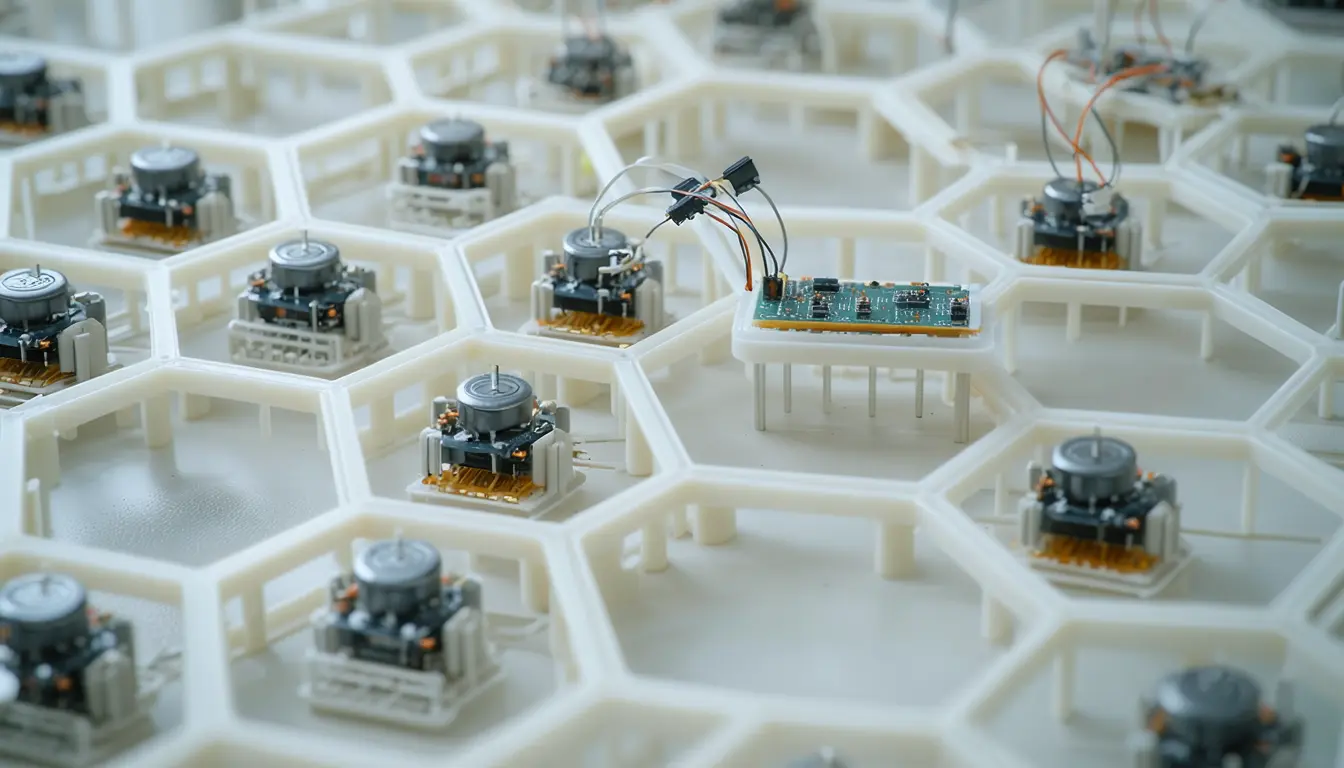
Key figures: units in the 2D honeycomb self-oscillated at around 30 Hz before the entire material oscillated collectively; the elastic ring had 24 motorized units; the experimental metamaterials incorporated more than 100 sensors and actuators, alongside custom-made Lorentz actuators.
| Figure | Value | Note | Claim |
|---|---|---|---|
| Honeycomb units' self-oscillation, around | 30 Hz | 6 | |
| Motorized units in elastic ring | 24 units | 7 | |
| Sensors and actuators, more than | 100 in the builds | alongside custom-made Lorentz actuators | 8 |
What happened
- The key ingredient was making interactions nonreciprocal, so that one component's response to another does not have to be mirrored in reverse.
- With reciprocity broken, vibrations that began at short wavelengths grew in wavelength, period and amplitude into a globally synchronized state the team calls wave coarsening.
- In a 2D honeycomb of 37 active units pushed past a stability threshold, units self-oscillated at around 30 Hz until longer waves dominated and the whole material oscillated together.
- An elastic ring of 24 motorized units went from higher-frequency deformation patterns to a single slow collective cycle.
Why it matters
- capability The authors propose using wave coarsening to control shape changes and directed motion, with uses they name in robotics, active matter and optomechanics.
- cost The reported builds used more than 100 sensors and actuators plus custom-made Lorentz actuators, so a bigger structure means more bespoke hardware before any robot task is attempted.
- decision Builders would have to choose between a separate structure for each task and one material whose modes serve several tasks; Veenstra describes the second only in conditional terms.
The paper, published in Nature on Oct. 14, describes a time crystal whose particles are robots, where the usual picture has atoms [1] [2]. Its building blocks pair elastic parts with sensors, electronics and actuators, so each component can act on the ones next to it [3].
Two layouts, a flat honeycomb and a closed ring, each ended in collective oscillation [6] [7]. Two is a small sample, but it suggests the coarsening is not tied to one geometry.
The result engineers will care about is robustness. According to phys.org's account, the experiments and the model both show that random disturbances do not destroy the collective order as the material grows in size, and the repeating pattern is very stable [9]. The larger of the two builds described has 37 units [11]. The account does not say how the pattern behaves under sustained load or contact. Random disturbances are the perturbation described, and a robot body in use meets others.
Jonas Veenstra, who started the work as a Ph.D. student at Amsterdam and is now a postdoctoral fellow at ENS Lyon, states the goal this way [10]. He said, "Our aim is a biology-inspired form of robotics where coordinated behavior emerges from carefully designed interactions between building blocks, rather than instructions from a central controller." [13]
In our view the result is a physics demonstration with a robotics motivation. A body that settles into one rhythm by itself and keeps it under noise has a useful property, since no controller needs to impose the rhythm. The multifunctional robots in the authors' account, though, need several stable patterns in a single material, and Veenstra says the team has "also started to think about making one material support several distinct, stable patterns of motion" [14]. We would treat the lifelike-robot framing as a hypothesis until a switching experiment exists. Veenstra himself puts the idea as a question: could the team switch between patterns and use each for a different robotic function [15]?
What to watch
- A switching experiment showing one material holding several stable patterns, the step Veenstra poses as a question.
- Builds or models well beyond 37 units that test whether the single rhythm survives at larger sizes.
- Tests with sustained loads or contact, not only random disturbances, on a robot body made from the material.
Clarity's read
What the record supports and how the coverage leans. The claims behind it follow.
Reality
- Evidence70
- Adoption
- Insufficient
- Hype gap+25
- Incentives
- Insufficient
- Confidence68
Claim ledger
Ranked by verification strength, evidence, and original report placement.
- [1]
Publishing in Nature on Oct. 14, engineers from the University of Birmingham, working with the universities of Amsterdam, Lyon, Delft, Leiden and Cambridge, report a mechatronic metamaterial that behaves as a time crystal.
- [2]
Time crystals are an unusual form of matter in which particles endlessly move in regular, repeating cycles; here the particles were not atoms but robots.
- [3]
The experimental material combines elastic structures, sensors, electronics and actuators so that neighboring components can influence one another.
- [4]
The key ingredient for the time-crystalline state was making interactions between components nonreciprocal, meaning one component's response to another does not have to be mirrored in reverse.
- [5]
When reciprocity was broken, individual vibrations first appeared at short wavelengths, then grew in wavelength, period and amplitude, producing a globally synchronized state the researchers demonstrate is a time crystal; the team calls the process wave coarsening.
- [6]
The researchers first built a 2D honeycomb material from 37 active units; pushed beyond a stability threshold, individual units self-oscillated at around 30 Hz, and longer waves gradually dominated until the entire material oscillated collectively.
- [7]
They then built an elastic ring containing 24 motorized units, where higher-frequency deformation patterns appeared first and progressively combined into larger patterns until the ring settled into a slow collective cycle.
- [8]
The experimental metamaterials incorporated more than 100 sensors and actuators alongside 3D-printed components and custom-made Lorentz actuators that convert electrical energy into mechanical motion.
- [9]
The experiments as well as the model show that random disturbances do not destroy the collective order as the size of the material is increased; the repeating pattern is very stable.
- [10]
Co-lead author Jonas Veenstra was a Ph.D. student at Amsterdam when the research started and is now a postdoctoral fellow at ENS Lyon.
- [11]
The larger of the two physical builds described has 37 units (honeycomb 37 versus ring 24).
- [12]
The authors say wave coarsening could be exploited to control shape changes and directed motion, proving useful in robotics, active matter and optomechanics.
- [13]
Veenstra said: "Our aim is a biology-inspired form of robotics where coordinated behavior emerges from carefully designed interactions between building blocks, rather than instructions from a central controller."
- [14]
Veenstra said the team has "also started to think about making one material support several distinct, stable patterns of motion."
- [15]
Veenstra asked whether the team could switch between these patterns and use each one for a different robotic function, such as a different shape change or direction of movement.
- [16]
Veenstra said that instead of designing a separate structure for every task, the team could use the different modes of a single material to achieve different behaviors.
Get this ledger inside ChatGPT. Ask about any of our stories and the answer brings its figure, each claim’s verdict and the sources. Free, no account.
Sources
2 independent publishers whose own reporting we read for this story.
- nature.comWave coarsening drives time crystallization in mechatronic metamaterials
1 article · October 13, 2026
- phys.orgRobotic 'time crystal' organizes itself into a single rhythm despite random disturbances
1 article · October 14, 2026
Topics and entities
Follow any of these and your For You feed starts watching them — no settings page required.
Topics
- Soft RoboticsFollow
- Mechanical metamaterialsFollow
- Time crystalsFollow