National datasets lift estimated land conservation coverage from 18.5% to 26.81%
Extrapolating from 25 countries and territories, a Nature study estimates conservation areas cover 26.81% of land against 18.5% reported. The authors say the extra land does little to fill gaps in ecological representativeness.
The Scientist · Science desk
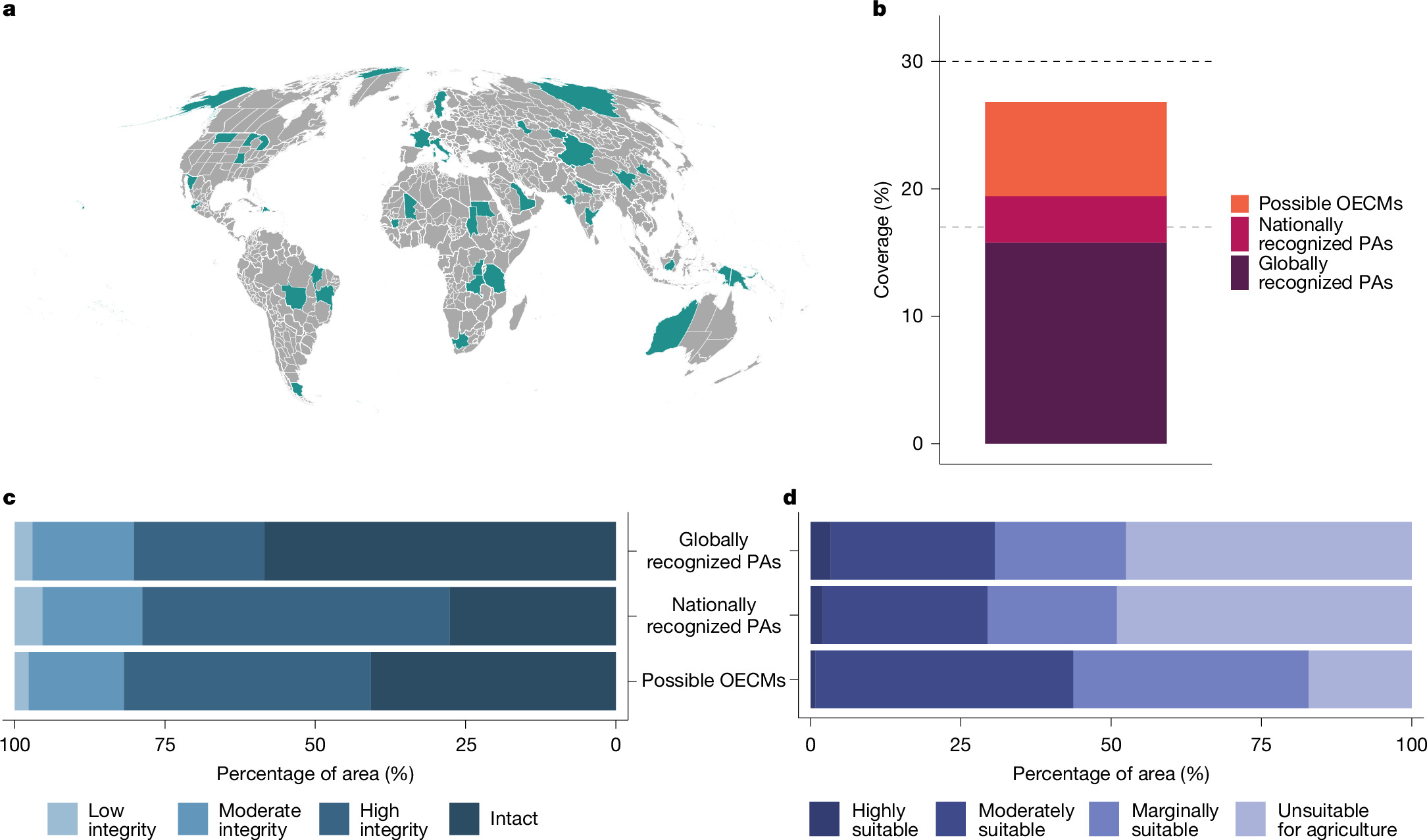
Key figures: on the study's estimate, 3.19 percentage points of the terrestrial realm remain to reach 30%. On official statistics, an extra 11.5%, or 15.5 million km2, is needed. Signatories agreed a goal of at least 30% coverage by 2030.
| Figure | Value | Note | Claim |
|---|---|---|---|
| Land still needed for 30%, on the study's estimate | 3.19 points | 15 | |
| Extra land needed, on official statistics | 11.5% of land | 15.5 million km2 | 4 |
| Agreed coverage goal, 2030 | 30% at least | 6 |
What happened
- The reported 18.5% comes from the World Database on Protected and Conserved Areas, which mostly lists state-governed protected areas because most nations only recently began to map and report other types.
- On the official numbers, meeting the 30% goal needs another 11.5% of the terrestrial realm, or 15.5 million km2.
- The 30 by 2030 goal was agreed in 2022 by 195 signatories to the Convention on Biological Diversity, and Target 3 also asks that sites be effectively managed, equitably governed, representative and connected.
- Other effective area-based conservation measures, or OECMs, need not have conservation as a primary objective, and many are expected to be governed by private actors, Indigenous Peoples or local communities.
Why it matters
- decision Funders choosing between adding new area and improving sites already counted have a published argument for the second, since the authors say the target's other components need more focus and resources.
- exposure The worry that a near-doubling of coverage would fall on vulnerable people and stretch conservation budgets was set against the 18.5% base. On the study's estimate, the expansion still to be negotiated is far smaller.
- precedent As more nations map and report non-state conservation land, we'd expect the official figure to climb toward the study's estimate, so a 2030 success on coverage may partly reflect better counting.
Subtract the two figures and the gap is 8.31 percentage points [14]. The official count leaves 11.5 points to find [4]. The study's estimate leaves 3.19 [15], about 28% of the official remainder [16]. At the paper's own conversion of 15.5 million km2 for 11.5 points, 3.19 points is roughly 4.3 million km2 [17].
The design decides how to read 26.81%. The 18.5% is a count of sites already recorded in the global database [5]. The new figure is an estimate. The authors drew a globally representative sample, folded each country's national datasets into it, and extrapolated to the terrestrial realm [2]. That design can find land the database misses. A two-decimal figure built from a sample also hides sampling uncertainty, and the authors' own wording is hedged: they say conservation areas likely already cover this much [2].
The thing this doesn't tell you is how much of the extra land meets the target's other tests. Target 3 asks that sites be effectively managed and equitably governed [6]. The abstract tests the added land for ecological representativeness [3]. Earlier studies the paper cites say much of the unreported land has the potential to be recognised as protected areas or OECMs [10].
Area is the component with a headline indicator [13]. The paper cites concern that over-focusing on percentage coverage risks spreading conservation funds more thinly and undermining management effectiveness [12].
What to watch
- Whether the Protected Planet database starts incorporating national datasets, which would move the official 18.5% itself.
- Whether other teams reproduce the 26.81% estimate with different samples of countries.
- Whether anyone measures how much of the extra land governments would formally recognise as protected areas or OECMs.
Clarity's read
What the record supports and how the coverage leans. The claims behind it follow.
Reality
- Evidence55
- Adoption
- Insufficient
- Hype gap−10
- Incentives
- Insufficient
- Confidence50
Claim ledger
Ranked by verification strength, evidence, and original report placement.
- [1]
Conservation areas are reported as covering 18.5% of the terrestrial realm.
- [2]
Extrapolating from a globally representative sample across 25 countries and territories that incorporated national datasets, the authors show conservation areas likely already cover 26.81% of the terrestrial realm.
- [3]
The authors show that the extra land does not substantially address gaps in ecological representativeness, so solely meeting the area component of Target 3 will do little to solve continuing global biodiversity loss.
- [4]
Present official coverage statistics indicate that meeting Target 3 will require conserving an extra 11.5% (15.5 million km2) of the terrestrial realm.
- [5]
Official coverage statistics are derived from the World Database on Protected and Conserved Areas, available through the Protected Planet website, and chiefly comprise state-governed protected areas because most nations only recently began to recognize, map and report on other conservation area types.
- [6]
In 2022 the 195 government signatories to the Convention on Biological Diversity agreed to increase protected area and OECM global coverage to at least 30% by 2030; Target 3 of the Kunming-Montreal Global Biodiversity Framework also states these sites should be effectively managed, equitably governed, ecologically representative and well-connected.
- [7]
Other effective area-based conservation measures (OECMs) are a conservation area type that does not need to have conservation as its primary objective, and it is expected that many will be governed by private actors, Indigenous Peoples or local communities.
- [8]
There are concerns that the potential near-doubling of conservation area coverage will negatively affect vulnerable people and over-stretch conservation resources.
- [9]
The authors say more focus and resources are needed to achieve the other components of the target, using a more strategic and inclusive approach to fill present gaps and produce equitable and effective conservation area networks.
- [10]
Studies based on nationally available data indicate that substantially more land is managed for conservation than appears in official global statistics, much of which has the potential to be recognized as protected areas or OECMs.
- [11]
Community-, Indigenous- or privately-governed lands can have better conservation outcomes than some state-governed protected areas and could improve ecological representativeness and connectivity of conservation area networks.
- [12]
There are concerns that over-focusing on percentage coverage risks spreading conservation funds more thinly, perpetuating present under-resourcing of protected areas and undermining implementation and management effectiveness.
- [13]
The World Database on Protected and Conserved Areas tracks the implementation of Target 3, providing the headline indicator for the target.
- [14]
The estimate is 8.31 percentage points above the reported coverage.
- [15]
Under the study's estimate, 3.19 percentage points of the terrestrial realm remain to reach 30%.
- [16]
The remaining 3.19 points are about 28% of the 11.5 points the official statistics leave.
- [17]
Using the paper's conversion of 15.5 million km2 for 11.5 points, 3.19 points is roughly 4.3 million km2.
Get this ledger inside ChatGPT. Ask about any of our stories and the answer brings its figure, each claim’s verdict and the sources. Free, no account.
Sources
1 independent publisher whose own reporting we read for this story.
- nature.comLay of the land: terrestrial conservation efforts cover a wider area than thought
2 articles · October 13, 2026
Topics and entities
Follow any of these and your For You feed starts watching them — no settings page required.
Topics
- Biodiversity and species conservationFollow
- Environmental policyFollow
- Protected areasFollow