Science2 publishers3 min readPublished
Every breached planetary boundary hit its worst recorded value in PIK's 2026 check
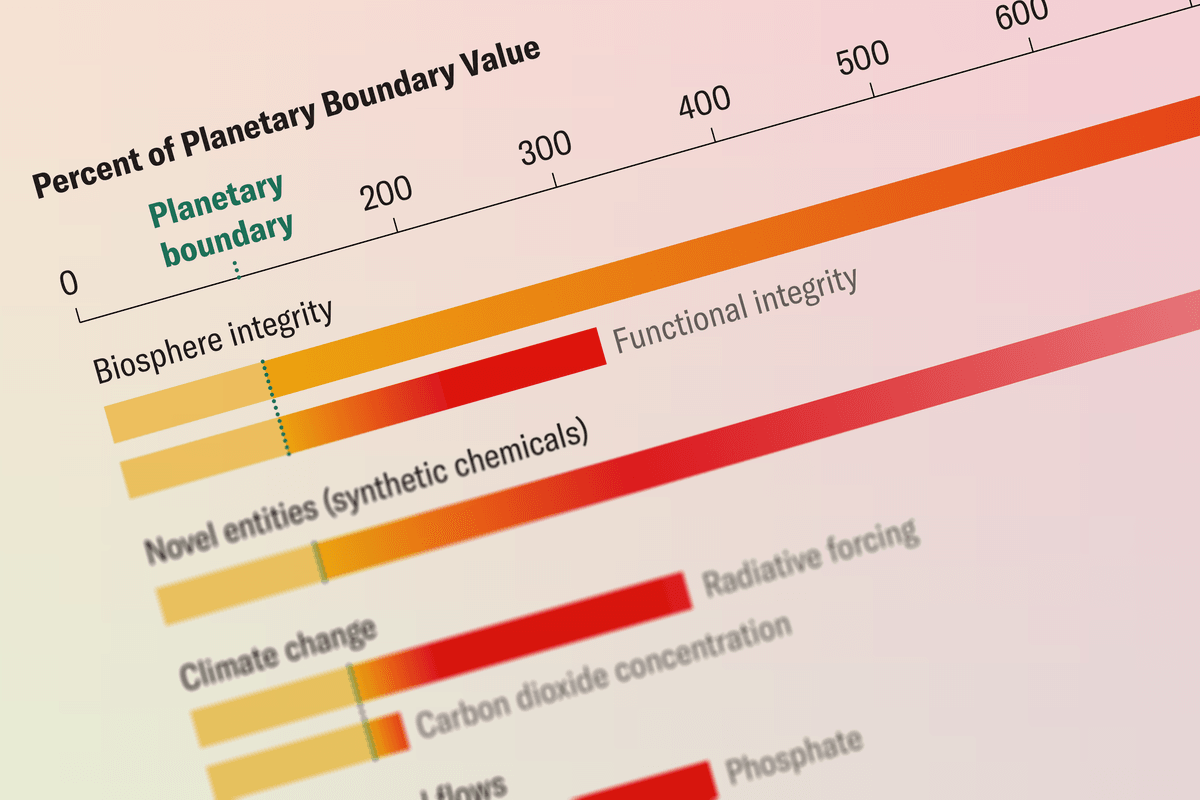
The annual Planetary Health Check counts seven of nine boundaries transgressed, ocean acidification among them since 2025, and puts carbon dioxide at 426 parts per million against 280 before industrialisation. More than 60 scientists signed it.
The Scientist · Science desk
What happened
- Carbon dioxide reached a record 426 parts per million, which the report attributes to fossil fuel burning not falling at anything close to the needed pace.
- Only stratospheric ozone depletion and atmospheric aerosol loading have improved over the past decade, and the authors warn that the global aerosol picture may hide unsafe regional levels.
- Bleaching-level heat stress hit about 84.4% of the world's coral reef area between January 2023 and September 2025, the largest bleaching event observed so far.
Compiled by The ScientistSomething wrong?How this is made
Why it matters
- decision An assessment still citing six breached boundaries is describing the 2023 edition. The count has moved once in three years, so the baseline needs re-pulling each time the check publishes.
- constraint The framework scores distance from preindustrial conditions inside a zone of increasing risk, so it cannot supply the event probabilities an insurer or a capital works budget runs on.
- exposure By the authors' own caution, a global aerosol figure inside the boundary can sit above it locally. Anyone reading the two intact boundaries as locally safe can be misinformed about their own airshed.
- precedent If heat, drought and fire keep cutting uptake by vegetation and soils, the climate boundary can worsen while emissions hold flat. Plans that assume cuts translate one-for-one into boundary improvement would need reworking.
An index like this measures distance from a reference state. Each of the nine measures is set against a preindustrial baseline, roughly the mid-19th century, and past each boundary lies what the authors call a "zone of increasing risk" [11]. Katherine Richardson, the Earth systems scientist at the University of Copenhagen, led the 2023 edition. She told Scientific American then that "it's like blood pressure": a high value is "not a guarantee that you're going to have a heart attack," but it raises the risk of one [10].
Carbon dioxide carries the fully specified numbers. The check records a record 426 parts per million [12]. Preindustrial concentration was 280 ppm, and 350 ppm is the level many scientists have treated as safe [13][14]. The gap to preindustrial air is 146 ppm, and the overshoot past 350 ppm is 76 ppm [15][16]. The 350 ppm line was crossed in 1987, 39 years before this edition [14][17].
The count itself has moved since the series began. The first check, in 2023, found six boundaries breached [7]. Ocean acidification went past its boundary in 2025, making seven [6], and all seven now sit at their highest recorded levels of transgression [4]. That is one additional boundary crossed across three annual editions [30]. Boris Sakschewski, the PIK scientist who led the report, said "Pressure is rising across every Planetary Boundary already outside the safe operating space" [8].
The two boundaries still inside the safe operating space are stratospheric ozone depletion and atmospheric aerosol loading, and both have improved over the past decade [18]. The aerosol result comes with a caution from the authors: global progress may mask unsafe aerosol levels persisting in some regions [18]. Scientific American's account is narrower, saying only ozone shows clear progress away from its boundary [19].
Vegetation and soils take up a substantial share of human carbon dioxide emissions. The report notes that repeated heat, drought, fire and ecosystem degradation can reduce that uptake and, in some regions, turn ecosystems from sinks into carbon sources [24]. Land-sink weakening moves the climate number without any change in emissions.
The 12 months covered include Pakistan's 2025 monsoon floods, which affected more than 6.9 million people [20], and a new record in global ocean heat content in 2025 [21]. Bleaching-level heat stress reached about 84.4% of the world's coral reef area between January 2023 and September 2025, the largest such event yet observed [22]. Western Europe had its hottest June-July on record in 2026, with drought in France, Spain, Germany and the United Kingdom [23].
Neither account puts a cost on a boundary. The one dollar figure on the record is a 2020 NOAA finding, cited by Scientific American, that ocean acidification would cost the US economy billions [26]. Johan Rockström, PIK's director and a co-author, said: "We do not have the luxury of time, but we do have the knowledge, capacity and solutions to change course" [9].
What to watch
- Whether the 2027 update shows any of the seven transgressed boundaries falling back from its record value.
- Whether PIK quantifies land and soil sink weakening inside the climate boundary number.
- Whether the aerosol boundary keeps its safe classification once the regional exceedances the authors flag are scored.