ProductNot yet confirmed elsewhere1 publisher3 min readPublished
China sends a domestically built 4,500-meter work robot out for South China Sea trials
China has sent a domestically built work-class robot rated to 4,500 meters to the South China Sea for full-system field trials. An operator weighing it for pipeline or mineral work needs the depth it actually reaches and the hours it logs there, and state media has reported neither so far.
The Product Desk
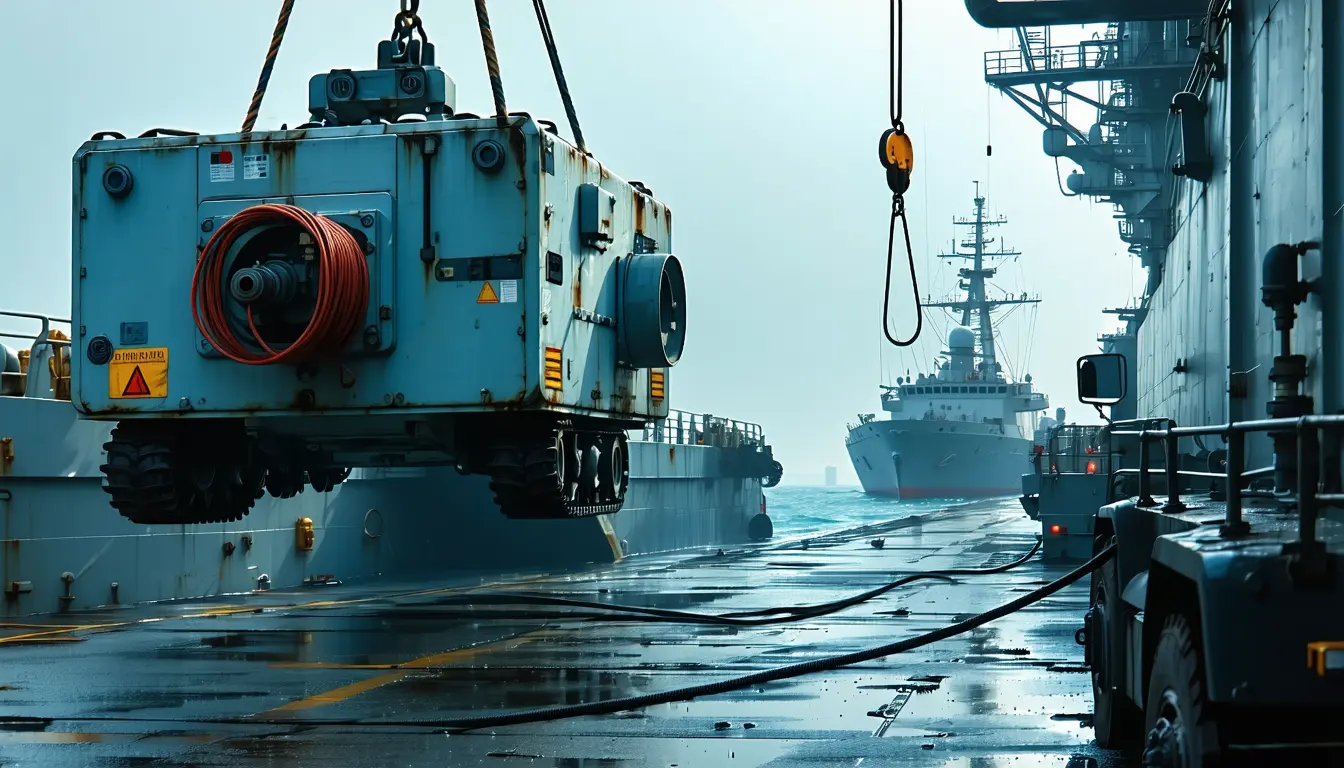
What happened
- The robot left Weihai Port in Shandong on September 28 for a joint expedition with the Harbin Institute of Technology's Weihai branch, according to Chinese state media.
- Its seven-axis multifunction hydraulic manipulator, the arm that does the handling work, was also developed domestically.
- State media lists its intended jobs as deep-sea oil and gas work, pipeline inspection, mineral exploration, scientific sampling and emergency salvage.
- China's Haiqin ROV, rated to 6,000 meters, reached 4,140 meters in the South China Sea in 2025 while collecting biological and sediment samples.
Why it matters
- decision Anyone weighing this robot for commercial subsea work has only a design rating and a trial plan to judge it by, so buying before results are published means taking on the trial's risk.
- constraint Because the first outing is a scientific expedition with a university, its results will speak to sampling before they speak to pipeline inspection or salvage.
- precedent On the Haiqin record, a Chinese depth rating and a demonstrated working depth can sit well apart, so the 4,500-meter figure stays a design limit until a trial dive confirms it.
The person who signs off a subsea pipeline inspection from a support vessel has a short list of questions for any new robot. They want to know whether it has done this job at this depth, and how many hours it ran before it came up for repairs.
The state-media account covers the spec sheet in detail. Engineers worked through more than 30 technical problems to build the robot, including pressure-resistant sealing, high-power propulsion, long-distance underwater communications and multimodal autonomous navigation [5]. At 4,500 meters, according to the report, pressure, communications and navigation become major engineering challenges [7].
What is being pitched is the five-job commercial list. What is being done this autumn is a scientific cruise with a university [2], meant to test the complete system in real-world conditions and move it from laboratory development toward industrial applications [3]. In my view a sampling cruise can show that the vehicle holds up at depth and that the arm works. It will not show how the robot handles a pipeline survey on a contractor's schedule.
Rated depth and working depth are separate figures. China's Haiqin dive in 2025 reached 69 percent of that vehicle's 6,000-meter rating [14]. It was a sampling mission, so the depth reflects where the samples were, and the vehicle's limit was not under test [8].
The figure an operator can plan a season around is hours at depth, and the same report has one for other Chinese equipment. On the Mengxiang drilling vessel's recent mission, which reached the 5,000-meter level while taking basalt samples [9], two ROVs logged more than 358 hours in total at around 4,000 meters [10]. Split evenly, that is about 179 hours per vehicle [15].
The report places the new robot inside a broader push for domestically produced equipment that can work deeper and handle more complex tasks [13]. It does not name the imported systems the robot would replace, give a price, or identify a commercial customer. The resource groundwork is easier to see. In April the China Geological Survey reported a geochemical dataset from more than 10,000 survey stations in China's eastern waters, mapping elements including iron, manganese, copper and rare earths [11]. Chinese researchers have named deep-sea rare earths and polymetallic nodules as exploration targets [12]. The robot's mineral role in the account is exploration [6].
I would treat 4,500 meters as the design ceiling and plan around logged hours. The cost of that is time. An operator that waits for trial hours may run another season on whatever gear it uses now, and one that moves early carries the trial risk on its own schedule.
Two axes sort any new work-class robot, this one included: depth demonstrated on the task you need, and hours logged at that depth.
- Deep, many hours: a candidate for a paid pilot. - Deep, few hours: a record dive, useful for a demo and thin for a contract. - Shallow, many hours: proven for shallower work, with the rating still a claim. - Shallow, few hours: a spec sheet.
Until trial results are published, this robot sits in the last box. For work around 4,000 meters, the Mengxiang ROVs are the nearest thing in the report to the first [10].
What to watch
- The depth the robot actually reaches during the South China Sea trial, and how many hours it logs at that depth.
- A named oil-and-gas or mining customer, or a published price, for the 4,500-meter work-class robot.
- Whether later trials test pipeline inspection or salvage work, the commercial jobs in the pitch.
Clarity's read
What the record supports and how the coverage leans. The claims behind it follow.
Reality
- Evidence35
- Adoption10
- Hype gap+25
- Incentives55
- Confidence40
Claim ledger
Ranked by verification strength, evidence, and original report placement.
- [1]
China has reportedly launched a domestically developed deep-sea robot capable of operating at depths of up to 4,500 meters for a scientific expedition in the South China Sea.
- [2]
The 4,500-meter-class work-class robot departed Weihai Port in Shandong on September 28 and is heading to the South China Sea for a joint expedition with the Harbin Institute of Technology's Weihai branch, according to Chinese state media.
- [3]
The mission is intended to test the complete system under real-world conditions and help move the technology from laboratory development toward industrial applications.
- [4]
The robot is equipped with a domestically developed seven-axis multifunction hydraulic manipulator.
- [5]
The robot incorporates technologies developed to address more than 30 technical challenges, including pressure-resistant sealing, high-power propulsion, long-distance underwater communications and multimodal autonomous navigation.
- [6]
The robot is designed for tasks including deep-sea oil and gas operations, underwater pipeline inspections, mineral-resource exploration, scientific sampling and emergency salvage.
- [7]
The vehicle's 4,500-meter operating class puts it in an environment where pressure, communications and navigation become major engineering challenges.
ReportedSupportedSource: Interesting Engineering, citing a Chinese state broadcasterView cited source - [8]
In 2025, China's Haiqin 6,000-meter-class ROV reached 4,140 meters in the South China Sea while collecting biological and sediment samples.
- [9]
China's Mengxiang drilling vessel recently reached the 5,000-meter level while obtaining basalt samples from the South China Sea basin.
- [10]
Two ROVs operated for more than 358 hours in total at depths of around 4,000 meters during the Mengxiang mission.
- [11]
In April, the China Geological Survey reported a geochemical dataset covering more than 10,000 survey stations in China's eastern waters, mapping locations and concentrations of elements including iron, manganese, copper and rare earth elements.
ReportedSupportedSource: Interesting Engineering, citing the China Geological SurveyView cited source - [12]
Chinese geological researchers have identified deep-sea rare earths, polymetallic nodules and other seabed resources as targets for exploration.
- [13]
China's latest system is part of a broader push to develop domestically produced equipment that can operate farther below the surface and perform increasingly complex tasks.
- [14]
Haiqin's 2025 South China Sea dive reached about 69 percent of its 6,000-meter rated depth.
- [15]
The two ROVs on the Mengxiang mission averaged about 179 hours each at around 4,000 meters, if the hours are split evenly.
Sources
1 independent publisher whose own reporting we read for this story.
- interestingengineering.comChina deploys 14,764-foot robot for deep-sea exploration in South China Sea
1 article · September 30, 2026
Topics and entities
Follow any of these and your For You feed starts watching them — no settings page required.