InvestNot yet confirmed elsewhere1 publisher3 min readPublished
Korea's Alaska LNG orders hinge on Glenfarne binding 16 million tons of buyers
Glenfarne needs long-term buyers for 16 million tons of Alaska LNG a year before it can finance a project Korean pipe and ship makers hope to supply. Potential deals cover 13 million tons, mostly nonbinding, and Seoul says any money from its $350 billion US pledge depends on commercial viability.
The Investor · Invest desk
What happened
- Alaska LNG would pipe North Slope gas to Nikiski for liquefaction and export to Asia, at an estimated cost of $44.5 billion to $54.5 billion.
- Korean shipbuilders would see new carrier demand only if the project's annual exports reach 20 million tons.
- A Korea Energy Economics Institute source said many expect environmental assessments to push completion beyond 2040.
Compiled by The InvestorSomething wrong?How this is made
Why it matters
- constraint Pipe makers such as SeAH Steel cannot book line-pipe orders before financing closes, and closing needs 3 million more tons of contracts than even the full set of nonbinding talks would supply.
- decision By making commercial viability the test, Seoul lets Glenfarne's offtake book set the timing for Korea's own industrial orders and holds its pledge money back until buyers sign.
- exposure Shipyards face the longest wait, because their trigger is 20 million tons of exports, 25% above the financing bar, on a project some expect to finish after 2040.
"Companies need long-term contracts as collateral to raise financing through loans and other means," an LNG industry source told Korea JoongAng Daily [8]. Glenfarne Group, the lead developer, sets that bar at 16 million tons a year [9]. Potential agreements reach 13 million tons, about 81% of it, though most are reportedly nonbinding [10][22]. If every one of them signed tomorrow, the project would still be 3 million tons short [21]. Posco International's heads of agreement for 1 million tons a year is about 6% of the threshold, and Posco is waiting for Glenfarne to complete financing, the source said [11][23].
Seoul has put itself in the same queue. Kim Jung-kwan, the trade minister, told a National Assembly audit on Tuesday that the government is still reviewing the project [6]. "Any review would have to be premised on its commercial viability," he said [7]. The pledge Seoul made during last year's tariff talks is $350 billion [4]. The whole project, at $44.5 billion to $54.5 billion, would equal between 13% and 16% of it [3][24]. Donald Trump has pressed Korea to invest [5]. Kim's condition puts pledge money behind the buyers, so the pledge is not what gets Glenfarne from 13 million tons to 16 [7][21].
Kim also gave the case for moving anyway. "It is true that the project did not move forward in the past because its commercial viability was clearly low," he said. "But the war in the Middle East has clearly created new strategic value." [16] Alaska cargoes could reach Northeast Asia without crossing the Strait of Hormuz [17].
This could go three ways. Seoul could decide the Hormuz route is worth paying for and commit pledge money before buyers bind, putting the government ahead of the lenders. Glenfarne could convert the nonbinding talks and find the missing 3 million tons, in which case line pipe for makers such as SeAH Steel comes first [18][21]. Or the schedule slips. Many expect environmental reviews to push completion beyond 2040, a Korea Energy Economics Institute source said, and weaker demand under carbon-neutrality policies could leave suppliers selling "below cost" [14][15]. The cost estimate already spans $10 billion, and the pipeline has to cross permafrost, with material, labor and permitting costs that could push expenses higher [25][12]. A Korean-backed LNG project in Canada took longer than planned to build its pipeline because the route passed through Indigenous lands, a gas industry source said [13].
Shipyards sit furthest out. New carriers come into play if exports reach 20 million tons a year [19], 25% above the financing threshold and 7 million tons beyond every potential deal now on the table [26][27]. "But there are still far too many stages the project must go through before that happens," a shipbuilding industry source said [20].
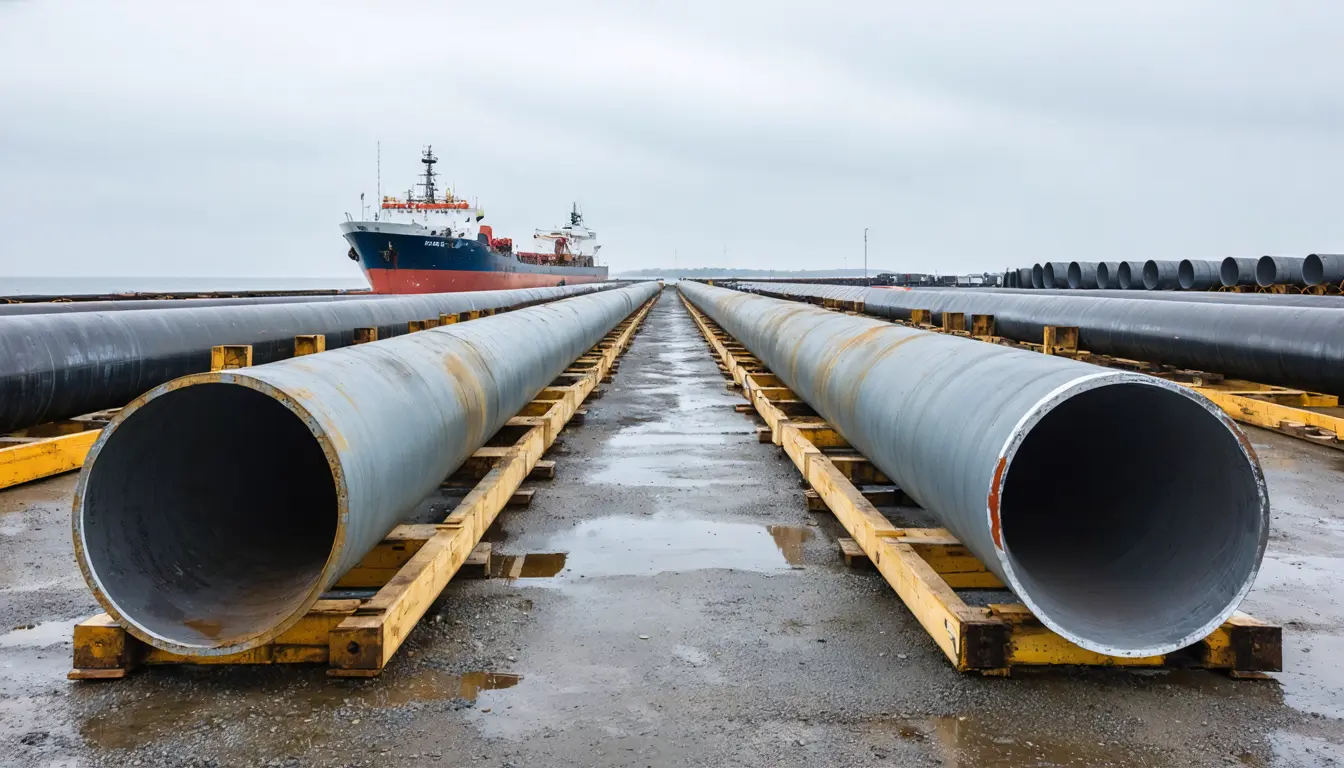
I'd count line pipe as an option that turns into an order on the day Glenfarne closes financing, and carriers as an option on that option. Neither is a pipeline a steelmaker or shipbuilder can book today [9][19]. The counter-case is political. Trump's pressure and the Hormuz argument give Seoul grounds to call the project viable on strategic terms [5][16]. If Seoul commits pledge money before contracts bind, the government sets the start date, pipe orders move up, and this view is wrong.
What to watch
- Whether Posco International's 1-million-ton heads of agreement, or any other potential deal, becomes a binding long-term contract with Glenfarne.
- A revised Glenfarne cost estimate once permafrost, labor and permitting costs are priced, compared with the current $44.5 billion to $54.5 billion range.
- The timetable for the project's environmental impact assessments, the step a KEEI source expects could push completion past 2040.
Clarity's read
What the record supports and how the coverage leans. The claims behind it follow.
Reality
- Evidence40
- Adoption15
- Hype gap+35
- Incentives60
- Confidence45
Claim ledger
Ranked by verification strength, evidence, and original report placement.
- [1]
The Alaska LNG project could hand Korean steelmakers and shipbuilders new orders, from a 1,300-kilometer pipeline to LNG carriers.
- [2]
The project would transport natural gas from the North Slope in northern Alaska to Nikiski in the south, where it would be liquefied and exported to Asia, via a 1,300-kilometer pipeline.
- [3]
The Alaska LNG project, which would move North Slope gas to Nikiski for liquefaction and export to Asia, is estimated to cost between $44.5 billion and $54.5 billion.
- [4]
Seoul pledged $350 billion to invest in the United States during tariff negotiations with Washington last year.
- [5]
U.S. President Donald Trump has pressed Korea to invest in the Alaska LNG project.
- [6]
Minister of Trade, Industry and Resources Kim Jung-kwan said during a National Assembly audit on Tuesday that the government is still reviewing the project.
- [7]
"Any review would have to be premised on its commercial viability." (Kim Jung-kwan)
- [8]
"Companies need long-term contracts as collateral to raise financing through loans and other means." (LNG industry source)
ReportedSupportedSource: unnamed LNG industry source quoted by Korea JoongAng DailyView cited source - [9]
The project needs long-term contracts for 16 million tons of LNG a year to secure financing, according to lead developer Glenfarne Group.
- [10]
Potential agreements currently cover 13 million tons a year, but most are reportedly nonbinding.
- [11]
Posco International, which has signed a heads of agreement to buy 1 million tons annually, is waiting for Glenfarne to complete financing, an industry source said.
- [12]
The pipeline would have to cross permafrost, and higher material and labor costs as well as permitting issues could push up expenses and extend the construction schedule.
- [13]
A gas industry source said the LNG project in Canada that Korea participated in took longer than expected to build its pipeline because it passed through Indigenous lands.
- [14]
A Korea Energy Economics Institute source said many expect the project could be delayed by environmental impact assessments and other procedures, with completion pushed beyond 2040.
- [15]
The KEEI source said lower demand under the global push for carbon neutrality could create a buyers' market and force suppliers to sell LNG "below cost."
- [16]
"It is true that the project did not move forward in the past because its commercial viability was clearly low. But the war in the Middle East has clearly created new strategic value." (Kim Jung-kwan)
- [17]
Cargoes from Alaska could reach Northeast Asia without transiting the Strait of Hormuz.
- [18]
Steelmakers and pipe makers such as SeAH Steel could be among the first Korean beneficiaries, turning materials into large-diameter line pipe, and the project could generate demand for high-grade cold-resistant steel.
- [19]
Korean shipbuilders could benefit if annual LNG exports reach 20 million tons and create demand for new carriers.
- [20]
"But there are still far too many stages the project must go through before that happens." (shipbuilding industry source)
- [21]
Even if all potential agreements became binding, contracted volume would be 3 million tons a year short of the financing threshold.
- [22]
Potential agreements equal about 81% of the 16-million-ton financing threshold.
- [23]
Posco International's 1-million-ton heads of agreement is about 6% of the financing threshold.
- [24]
The full project cost equals between about 13% and 16% of Seoul's $350 billion US investment pledge.
- [25]
The project's cost estimate spans $10 billion from low end to high end.
- [26]
The 20-million-ton export level that would create carrier demand is 25% above the 16-million-ton financing threshold.
- [27]
The 20-million-ton export level is 7 million tons above the 13 million tons covered by potential agreements.
Sources
1 independent publisher whose own reporting we read for this story.
- koreajoongangdaily.comKorean steelmakers and shipbuilders eye Alaska LNG upside, weigh risks
1 article · October 9, 2026
Topics and entities
Follow any of these and your For You feed starts watching them — no settings page required.
Topics
Entities
- Alaska LNGFollow
- Glenfarne GroupFollow
- POSCO InternationalFollow
- SeAH SteelFollow
- Korea Energy Economics InstituteFollow
- Kim Jung-kwanFollow
- Donald TrumpFollow
- Strait of HormuzFollow