Science1 publisherNot yet confirmed elsewhere2 min readPublished
Hundreds of genes place a yellow Costa Rican seamount coral in a new family
Researchers led by Odalisca Breedy named a new coral family, Laurinqueidae, for a yellow octocoral living 360 to 529 meters deep off Costa Rica. That so conspicuous an animal went unclassified shows how thinly described seamount life still is.
The Scientist · Science desk
What happened
- When the team first sequenced three genes commonly used to classify corals, each gene pointed to a different, unrelated family.
- A comparison of hundreds of genes put the coral on its own lineage, closest to the family Eunicellidae but distinct in both genetics and anatomy.
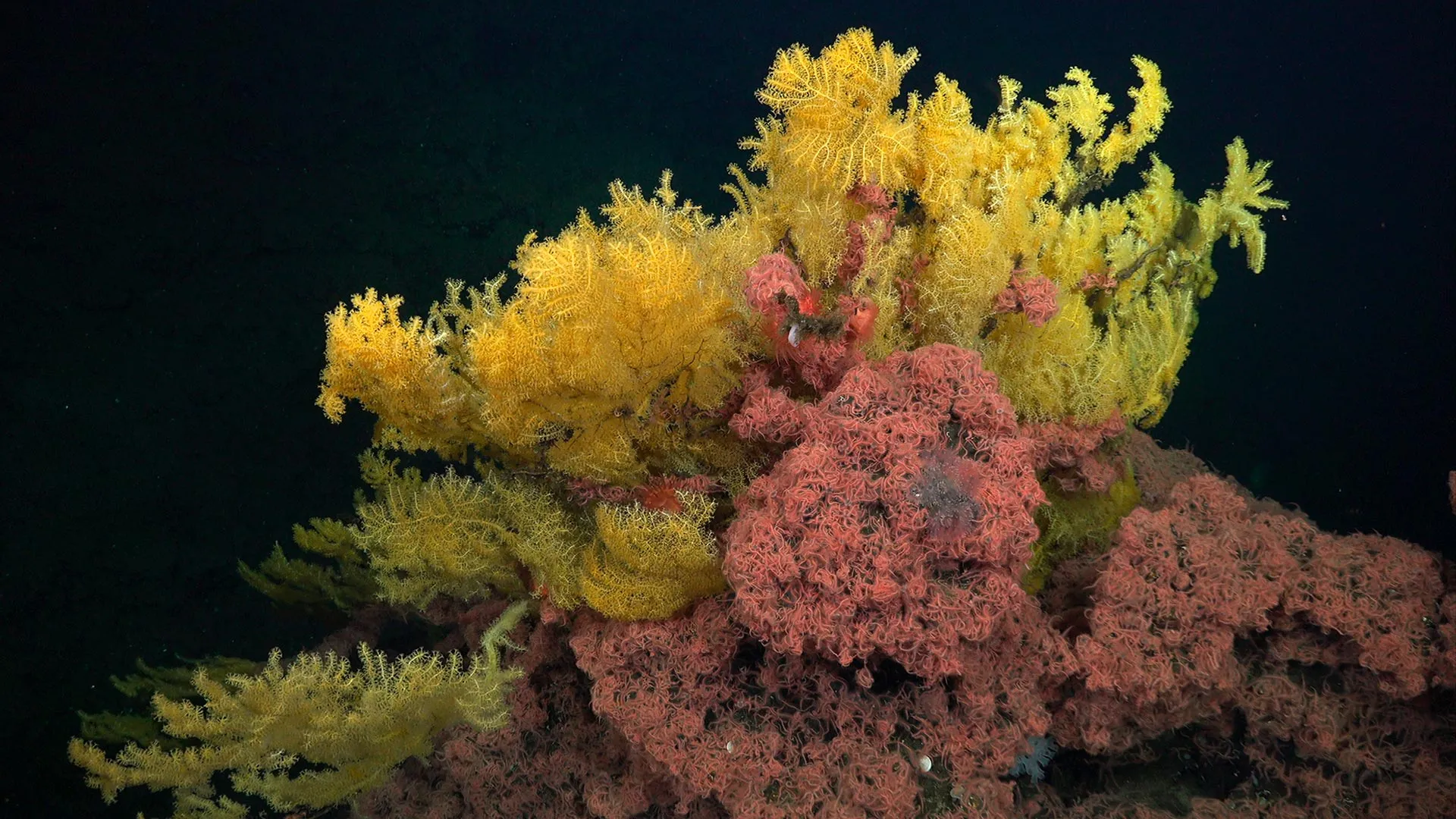
- Colonies branch like trees, some taller than a meter, on rocky outcrops where brittle stars cover nearly every surface.
- The remotely operated vehicle SuBastian collected the specimens on Schmidt Ocean Institute expeditions in 2019 and 2023 aboard Falkor and Falkor (too).
- The species, Laurinque elenya, is described in the open-access journal ZooKeys.
Compiled by The ScientistSomething wrong?How this is made
Why it matters
- constraint For unusual deep octocorals, a standard three-gene screen can return contradictory family placements, so settling them may take a phylogenomic dataset that most quick surveys do not collect.
- exposure A newly recognised coral family now sits inside a habitat type, deep coral gardens, that is already treated as a vulnerable marine ecosystem.
- capability With a formal genus and family, later surveys of these seamounts can record this coral as its own taxon instead of forcing it into Eunicellidae or another existing group.
When a standard three-gene panel returns three unrelated families, any placement drawn from it is a guess [8]. The team turned to phylogenomics, which compares hundreds of genes at the same time [9]. A placement supported across that many genes is much harder for one misleading marker to overturn. The larger dataset clarified where the coral sits [9].
Anatomy carried half the case. According to the Pensoft Publishers release, the new family rests on genetic and anatomical differences together [10][18]. Breedy's account puts the anatomy first. "I thought the species could belong to a known family and genera, but after the preliminar morphological analysis I realised that it was something very different that I could not match with the known taxa," she said [12].
She first saw the site in 2019. "I saw the octocoral garden for the first time in 2019 and I was impressed by the beauty of the landscape, which inspired, later the elvish name of the taxa," she said [11]. The genus name comes from the Quenya word for "golden tree," and elenya means "stellar" or "of the stars," for the brittle stars crowded around the colonies [7]. The family placement waited for a second trip. "In 2023 we collected more samples and thanks to the exhaustive molecular analyses made by my colleagues, Cathy McFadden, Catalina Murillo and Andrea Quattrini, we were able to determine the taxonomic placement of the stunning species, in one of the most enigmatic sites," she said [13]. Four years passed between the first sighting and the samples that settled the question [19].
The colonies span a 169-meter band of depth [20], on seamounts near Isla del Coco and along Costa Rica's Pacific margin [5]. The Schmidt Ocean Institute and a National Geographic Society research grant supported the expeditions [14].
The release places the coral among a growing number of previously undocumented species from Costa Rica's seamounts, in a deep ocean that covers roughly two-thirds of Earth's surface and remains poorly explored [15]. Coral gardens like this one are considered vulnerable marine ecosystems [16]. The thing this doesn't tell you is how far the family ranges or what pressure its sites face. Every specimen comes from Costa Rican seamounts [5], and the release does not link the site to a specific threat, deep-sea mining included.
I think the method holds the wider lesson. A coral striking enough to inspire an Elvish name still needed hundreds of genes to place [7][9]. Surveys of seamount fauna that rely on short marker panels can file some of what they collect under the wrong family, as the first three genes would have done here [8].
What to watch
- Whether later dives find Laurinque elenya or other members of Laurinqueidae on seamounts beyond Isla del Coco and Costa Rica's Pacific margin.
- Whether other deep octocorals show the same conflict among the three standard marker genes, which would argue for phylogenomic placement as a routine step.
- Whether Costa Rican or regional managers cite the new family when deciding protections for seamount coral gardens.
Clarity's read
What the record supports and how the coverage leans. The claims behind it follow.
Reality
- Evidence55
- Adoption
- Insufficient
- Hype gap+10
- Incentives30
- Confidence60
Claim ledger
Ranked by verification strength, evidence, and original report placement.
- [1]
Scientists surveying seamounts off Costa Rica identified a coral whose genetic makeup and physical features were distinctive enough that they created a new family to classify it.
- [2]
The coral was found between 360 and 529 meters below the Pacific Ocean's surface.
- [3]
The findings are reported in the open-access journal ZooKeys; the species is named Laurinque elenya.
- [4]
The coral is bright yellow with a branching, tree-like appearance, and some colonies grow more than a meter tall.
- [5]
Specimens were collected with the remotely operated vehicle SuBastian during 2019 and 2023 expeditions aboard the Schmidt Ocean Institute's research vessels Falkor and Falkor (too), which explored seamounts near Isla del Coco and along Costa Rica's Pacific margin.
- [6]
The coral was especially abundant on rocky outcrops where brittle stars covered nearly every available surface.
- [7]
The genus name Laurinque derives from the Quenya 'Laurinque', meaning 'golden tree'; the species name elenya means 'stellar' or 'of the stars', referring to the dense brittle star populations around the colonies.
- [8]
Scientists initially sequenced three genes commonly used to identify and classify corals; each gene suggested a different and unrelated family.
- [9]
Because the results were inconsistent, researchers used phylogenomics, comparing hundreds of genes at the same time, which clarified the coral's evolutionary position.
- [10]
The species is a distinct evolutionary lineage most closely related to Eunicellidae, but its genetics and anatomy differ enough to justify a new family, Laurinqueidae; a new genus, Laurinque, was established for the species.
- [11]
"I saw the octocoral garden for the first time in 2019 and I was impressed by the beauty of the landscape, which inspired, later the elvish name of the taxa."
- [12]
"I thought the species could belong to a known family and genera, but after the preliminar morphological analysis I realised that it was something very different that I could not match with the known taxa."
- [13]
"In 2023 we collected more samples and thanks to the exhaustive molecular analyses made by my colleagues, Cathy McFadden, Catalina Murillo and Andrea Quattrini, we were able to determine the taxonomic placement of the stunning species, in one of the most enigmatic sites."
- [14]
The Schmidt Ocean Institute supported the expeditions, along with a National Geographic Society research grant.
- [15]
The find joins a growing number of previously undocumented species discovered on Costa Rica's seamounts; the deep ocean covers roughly two-thirds of Earth's surface and remains poorly explored.
- [16]
Coral gardens like this one are considered vulnerable marine ecosystems.
- [17]
Dr. Odalisca Breedy of the Universidad de Costa Rica led the research with an international team of collaborators.
- [18]
The account was issued by Pensoft Publishers and published by ScienceDaily on October 8, 2026.
- [19]
Four years separated Breedy's first sighting of the coral garden (2019) and the sample collection that enabled the taxonomic placement (2023).
- [20]
The coral was recorded across a depth band of 169 meters.
Sources
1 independent publisher whose own reporting we read for this story.
- sciencedaily.comThis “golden tree” coral was too strange for any known family
1 article · October 8, 2026
Topics and entities
Follow any of these and your For You feed starts watching them — no settings page required.