Science1 publisher2 min readPublished
MIT-led CMS analysis catches individual quarks leaving wakes in quark-gluon plasma
MIT physicists at CERN's CMS report quarks leaving wakes in quark-gluon plasma, calling it the first direct sign the plasma reacts to a quark as a fluid. The wakes bear on a narrower, long-debated question than whether the plasma is a liquid, though the MIT release does not say how strong the signal is.
The Scientist · Science desk
Drafted by a language model from the sources cited here and checked against its claim ledger before publication. How we use AISend a correction
What happened
- The wake signals were identified with the CMS detector at CERN's Large Hadron Collider, and the open-access paper appears in Physics Letters B.
- Lee's group built a new method for spotting quark wakes and plans to run it on further collision data to find more examples.
- Krishna Rajagopal's hybrid model had predicted that a fast-moving jet of quarks would disturb the plasma and leave a wake behind it.
- In the early universe the plasma lasted only a few millionths of a second at trillions of degrees before cooling into protons and neutrons.
Compiled by The ScientistSomething wrong?How this is made
Why it matters
- capability A detectable wake can be sized and timed, so its spread, speed, reach and fade become measurements of the plasma's properties.
- precedent The hybrid model's wake prediction can now be checked against data, first on whether a wake exists and next on its measured shape and speed.
- constraint Statements about the newborn universe depend on collider droplets being the same matter as the cosmic plasma; CMS measured the droplets, and the cosmology follows by inference.
The MIT release's summary calls the result "the clearest evidence yet" that quark-gluon plasma "behaves like a true liquid" [1]. The liquid description is older than this experiment. Numerous experiments and theoretical studies had already led physicists to call the plasma a near-"perfect" liquid, in which quarks and gluons move together with almost no friction [7]. The new observation is narrower. According to the release, the plasma answers a single fast-moving particle as one fluid, with waves, splashes and swirls, instead of acting like a crowd of particles that each scatter on their own [15].
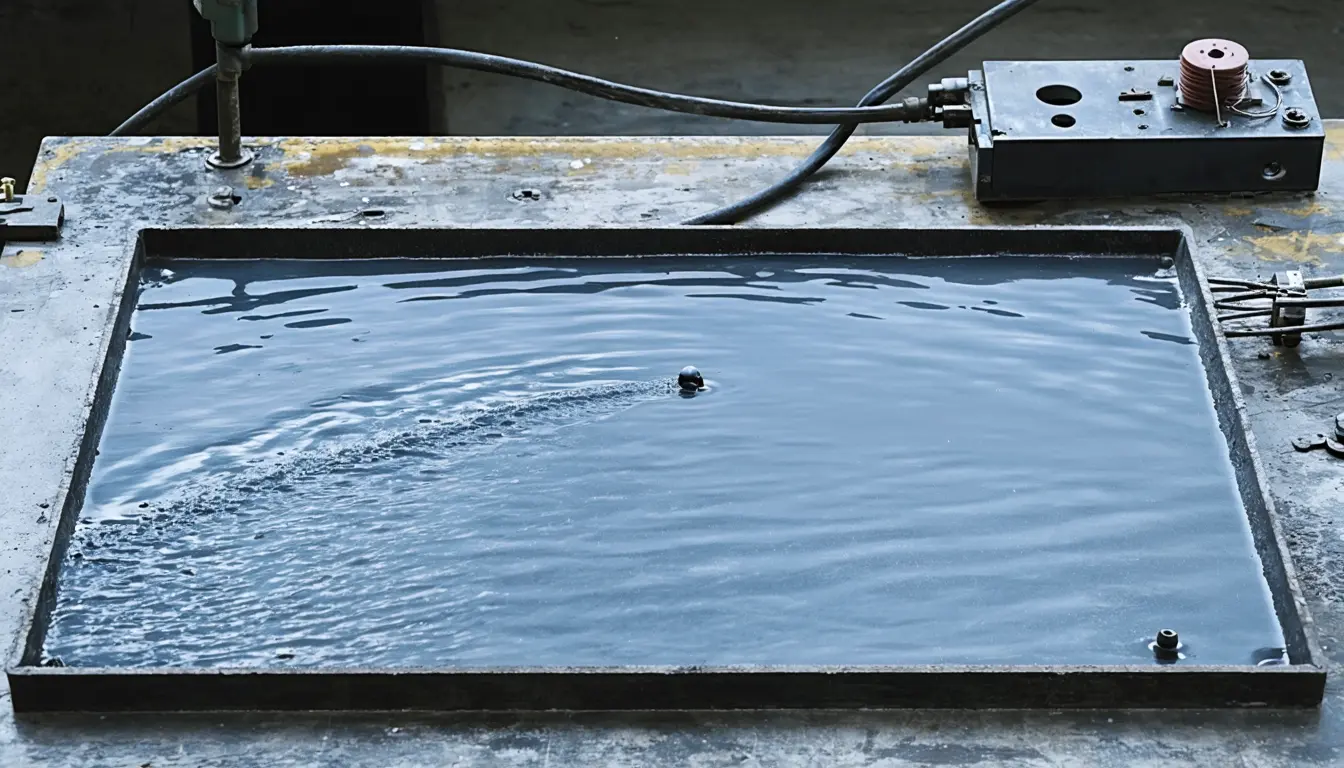
I find the narrower result the more interesting one, because it was the contested part. "It has been a long debate in our field, on whether the plasma should respond to a quark," Yen-Jie Lee, a professor of physics at MIT, said [2]. A wake is a direct way to answer it: the disturbance trails the quark the way ripples trail a duck across water [14].
Lee read the result as a statement about density. "Now we see the plasma is incredibly dense, such that it is able to slow down a quark, and produces splashes and swirls like a liquid. So quark-gluon plasma really is a primordial soup," he said [3].
The release calls the evidence clear [14]. It does not report how many collisions went into the analysis, how large the wake is against the background of the collision itself, or the statistical significance of the signal. For a first observation, those figures decide how much weight the word "clear" can carry. The account was issued by MIT and carried by ScienceDaily on October 6, 2026 [13].
Lee pointed the follow-up work at how the wakes move. "Studying how quark wakes bounce back and forth will give us new insights on the quark-gluon plasma's properties," he said [11]. Of the present result, he said: "With this experiment, we are taking a snapshot of this primordial quark soup" [12].
What to watch
- The event counts, wake size relative to the collision background, and statistical significance reported in the Physics Letters B paper itself.
- An independent analysis, by another team or with a different method, finding the same wake signal in heavy-ion collisions.