BuildNot yet confirmed elsewhere1 publisher3 min readPublished
Nvidia's Groq-derived LPX rack posts 3,431 tokens/sec on 128GB of SRAM
The first third-party benchmark of the LP30 rack came in at roughly four times the next-fastest public endpoint, measured one request at a time on a model small enough to fit.
The Engineer · Build desk
What happened
- Artificial Analysis clocked the rack at 3,431 output tokens per second on a 100K-context Gemma 4 31B reasoning workload, about four times the 870 of the next-fastest public endpoint.
- Groq's former chief architect, now Nvidia's VP of hardware, presented the design at Hot Chips 2026 and said the LP30-based rack is already in production.
- The test used a private pre-release endpoint on Google Cloud at a concurrency of one; the endpoints it beat were shared production serverless services.
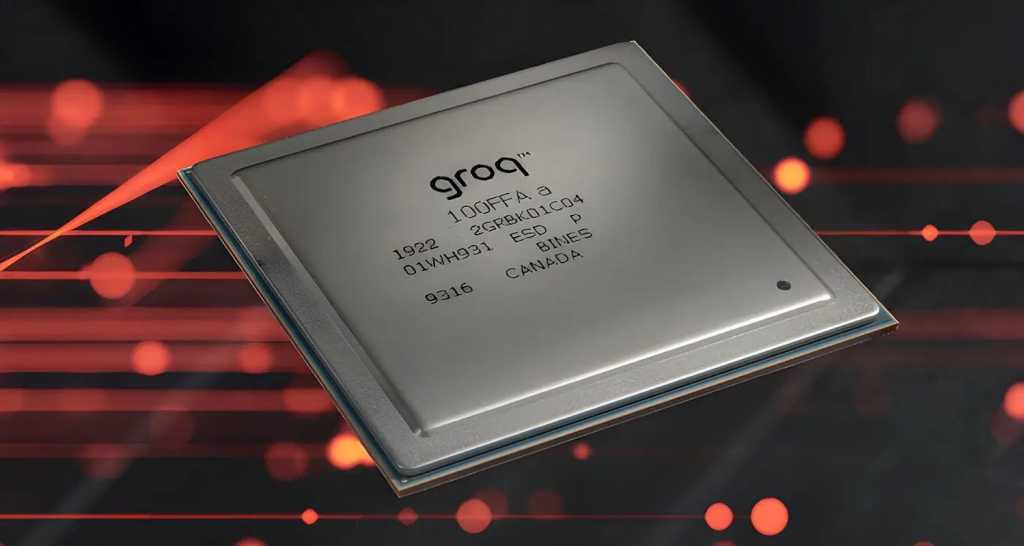
- Each LP30 carries roughly 500MB of on-die SRAM and no HBM at all.
Why it matters
- constraint The token rate is only purchasable by buyers whose model fits the SRAM budget; anything past a single-rack dense model becomes a multi-rack order, and Nvidia is selling the part for decode rather...
- decision Anyone comparing this against their current provider has to pick which number to trust: the single-request ceiling, or a production-concurrency figure nobody has published yet.
- exposure Buyers who had planned capacity around Rubin CPX lost it to the same $20 billion deal that produced this rack, and the replacement has a different memory model to design around.
- capability With power draw known ahead of time, current delivery and thermal headroom become scheduled quantities rather than reactive margins, so the rack can be run nearer its limits.
The memory ledger is the part to read first. A full rack is 256 LP30s, which totals 128GB of on-die SRAM feeding 40 PB/s of aggregate bandwidth against 315 PFLOPS of FP8 compute, with 350 ns of chip-to-chip latency in an MGX liquid-cooled, Vera Rubin-compatible frame [10]. One Rubin GPU carries 288GB of HBM4 [12]. The rack that posted the record therefore holds about 44 percent of the memory of a single GPU [19], and every byte of a served model has to live inside it.
Nvidia's own arithmetic puts a 31-billion-parameter model at FP8 at around 62 LPUs just to hold weights [12]. That is about 31GB, roughly a quarter of the rack, leaving on the order of 97GB for the 100K-context state and everything else [20]. Gemma 4 31B is dense and fits in one rack [9]. A large mixture-of-experts model runs to four figures of chips across several racks [12], and that case did not come up on stage [9].
The measurement deserves the same close reading. Artificial Analysis took the median of 50 sequential client requests at a concurrency of one, against a private pre-release endpoint served through Google Cloud [5]. Serving one request at a time is the condition that yields the highest per-user token rate a machine can post, and it does not map onto the multi-tenant load the rival endpoints were carrying [c5b]. Nvidia's own demo figure of 10,996 tokens per second on the same model is 3.2 times the audited number [7][18]; Arsovski labelled it self-reported before telling the room the aim was "third-party verified independent benchmarks that you guys can trust" [c6b].
Underneath is a pipeline with no caches, no branch prediction and no out-of-order execution, scheduled by the compiler at clock-cycle granularity, with weights resident in SRAM rather than streamed from HBM [11]. Determinism then earns its keep twice over. Because power draw is known cycle by cycle, Nvidia pre-orders current from the rack's regulators, which it says cuts voltage droop by more than 60 percent and overshoot by more than 70 percent against an uncompensated load [14]. Per-block scheduling also equalizes heat instead of throttling to the hottest tile, worth roughly 10 to 11 percent more performance under a fixed thermal limit, according to Arsovski [15]. Across racks, chips run against a single virtual clock and each one routes as well as computes, so the fabric needs no adaptive routing or congestion sensing [17].
That puts weight on the failure answer. Asked in Q&A about a chip dying mid-workload, Arsovski said users "would experience the exact same as any other hardware in the industry" and would "just checkpoint it or reconfigure the hardware" [16]. On a rack where one model's weights are spread over dozens of chips [12] and the network has nothing sensing congestion to steer around a hole [17], reconfiguration is not a small operation.
What to watch
- Whether Artificial Analysis or anyone else publishes LPX numbers at production concurrency on a shared endpoint.
- Whether Nvidia discloses a mixture-of-experts configuration with its chip count, rack count and measured token rate.
- Whether LPX capacity is sold or rented in units smaller than a 256-chip rack, and at what price per token against HBM GPUs.
Clarity's read
What the record supports and how the coverage leans. The claims behind it follow.
Reality
- Evidence58
- Adoption20
- Hype gap+32
- Incentives74
- Confidence55
Claim ledger
Ranked by verification strength, evidence, and original report placement.
- [1]
Igor Arsovski, Groq's former chief architect and now Nvidia's VP of hardware, presented the Groq 3 LPX rack architecture at Hot Chips 2026.
- [2]
Artificial Analysis measured the Groq 3 LPX rack at 3,431 output tokens per second on a 100K-context Gemma 4 31B reasoning workload, roughly four times the 870 tokens per second of the next-fastest public endpoint; this was the first third-party benchmark of the hardware.
- [3]
Arsovski said the rack is already in production, built on the LP30 chip Nvidia obtained through its $20 billion Groq deal in December 2025.
- [4]
The same Groq deal pushed the Rubin CPX, which the LPX rack replaces, off Nvidia's roadmap.
- [5]
Artificial Analysis ran the comparison on a private, pre-release Gemma 4 31B endpoint served through Google Cloud, taking the median of 50 sequential client requests at a concurrency of one, while the public providers it measured against ran shared production serverless endpoints.
- [6]
Serving one request at a time produces the highest per-user token rate the hardware can post, and it is not directly comparable to the multi-tenant conditions the other endpoints run under.
- [7]
Nvidia's on-stage demo showed 10,996 tokens per second on the same Gemma 4 31B model, which Arsovski flagged as self-reported.
- [8]
Arsovski said the aim was "third-party verified independent benchmarks that you guys can trust."
- [9]
Gemma 4 31B is a dense model small enough to sit inside a single LPX rack, and the picture at trillion-parameter mixture-of-experts scale, where memory capacity becomes the main constraint, went unaddressed.
- [10]
Each LP30 carries roughly 500MB of on-die SRAM and no HBM, so a full LPX rack of 256 chips holds 128GB of memory delivering 40 PB/s of aggregate bandwidth against 315 PFLOPS of FP8 compute, with 350 ns of chip-to-chip latency in a Vera Rubin-compatible, MGX liquid-cooled rack that scales past 1,000 LPUs.
- [11]
Keeping weights resident in SRAM rather than streaming them from HBM removes the memory-access latency that dominates single-token decode, and the design drops caches, branch prediction and out-of-order execution in favour of a fully deterministic pipeline the compiler schedules at clock-cycle granularity.
- [12]
A Rubin GPU carries 288GB of HBM4, roughly 576 times the memory of a single LP30, so a 31-billion-parameter model at FP8 needs on the order of 62 LPUs to hold its weights, and a large mixture-of-experts model runs into four figures of chips across several racks.
- [13]
Capacity is the cost of the SRAM-only design, and Nvidia is describing the LPU as for decode rather than as a general-purpose replacement for its GPUs, pitching the LPX rack as a decode co-processor.
- [14]
Determinism lets the compiler predict power draw cycle by cycle, which Nvidia uses to pre-order current from the rack's regulators ahead of demand, cutting voltage droop by more than 60% and overshoot by more than 70% against an uncompensated load.
- [15]
Per-block scheduling lets the hardware equalize heat instead of throttling to the hottest tile, which Arsovski put at roughly 10% to 11% additional performance under a fixed thermal limit.
- [16]
Asked during Q&A about the blast radius of a chip that fails mid-workload, Arsovski said users "would experience the exact same as any other hardware in the industry" and would "just checkpoint it or reconfigure the hardware."
- [17]
Nvidia synchronizes chips across racks to a single virtual clock in what it calls a plesiosynchronous network, with each chip acting as both processor and router so the fabric needs no adaptive routing or congestion sensing, and clock drift compensated at the chip-to-chip links.
- [18]
Nvidia's self-reported 10,996 tokens per second is about 3.2 times the third-party measured 3,431 tokens per second on the same model.
- [19]
A full 256-chip LPX rack's 128GB of SRAM is about 44 percent of the 288GB of HBM4 on a single Rubin GPU.
- [20]
The roughly 62 LPUs needed to hold a 31B model at FP8 amount to about 31GB, some 24 percent of a 256-chip rack's 128GB, leaving on the order of 97GB for context state and everything else.
Sources
1 independent publisher whose own reporting we read for this story.
Topics and entities
Follow any of these and your For You feed starts watching them — no settings page required.
Topics
- Deterministic execution and rack power managementFollow
- Inference benchmark methodologyFollow
- Wafer-Scale ComputingFollow
- Inference Accelerators and Compute SupplyFollow
- Nvidia's Groq acquisition and roadmapFollow
- SRAM vs HBM memory architectureFollow
Entities
- NvidiaFollow
- GroqFollow
- Igor ArsovskiFollow
- Artificial AnalysisFollow
- Groq 3 LPXFollow
- LP30Follow
- Gemma 4 31BFollow
- Vera Rubin NVL72Follow
- Rubin CPXFollow
- Rubin GPUFollow
- CerebrasFollow
- Cerebras CS4Follow
- Jean-Philippe FrickerFollow
- Jonathan RossFollow
- Nvidia DynamoFollow
- CUDAFollow
- Google CloudFollow
- Tensor Streaming ProcessorFollow
- Hot Chips 2026Follow