InvestIndependently confirmed2 publishers3 min readPublished
Nvidia's $20bn Groq buy becomes shipping racks, and the tape reads it as execution risk
Hardware from the largest acquisition in Nvidia's history is in production and headed to a neocloud this year. The market sold it anyway, two days before earnings.
The Investor · Invest desk
What happened
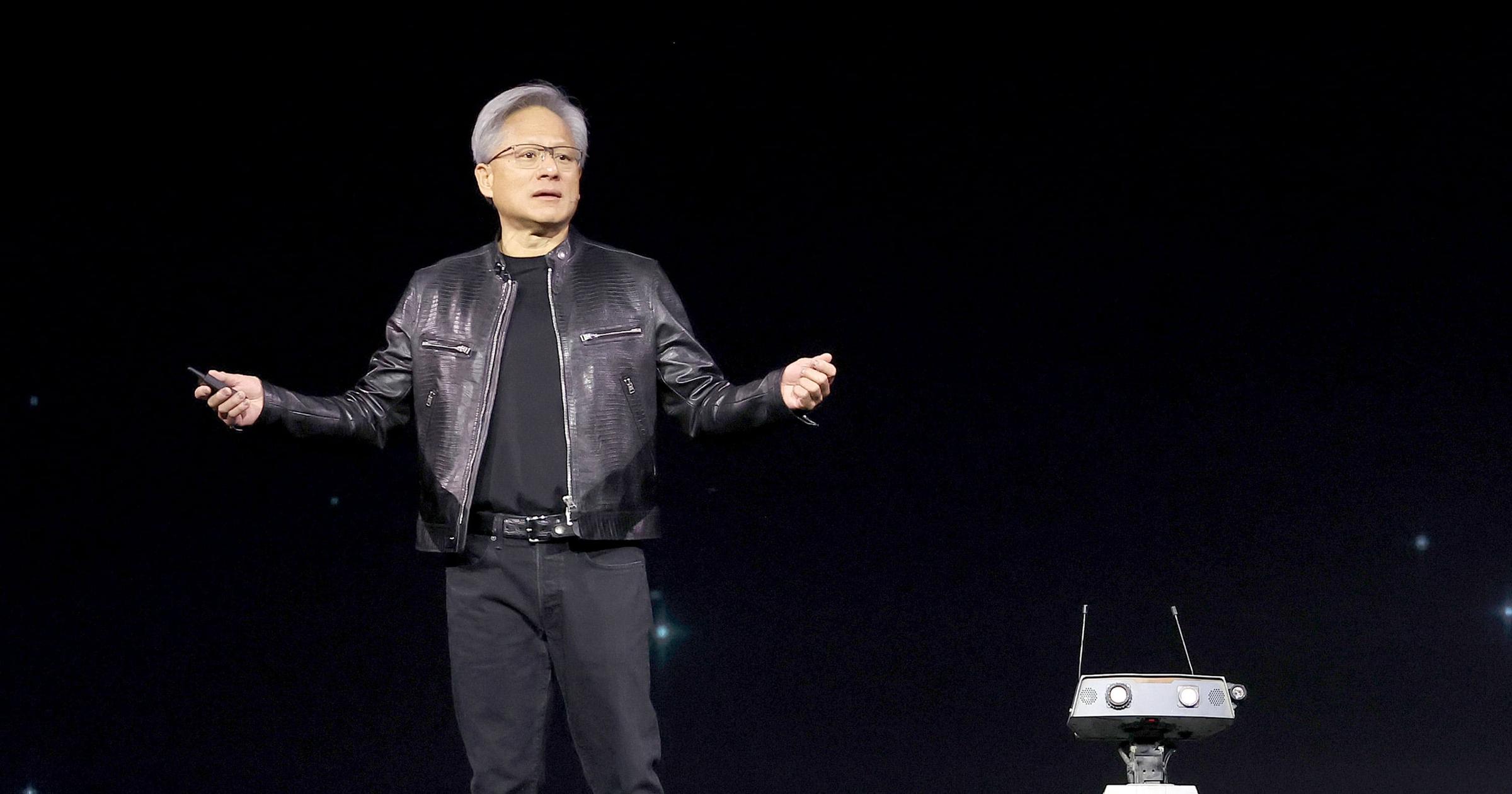
- Nvidia said Monday that its Groq 3 LPX rack is in full production, commercialising the technology behind its largest acquisition on record.
- The racks go to neocloud Nebius alongside Vera CPUs and Rubin GPUs, and will be online later this year, according to senior director Dion Harris.
- The stock opened about 3% higher and finished roughly 2% lower after the Groq announcement.
- Nvidia reports fiscal second-quarter results on Wednesday after the market closes.
Why it matters
- capability Neoclouds acquire a product line they could not price before: a latency-tiered service sitting above standard token serving, which turns response time into a billable feature rather than an...
- constraint Huang has already capped the Groq line himself at a quarter of coding-workload data centre space, so the return on the purchase has to come from protecting GPU pricing at the high end, not from...
- exposure Part of Nvidia's inference roadmap now sits at Samsung rather than TSMC, which is useful capacity if components are the binding constraint and a new dependency if they are not.
- contradiction Two published estimates of the same share price are a quarter apart, and Monday's trading agreed with neither, which is the definition of a name where the debate is execution rather than demand.
Roughly five points of intraday reversal on a company valued near $5.2 trillion is about $260 billion of market capitalisation moving on one product announcement [21], and it came in a month when the shares had been running nearly 7% against 2.5% for the S&P 500 [20].
What the buyer of that stock is underwriting here is smaller than the headline suggests. Nvidia paid $20 billion for Groq's assets in December [3]. Set against the $1 trillion in cumulative Blackwell and Vera Rubin sales Jensen Huang projected through 2027 when the products were unveiled in March, the deal is about 2% of the revenue Nvidia has already pointed the market at [23]. Groq does not need to be a large business. It needs to stop someone else from owning the fast end of serving.
The hardware is narrower than a GPU by design. Each Groq 3 chip carries 500 megabytes of SRAM on the die itself to cut memory bottlenecks [6], and Nvidia packages 256 of them into an LPX rack [5], so a full rack holds roughly 128 gigabytes of on-chip memory [22]. That is a decode-phase machine, which is exactly what Nvidia says it is: low-latency parts handle the decode portion of serving, while GPUs still do training and adapt to new models [10]. Senior director Dion Harris put it as "using the right price, right processor for the right part of the workload" rather than replacing GPUs [9]. Huang's own allocation was more specific about the ceiling: a quarter of the data centre space intended for coding goes to Groq, and "the rest of my data center is all 100% Vera Rubin" [12].
The 3,400 tokens per second Nvidia cites is a full-rack number from an Artificial Analysis benchmark [5]. OpenAI's Ultrafast mode is quoted at 750 tokens per second on Cerebras silicon [16]. The division gives 4.5x [26], but the sources do not say the two figures are measured on the same basis, and one is a rack while the other is a service tier, so it is a marketing comparison rather than a competitive one. AMD has already said it will pair its rack-scale systems with Cerebras chips for the same low-latency work [15].
The quieter point is the fab. Samsung builds Groq's chips while TSMC builds Nvidia's GPUs [7]. Wedbush's Matt Bryson, who rates the stock Outperform, argues that "component and material access, not end demand, is defining shipments" [18], which makes a Samsung-fabbed product line a second source of units as much as a latency play.
The sell side shows how wide the range still is. Rosenblatt keeps a Buy and a $325 target against a $214.72 quote, about 51% above the tape [17][24], while InvestingPro's fair value of $259.96 sits 21% above the price, with Rosenblatt's target a quarter above that [25]. All of it rests on a consensus that already has quarterly revenue and earnings roughly doubling from a year ago [19]. And the premium-tier logic, that cloud providers can charge more for tokens carrying stricter latency terms [8], is still the vendor's own assertion about what buyers will pay.
What to watch
- Whether the Nebius deployment actually goes live this calendar year, and whether a second neocloud customer is named for LPX racks.
- Wednesday's October-quarter guide: above the Street as Wedbush expects, or merely in line with it.
- Whether Nvidia ever breaks out Groq-line revenue rather than folding it into the data centre segment, where its scale cannot be checked.
Clarity's read
What the record supports and how the coverage leans. The claims behind it follow.
Reality
- Evidence58
- Adoption28
- Hype gap+24
- Incentives74
- Confidence61
Claim ledger
Ranked by verification strength, evidence, and original report placement.
- [1]
Nvidia announced on Monday that its Groq 3 LPX rack is in full production, marking the commercialization of technology from the company's largest acquisition on record.
- [2]
The Groq rack will be deployed alongside Vera central processors and Rubin graphics processors at neocloud Nebius and will be online later this year, Nvidia senior director Dion Harris told reporters.
- [3]
In December, Nvidia bought assets from chip startup Groq for $20 billion, the company's largest purchase.
- [4]
Nvidia fell about 2% Monday after opening roughly 3% higher; the stock jumped about 3% soon after the opening bell, then dropped roughly 2% after the Groq news came out.
- [5]
Nvidia packages 256 individual Groq 3 chips into its LPX racks and says the rack can deliver 3,400 tokens per second, citing a benchmark from Artificial Analysis.
- [6]
The Groq architecture includes 500 megabytes of fast SRAM on the chip's die itself to reduce memory-related bottlenecks.
- [7]
Groq chips are manufactured by Samsung, while Taiwan Semiconductor Manufacturing makes Nvidia's GPUs.
- [8]
Cloud companies can charge more for low-latency tokens, Nvidia says; Harris said it "unlocks the ability to offer premium tiers of service for those users and those customers who actually demand the most latency-sensitive" service agreements.
ReportedSupportedSource: Nvidia senior director Dion Harris2 sources— create a free account to open themView cited source - [9]
"This isn't about replacing GPUs," Harris said. "It's about using the right price, right processor for the right part of the workload."
ReportedSupportedSource: Nvidia senior director Dion Harris2 sources— create a free account to open themView cited source - [10]
Low-latency chips do not replace GPUs, which can do training as well as inference and are flexible enough to adapt to new technologies and models; low-latency chips like Groq mainly focus on the "decode" phase of serving models.
- [11]
At the Vera Rubin and Groq 3 LPX unveiling in March, Jensen Huang projected $1 trillion in cumulative sales between current-generation Blackwell chips and the new Vera Rubin systems through 2027.
- [12]
Huang said he would allocate a quarter of data center space intended for coding applications to Groq chips: "The rest of my data center is all 100% Vera Rubin."
- [13]
Nvidia is due to report its fiscal second-quarter numbers on Wednesday after the market closes.
- [14]
Nvidia is worth close to $5.2 trillion based on FactSet data, making it the biggest company worldwide by market value.
- [15]
AMD announced earlier this year it would integrate its rack-scale systems with chips from Cerebras, which recently went public, focusing on low-latency inference.
- [16]
OpenAI's newly announced Ultrafast mode currently promises 750 tokens per second and is "powered by Cerebras."
- [17]
Rosenblatt Securities kept its Buy rating on Nvidia with a $325.00 share-price target; Nvidia was trading at $214.72, while InvestingPro put its fair-value estimate at $259.96.
- [18]
Wedbush analyst Matt Bryson, who has an Outperform rating, expects Nvidia to exceed its guidance and guide October above the Street, citing "a supply position we continue to view as the best in the industry at a point where component and material access, not end demand, is defining shipments."
- [19]
London Stock Exchange Group data shows analysts expect Nvidia's quarterly revenue and earnings to reach about twice their levels from the same period last year.
- [20]
Nvidia shares were up nearly 7% in August through Friday's close, while the S&P 500 had risen around 2.5%.
- [21]
A reversal from roughly plus 3% to roughly minus 2% is about five percentage points, or approximately $260 billion of market value on a roughly $5.2 trillion capitalisation.
- [22]
An LPX rack of 256 Groq 3 chips carries roughly 128 gigabytes of on-die SRAM in total.
- [23]
The $20 billion Groq purchase equals about 2% of the $1 trillion cumulative Blackwell and Vera Rubin sales figure Huang projected through 2027.
- [24]
Rosenblatt's $325 target is about 51% above the $214.72 trading price.
- [25]
InvestingPro's $259.96 fair value is about 21% above the $214.72 price, and Rosenblatt's $325 target is about 25% above that fair value.
- [26]
Nvidia's cited 3,400 tokens per second per rack is 4.5 times the 750 tokens per second quoted for OpenAI's Ultrafast mode, though the sources do not state that the two figures share a measurement basis.
Sources
2 independent publishers whose own reporting we read for this story.
- cnbc.comNvidia says Groq racks will be online this year following $20 billion purchase
1 article · August 24, 2026
- cryptopolitan.comWhy is Nvidia stock falling today?
1 article · August 24, 2026
Topics and entities
Follow any of these and your For You feed starts watching them — no settings page required.
Topics
Entities
- InvestingProFollow
- Rosenblatt SecuritiesFollow
- OpenAIFollow
- Matt BrysonFollow
- CerebrasFollow
- Groq 3 LPXFollow
- FactSetFollow
- Dion HarrisFollow
- NvidiaFollow
- Jensen HuangFollow
- WedbushFollow
- Artificial AnalysisFollow
- LSEGFollow
- Samsung ElectronicsFollow
- AMDFollow
- Vera RubinFollow
- GroqFollow
- Taiwan SemiconductorFollow
- NebiusFollow
- BlackwellFollow