Science1 publisher2 min readPublished
Alternating-polarity electrolysis joins carboxylic and boronic acids into saturated carbon bonds
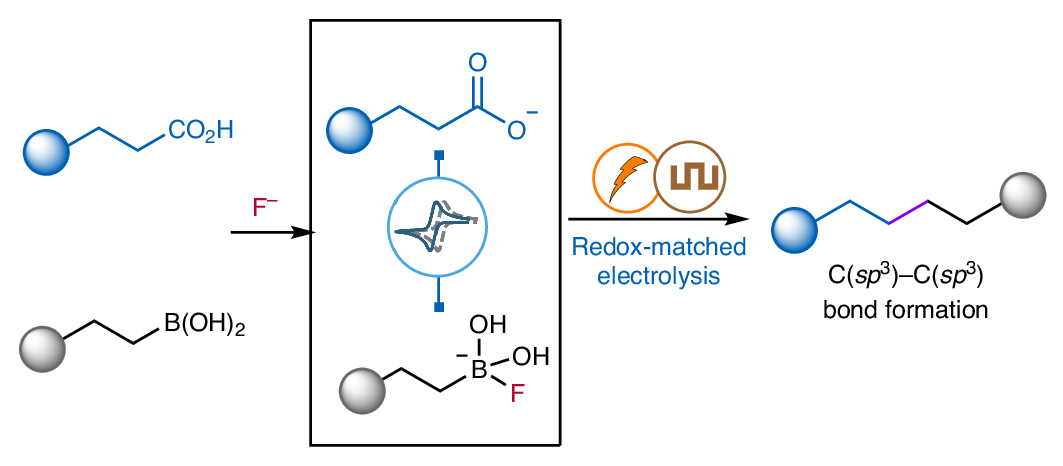
A team reporting in Nature Chemistry cross-coupled carboxylic and boronic acids using polarity-flipping electrolysis to form saturated carbon-carbon bonds. It directly joins two short-lived radicals that had resisted coupling.
The Scientist · Science desk
Drafted by a language model from the sources cited here and checked against its claim ledger before publication. How we use AISend a correction
What happened
- Kolbe electrolysis is one of the few existing methods that couples two short-lived radicals directly, and it works by oxidizing carboxylic acids at an electrode into carbon radicals.
- Most other direct radical couplings depend on the persistent radical effect, which pairs a long-lived radical with a short-lived one and so limits which partners can be joined.
- They also chained the new coupling into tandem Suzuki coupling and Buchwald-Hartwig amination sequences.
Compiled by The ScientistSomething wrong?How this is made
Why it matters
- capability The result gives route planners a new disconnection, letting a saturated carbon-carbon bond be traced back to a carboxylic acid and a boronic acid.
- constraint Because neither fragment has to be the long-lived radical, the choice of coupling partners is no longer boxed in by the persistent radical effect.
- precedent That it already runs in tandem with Suzuki coupling and amination suggests the step can drop into existing multistep routes without redesigning them.
The hard part is selectivity. Make two short-lived radicals in the same pot and each can pair with its own kind as readily as with the other, so the wanted cross product competes with two homocoupled ones. The field's usual answer, which the paper names, is the persistent radical effect: pair a long-lived radical with a short-lived one so the transient species mostly finds the persistent partner. [2]
Kolbe electrolysis is the exception. It oxidizes carboxylic acids at an electrode into carbon radicals and lets two of them combine directly, with no persistent partner needed. [3] Classically that gives a homocoupling. Pulling two different radicals from two different precursor families and getting them to cross-couple is the step the authors set out to make work. [4]
Their route is redox-matched alternating-polarity electrolysis. [5] The electrode potential is reversed back and forth instead of held steady. Matching the oxidation windows of the two precursors is meant to activate both in step, so that neither is spent before the other appears. To show the chemistry is not a one-substrate trick, they ran homocouplings and a net carboxylic acid-alkene coupling, making the boronic partner in place by hydroborating an alkene. [6] They also chained the step into Suzuki coupling and Buchwald-Hartwig amination. [7]
The paper's abstract reports no yields, and no measure of how often the cross product wins over the homocoupled ones. [9] For a chemist deciding whether to build a route around this bond, those numbers sit behind the journal's paywall. [10]
Saturated, three-dimensional fragments are what medicinal chemists increasingly want. The paper frames its method as a way to reach "complex, three-dimensional, value-added molecules," [1] and cites a 2009 analysis, "Escape from flatland," arguing that more sp3 character tracks with better odds in the clinic. [11]
What to watch
- Whether the full paper's yields and substrate scope show cross-coupling reliably beating the competing homocoupled products.
- Whether the coupling holds up on functionalized, drug-like substrates rather than simple test molecules.
- Whether other labs reproduce the method and adopt the carboxylic-acid-plus-boronic-acid disconnection in practice.