Science1 publisher2 min readPublished
Borane coordination opens the N-alkyl aziridines that metal catalysis leaves inert
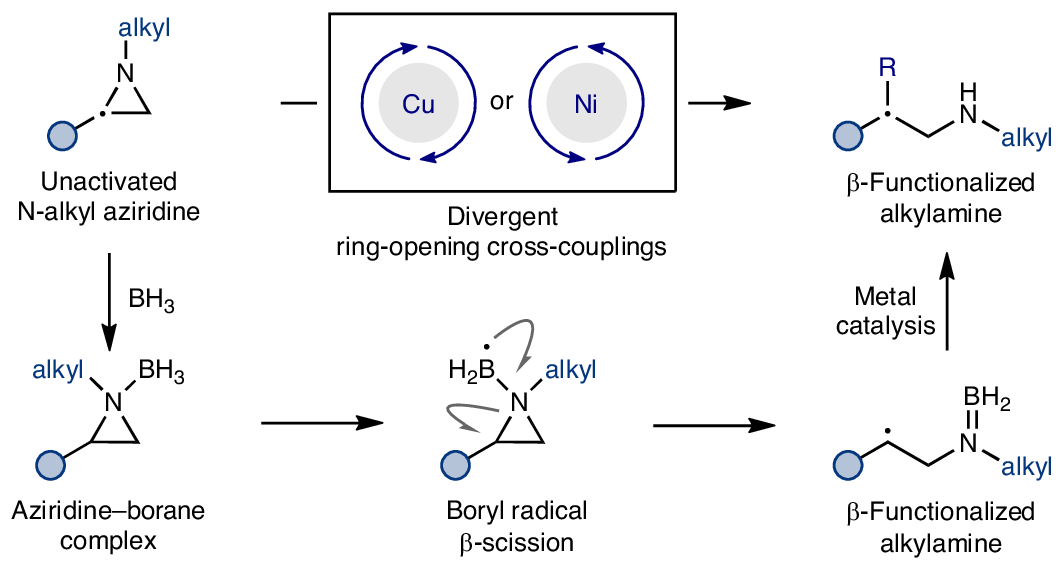
Peng and colleagues coordinate BH3 to an aziridine nitrogen, convert the adduct into a boryl radical, and let it fragment into a beta-aminoalkyl radical that copper and nickel catalysis can then couple to aryl and other partners.
The Scientist · Science desk
What happened
- Coordinating borane to the nitrogen of an unactivated N-alkyl aziridine gives a complex the authors describe as stable, and that complex can be converted selectively into an aziridine-ligated boryl radical.
- The boryl radical then fragments regioselectively at the beta position, releasing a beta-aminoalkyl radical that metal catalysis can intercept in a cross-coupling step.
- Two systems were built around that intermediate: an oxidative copper platform taking aryl boronic acids plus nitrile and sulfide nucleophiles, and a dual photo-nickel platform for aryl bromides.
- Existing catalytic routes all start by putting a strongly electron-withdrawing group such as tosyl or nosyl on the nitrogen, which then has to be removed and the N-alkyl group rebuilt afterwards.
Compiled by The ScientistSomething wrong?How this is made
Why it matters
- capability A route can carry the N-alkyl group the target needs straight through the ring-opening step, so the nitrogen substituent no longer has to be taken off and put back by alkylation or reductive amination.
- decision The coupling partner now picks the equipment: an aryl bromide commits a lab to a photoredox-plus-nickel setup, while a boronic acid, nitrile or sulfide keeps the work in a copper flask.
- constraint The nitrogen still has to be derivatized before anything opens, with a borane adduct in place of the sulfonamide, so the saving depends on coordination being cheaper than an install-and-remove pair.
- precedent A four-decade-old EPR finding of instability becomes the specification a method is designed around. Other amine-borane adducts are now in play as fragmentation handles.
The design question is which species gets to be stable. Borane binds the aziridine nitrogen and stays put; the abstract describes these aziridine-ligated borane complexes as stable, and says they can be converted selectively into aziridine-ligated boryl radicals [1]. Take a hydrogen off that boron and you have a radical that does not stay put. Baban and Roberts reported as much in 1983, in an ESR study of amine-boryl radicals that the Nature Chemistry summary cites as demonstrating aziridine-ligated boryl radicals are unstable [9]. A follow-up the next year examined 2-methylaziridine-boryl radicals and how stereochemistry affects the rate of beta-fragmentation [10]. Forty-three years separate that instability result from the paper built on it [14].
N-alkyl aziridines resisted catalysis because nothing weakens the ring bond. Acid activation does open aziridines, but in practice only highly activated ones, with strongly nucleophilic partners, often under forcing conditions [15]. The three transition-metal activation strategies all start further along: metal insertion into the strained C(sp3)-N bond, single-electron reduction to a beta-aminoalkyl radical, or halide opening to a beta-haloamine for reductive coupling [5]. Each of them needs a strongly electron-withdrawing group such as tosyl or nosyl on the nitrogen to weaken that bond first [6]. Under the established metal manifolds, the N-alkyl substrates are essentially inert [8].
The ring also has to break in the right place. Benzylic aziridines cleave at the more substituted carbon and give branched products. Beta-alkyl-substituted ones cleave at the less substituted carbon and give linear products. Methods that override that substrate control are rare [7]. The abstract calls the beta-scission regioselective and the functionalization downstream of it divergent [2] [3]. It does not include yields, substrate counts or borane loading [16].
An unsigned Nature Chemistry summary of the work says "simple borane coordination is shown to direct radical fragmentation of these substrates, providing a general platform for divergent ring-opening functionalization" [11]. General is a claim about scope, and the substrate table is what tests it. The abstract does not say whether the two platforms tolerate the heteroatom-dense substrates that make beta-functionalized amines worth chasing. Beta-substituted amines are common enough in bioactive molecules for that question to come up on most projects [13].
For anyone planning a route, the comparison is narrow and countable: total steps and isolated yield for the borane-and-couple sequence, against installing a sulfonamide, opening the ring, removing the sulfonamide and then N-alkylating or reductively aminating to put the alkyl group back [6]. That four-part detour is what the authors say their method streamlines [4].
What to watch
- Whether the full paper's substrate tables show the copper and photo-nickel platforms working on heteroatom-rich, medicinally typical aziridines and at what isolated yields.
- Whether beta-scission can be steered against the intrinsic benzylic-versus-alkyl regiochemical preference to give one regioisomer across substrate classes.
- Whether borane loading and handling at scale keep the route competitive on total step count against the sulfonamide install-and-remove sequence.