Science2 publishers2 min readPublished
Uranium carbyne crystallised with a 2.379-angstrom triple bond to carbon
Chemists have crystallised a uranium Fischer-type carbyne with a uranium-carbon distance of 2.379 angstroms, a bond long sought in f-element chemistry. Their analysis finds bonding related to, but distinct from, that of the transition-metal carbynes known since 1973.
The Scientist · Science desk
Drafted by a language model from the sources cited here and checked against its claim ledger before publication. How we use AISend a correction
What happened
- Earlier uranium-carbon triple bonds were seen only in cryogenic matrices or inside fullerene cages, methods the authors say do not carry over to regular synthetic chemistry.
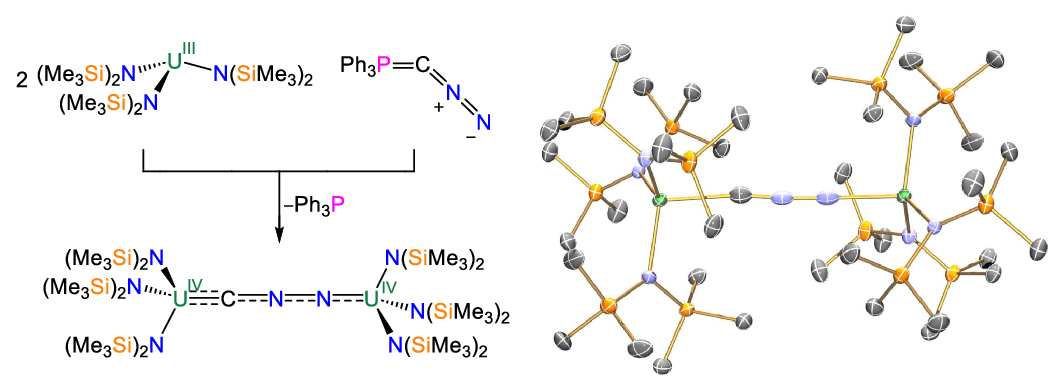
- The new compound links two uranium atoms, each bearing three N(SiMe3)2 ligands, through a bridging carbon-nitrogen-nitrogen unit.
- The authors trace the long difficulty to a shortage of practical carbon-atom transfer reagents and the challenge of building the donor-acceptor link.
Compiled by The ScientistSomething wrong?How this is made
Why it matters
- capability Chemists can now study a uranium-carbon triple bond in a compound made and crystallised by ordinary methods, so questions about its chemistry can be put to a real sample.
- constraint The triple-bond label depends on a bonding model the authors call partly arbitrary, so comparisons with other compounds rest more safely on the measured distance than on bond order.
- constraint Because the authors describe the bond as distinct from transition-metal Fischer carbynes, reactions known for those compounds have to be shown on uranium before anyone can assume they carry over.
- precedent Showing that diazomethanediide can carry a carbyne-type bond makes the CNN ligand a natural one to try on other f-elements, where practical carbon-atom transfer reagents are scarce.
Crystallographers report the distance as 2.379(15) angstroms [4]. The bracketed figure is the uncertainty in the last digits, so one standard uncertainty either side spans 2.364 to 2.394 angstroms [1]. A distance alone does not count bonds. The triple-bond assignment comes from density functional theory calculations combined with Hirshfeld atom refinement, a quantum-crystallography treatment of the experimental diffraction data [5].
Two families of metal-carbon triple bond set the terms of comparison. In a Fischer carbyne, a singlet carbon fragment donates to the metal and the metal sustains two orthogonal back-bonds to the carbon [8]. In a Schrock alkylidyne, quartet metal and carbon fragments combine into a covalent triple bond [8]. The uranium compound follows the Fischer pattern of donation and back-donation, but each of its two back-bonds from uranium holds one electron, and the authors classify the whole as sigma2pi1pi1 Fischer-type bonding [5]. On their scheme, possible electron counts form a continuum from classical Fischer to Fischer-type carbynes [9].
The authors are candid about how soft such labels are. Carbyne bonding is less clear-cut than the double-bonded alkylidene and carbene cases, they write, the choice of model is somewhat arbitrary, and even the fully back-bonded description is a formalism [9]. I think the evidence supports two statements at different strengths. The uranium-carbon contact is measured. The sigma2pi1pi1 picture is a model of that contact, built from calculation and refined experimental density [4][5].
Uranium is the most studied actinide and the most transition-metal-like [11]. It already forms many multiple bonds to nitrogen-group and oxygen-group elements, and double bonds to carbon in several alkylidene complexes [12]. Metal-carbon triple bonds in general have been known for more than half a century and are used in both fundamental and applied synthesis [15].
The thing this doesn't tell you is how the uranium-carbon unit behaves in a reaction; the abstract does not report any reactivity. The carbyne carbon belongs to a diazomethanediide ligand, and the work extends the bonding modes known for that ligand [7]. Fischer carbynes usually carry a heteroatom substituent. The paper notes that such substituents open alternative resonance forms that weaken the metal-carbon interaction compared with Schrock alkylidynes [14]. The authors offer the compound as a foundation, "providing a basis to develop and understand f-element carbyne chemistry" [6].
What to watch
- Reports of the uranium-carbon unit taking part in the bond-forming reactions that make transition-metal carbynes useful in synthesis.
- A uranium carbyne built from a ligand other than diazomethanediide, to test whether the sigma2pi1pi1 bonding depends on the bridging CNN unit.
- Attempts with other actinides, which the paper treats as less transition-metal-like than uranium.