Science1 publisher2 min readPublished
Hydrogen-bond donors on the ligand raise nitrate affinity by up to seven orders of magnitude
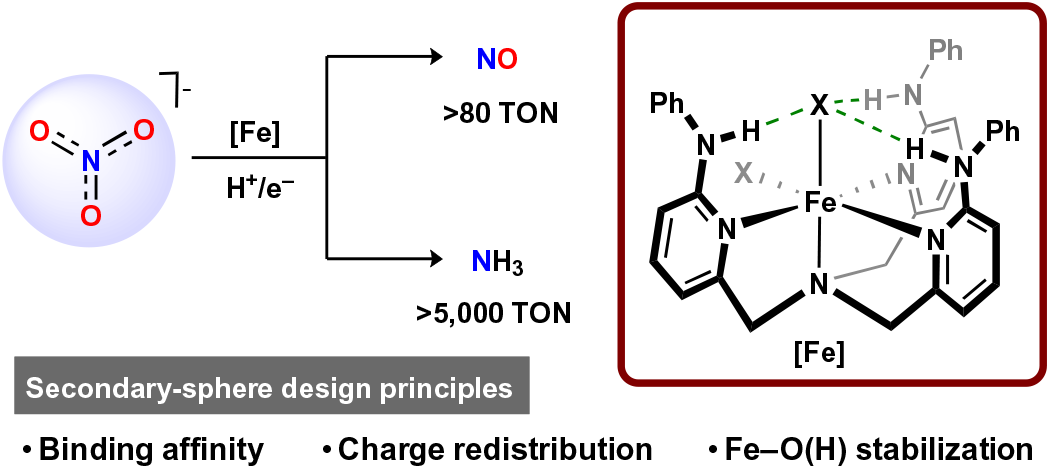
A redox-inactive zinc series isolates what appended aniline donors do to nitrate binding, and swapping in iron turns that binding into catalytic deoxygenation, giving NO under heat and ammonia under light.
The Scientist · Science desk
What happened
- Chemists built a network of hydrogen-bond donors into the ligand scaffold surrounding the metal, a bioinspired route to making nitrate both bind more tightly and reduce more readily.
- Zinc complexes on a tris(2-pyridylmethyl)amine framework carrying appended aniline donors bound nitrate up to seven orders of magnitude more tightly than analogues without those interactions.
- Stoichiometric experiments traced the role of dimeric intermediates and their conversion into more reactive monomeric species. That work guided the move to catalysis.
- The resulting catalysis ran under both thermal and photochemical conditions, producing nitric oxide in the first case and ammonia in the second, with high turnover numbers.
Compiled by The ScientistSomething wrong?How this is made
Why it matters
- cost Ion exchange and reverse osmosis hand a utility a nitrate-contaminated waste stream that itself needs treating, and a catalyst that destroys the anion removes that second bill.
- capability If affinity can be engineered into the ligand's outer shell, getting nitrate to bind no longer depends on reaching for heavy oxophilic metals such as molybdenum, tungsten or rhenium.
- constraint Binding and turnover are two different things. The scaffold makes the anion available and activated, but a redox-active metal still has to supply the electrons, so donors alone reduce nothing.
- decision Groups choosing where to spend synthetic effort now have a testable place to put it in a field whose own authors describe design principles for rational catalyst construction as limited.
Seven orders of magnitude is a factor of ten million [17]. The phrase "up to" matters here: it describes the best variant in the series measured against analogues that lack the donors [4], not an average across the set.
The number earns attention because of the metal chosen to obtain it. Zinc(II) is redox-inactive [3], so a series of zinc complexes built on one tris(2-pyridylmethyl)amine framework can vary the appended aniline donors and report the change in nitrate affinity with no reduction running in the background [2].
The hard step in nitrate deoxygenation is the first reduction event, because the anion has strong N=O bonds and binds transition metals poorly [11]. The established way around that has been to reach for an oxophilic metal; the literature runs through vanadium, chromium, manganese, molybdenum, tungsten, rhenium and the lanthanides [12].
The metal still has a job in the design. Deoxygenation appeared once zinc was replaced with a redox-active metal such as iron [6]. The ligand's outer shell handles binding and the charge redistribution inside the bound anion [5]; the metal handles electrons. The zinc work pins down the scaffold's half of that division of labour.
Activity is the harder comparison. The Mo=O and Re=O catalysts reported by the Sarkar, Moesch-Zanetti, Lin, Kim and Espenson groups reached up to 120 turnovers, driven by oxidation of phosphine or sulfide to stable P=O and S=O bonds [13]. The new system is described as achieving "high turnover numbers" thermally and photochemically, and the abstract prints neither the figure nor what supplies the driving force [8].
Turnover number is a durability measure for a catalyst, and durability is a different question from remediation. The goals the authors list for practical photochemical and electrochemical systems are minimal energy input, high product selectivity and faster rates [19]. Nitrate reaches water supplies as unabsorbed fertilizer carried in agricultural runoff, where it promotes cyanobacteria growth and eutrophication [9]. A homogeneous binding study is still some distance from either of those conditions.
The work does address the complaint the authors make about their own field. Homogeneous nitrate catalysts, they write, "generally operate with modest activity, and there are limited design principles that enable rational catalyst construction" [15]. Another group can append the same donor set to a different scaffold and test it against its own binding constants.
What to watch
- Whether the full paper's turnover figures, and the reagent consumed to drive them, stand up against the 120-turnover Mo=O and Re=O precedents.
- A test of the same ligand set in aqueous solution, where other anions can compete for the hydrogen-bond pocket.
- Whether other groups append donor arrays to different scaffolds and first-row metals and report the binding constants.