Science1 publisher2 min readPublished
Imma-B60 brings high conductivity and plasticity to elemental boron
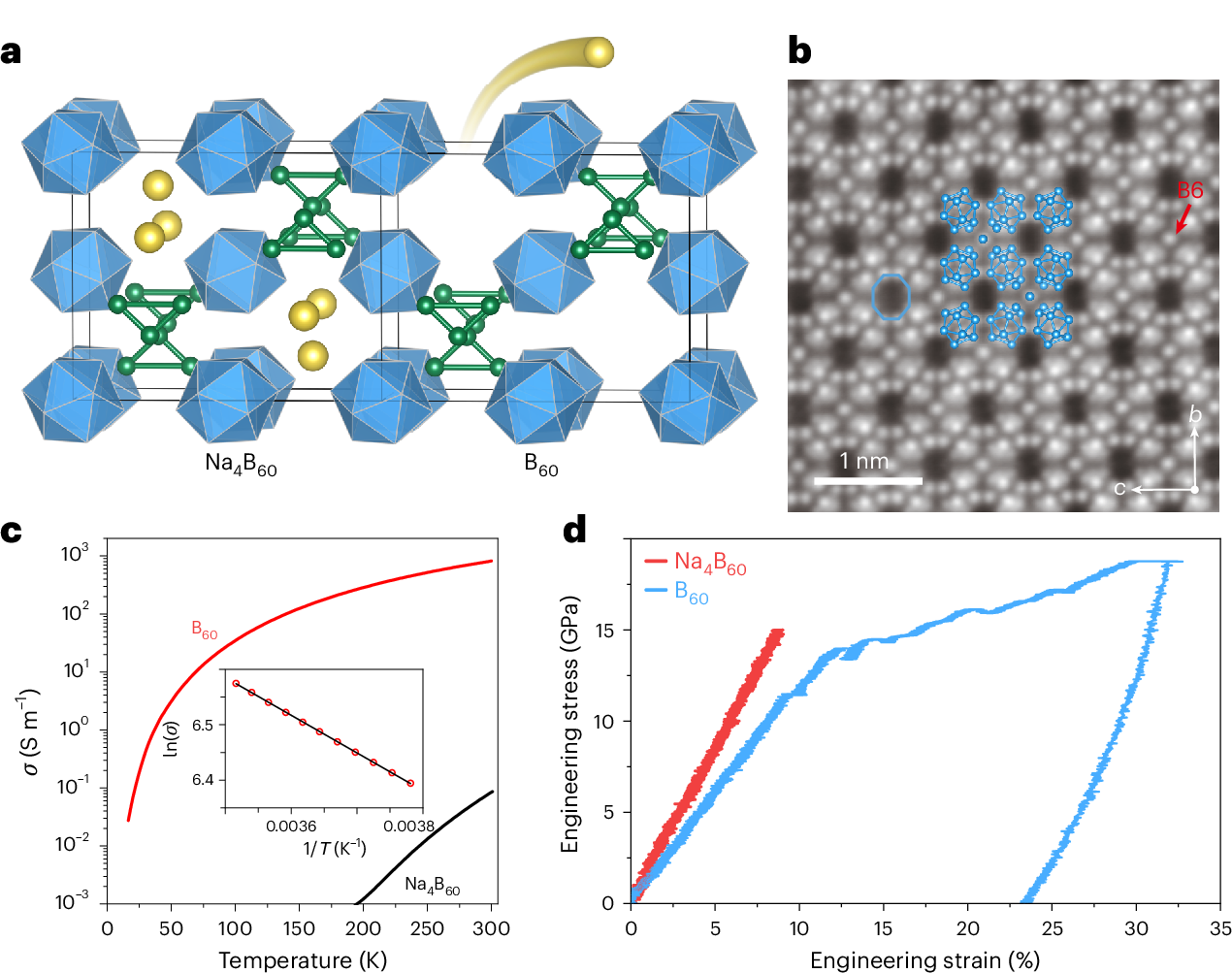
F. Chen and colleagues made Imma-B60, an open-framework boron allotrope with high electrical conductivity and plasticity, by degassing a precursor. Nature Chemistry's briefing says the pairing could widen boron's uses beyond its superhard and semiconducting phases.
The Scientist · Science desk
Drafted by a language model from the sources cited here and checked against its claim ledger before publication. How we use AISend a correction
What happened
- Imma-B60 also has a narrow bandgap, according to the Nature Chemistry research briefing that summarizes the paper.
- The briefing describes a boron allotrope combining mechanical flexibility with high electrical conductivity as a challenging synthesis target.
- The same precursor-mediated degassing route was used in 2015 to make Cmcm-Si24, an open-framework allotrope of silicon.
Compiled by The ScientistSomething wrong?How this is made
Why it matters
- capability If the conductivity and plasticity hold in bulk samples, boron becomes a candidate for parts that must carry current and tolerate deformation, a use its superhard and semiconducting phases do not cover.
- precedent A degassing route that has now produced open-framework allotropes of both silicon and boron makes trying it on other elements a reasonable next experiment for synthetic chemists.
- constraint Boron's earlier exotic behaviour, such as superconductivity in beta-boron, was seen under pressure, so the conditions needed to make and keep Imma-B60 decide how far it can be used outside a lab.
Boron's earlier surprises came with conditions attached. The references in the Nature Chemistry briefing go back to 1970, when Werheit and Leis measured the electrical conductivity and bandgap of beta-boron [10]. Eremets and colleagues reported in 2001 that beta-boron superconducts under pressure [7]. Oganov and colleagues made a partially ionic form, gamma-boron, in 2009, also under pressure [8].
The synthesis is what I would single out. Chen and colleagues took precursor-mediated degassing from silicon and applied it to boron, eleven years after the silicon work [1]. As the name implies, a precursor compound comes first and something is driven out of it. The open boron framework left behind is the product [2]. The full paper's title is "An open-framework boron allotrope exhibiting high conductivity and plasticity" [1].
The thing this doesn't tell you is how large the effects are. The summary does not report a conductivity value, a bandgap figure or the test used to establish plasticity [3][9]. "High" and "narrow" are comparative words. High conductivity measured against other boron phases would be a different result from high conductivity measured against a metal.
A research result and a production material face separate tests. The briefing says the properties expand the "potential application" of boron [5]. I think that is about the right level of confidence for a new allotrope made by a route that has now worked on two elements [2][6].
What to watch
- Independent replication of Imma-B60's plasticity by a second laboratory, using a mechanical test that is described in full.
- Whether Imma-B60 stays stable at ambient conditions and can be made in more than research-scale quantities.
- Whether precursor-mediated degassing yields open-framework allotropes of a third element.