Science1 publisherNot yet confirmed elsewhere2 min readPublished
Deleting up to 15 reductase genes lets E. coli retain di-nitro compounds and nitro-aldehydes
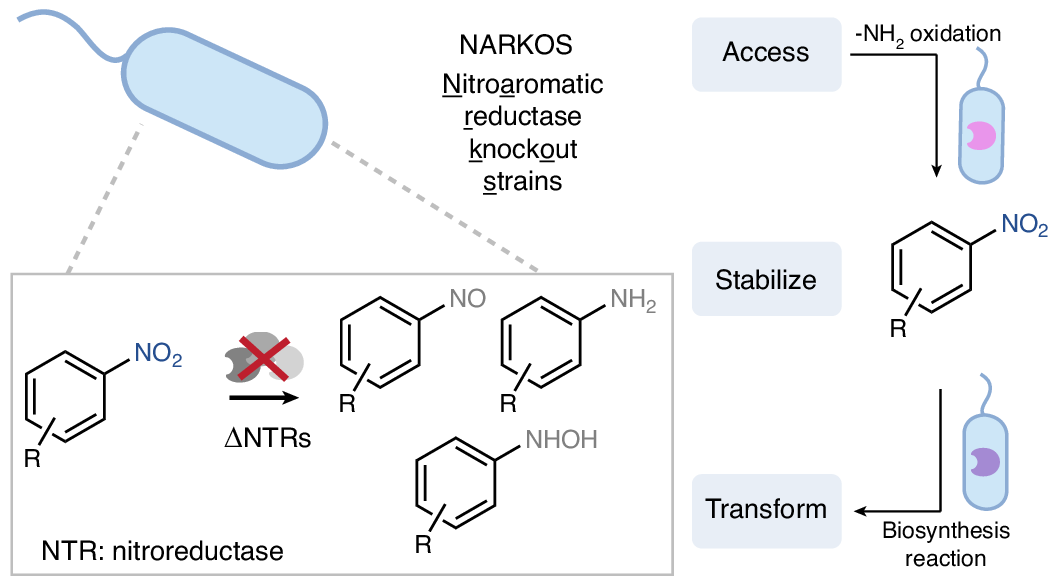
Researchers engineered Escherichia coli with up to 15 nitroreductase gene deletions that let the cells retain nitroaromatic compounds normal strains destroy. Industry makes these chemicals with nitric acid under heat and hazard that a cell-based route avoids.
The Scientist · Science desk
Drafted by a language model from the sources cited here and checked against its claim ledger before publication. How we use AISend a correction
What happened
- Retention held for two chemistries in particular, di-nitro compounds and nitro-aldehydes, which wild-type cells reduce away.
- Ordinary E. coli erases nitro functionality quickly because it reduces the group inside the cell before it can be used.
- No earlier study had measured nitroarene stability as a function of how many nitroreductase genes are deleted and how long the cells incubate.
Compiled by The ScientistSomething wrong?How this is made
Why it matters
- capability Removing the reductases makes E. coli a host that can hold a nitro group long enough to build on it, the condition whole-cell enzyme discovery and genetic-code expansion both need.
- constraint Retention is shown for two compound classes, not across the whole panel, so the result is limited to those classes and stops short of a general nitroarene host.
- precedent A reliable host makes screening and engineering new nitrating enzymes the expected next step, since nature offers only about 200 nitro natural products and three known enzyme families.
The abstract reports retention by class of compound. Di-nitro compounds and nitro-aldehydes held in the knockout strains, where wild-type E. coli reduces them [5]. The screen covered more than 20 nitroaromatic compounds, each supplied from outside the cell to wild-type and engineered strains [4]. The abstract does not say which compounds held, by how much, or over what incubation time.
Instability of nitroarenes in microbial cells is the barrier the work targets [1]. E. coli strips nitro groups fast through intracellular reduction [11]. The enzymes responsible, nitroreductases, are flavin-dependent reductases that also handle quinone reduction, redox mediation and oxidative-stress defence [12]. The activity is spread across many genes, so deleting one leaves it largely intact. That redundancy is the reason the team went to as many as 15 knockouts of known and candidate genes [3].
With the reductions removed, the strains can be used to make nitro compounds instead of destroying them. The team ran three transformations: converting an amine precursor to a nitro compound, synthesising nitrobenzaldehydes, and placing nitrophenylalanines into a translated protein from supplied nitrobenzaldehydes [6].
The industrial case for a biological route is in the comparison with current practice. Nitroarenes are used across pharmaceuticals, agrochemicals, dyes and energetic materials [7]. Nitration still runs on nitric acid and nitric-sulfuric mixtures, which demand careful heat management, generate environmental hazards, and constrain regioselectivity and functional group tolerance [8]. An enzyme route works in water with enzyme-defined selectivity, and in the best case uses molecular oxygen as co-reactant and leaves water as the only byproduct [9].
That best case depends on having nitrating enzymes to deploy, and there are not many. Nature has yielded roughly 200 nitro-containing natural products [10], and the known enzymes fall into three families [15]. A host that holds a nitro group long enough to measure is a prerequisite for screening new ones.
Earlier work had shown that deleting multiple NTR genes keeps certain pro-drugs and photocaged amino acids intact [13], and the link between NTR deletions and stability was known even if its extent was not [2]. What this adds is the systematic version. The field had not had a measure of nitroarene stability across a panel of chemistries as a function of how many genes come out and how long the cells incubate [14].
What to watch
- The full results: which of the 20-plus compounds were stabilised, the retention percentages, and the incubation times.
- Whether the 15-knockout strains grow and behave like wild-type, given that the deleted reductases also contribute to oxidative-stress defence.
- Whether nitrating enzymes run in these strains at titres and yields that matter for manufacturing, not just for discovery.