Cropland is less likely than forest or wildland to end up inside a Western burn scar
A study co-led by DRI's Bea Gordon finds cropland 1.3 to 5 times more associated with where nearly 10,000 Western fires stopped than other land types. Its authors want drought plans that idle irrigated land to count the lost buffer, though the moisture explanation is a proposal.
The Scientist · Science desk
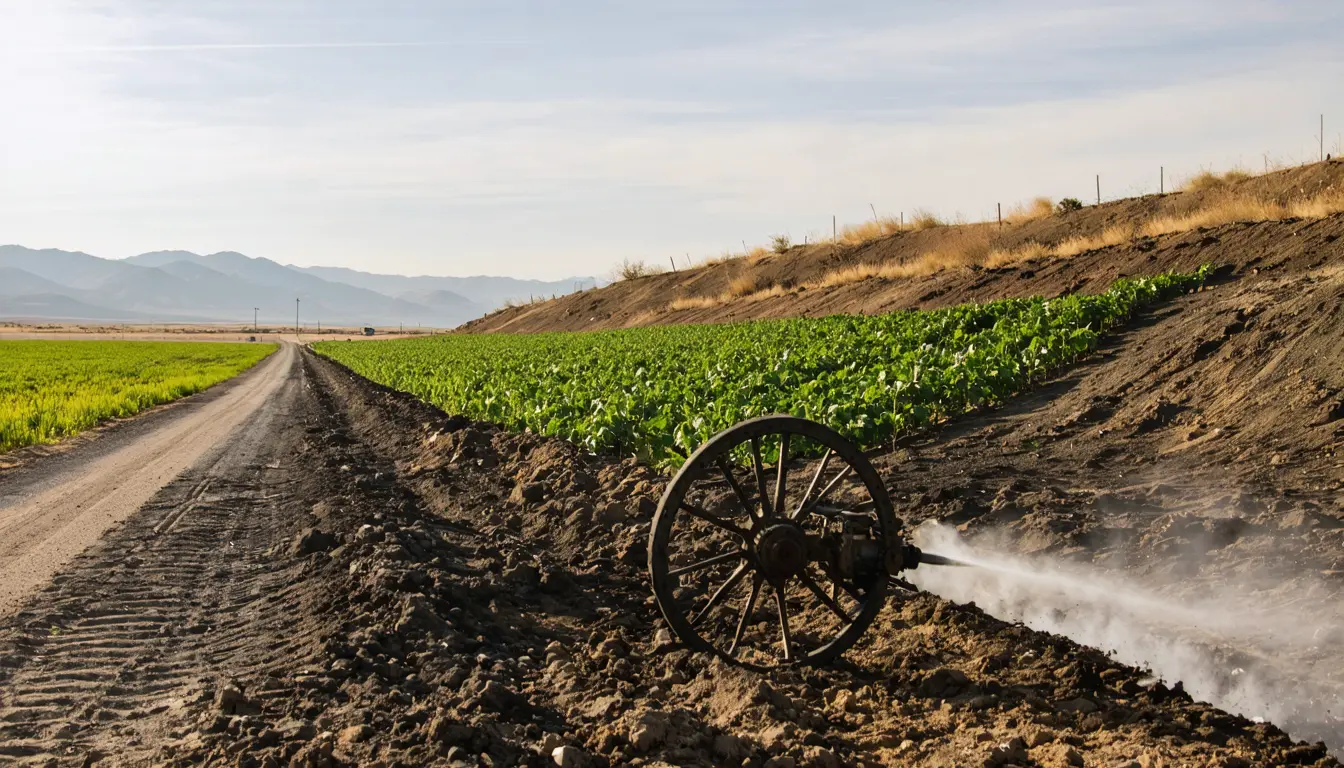
Cropland was at least 1.3 and up to 5 times more associated with where fires stopped than other land types. The study covered nearly 10,000 fires across 11 western states.
| Figure | Value | Note | Claim |
|---|---|---|---|
| Cropland vs other land at fire stops, at least | 1.3 times more | up to 5 times more | 4 |
| Fires studied, nearly | 10,000 fires | 2 | |
| Western states covered | 11 states | 3 |
What happened
- Published in Environmental Research Letters, the work was co-led by Austen Lorenz and included fire managers among its colleagues.
- Since 1985, about 4.3 million hectares of cropland in the study regions moved to other uses, an area about the size of Switzerland.
- Much of that land became scrubland or other low vegetation that is more flammable than irrigated farmland.
- About 20% of the converted cropland was developed into communities, largely around metropolitan areas.
Why it matters
- decision Water managers choosing which land to idle now have a second hazard to weigh, and the authors name programs such as USDA's Conservation Reserve Program as ones that could be expanded.
- constraint The conversion record covers land that changed use, and the summary does not say how fields idled for a season behave, so the fire cost of voluntary idling, which the authors call widely used, is unmeasured.
- exposure The effect is strongest where irrigation overlaps fire season, in the Central Valley, Columbia Basin and Snake River Plain, so those are the places where idling would be expected to cost the most buffer.
The finding is an association. That is what perimeter records can show [2]. The team worked from those records for nearly 10,000 fires across 11 western states between 1985 and 2024 [2][3]. The records cannot show whether a fire that stopped at a field would have stopped there had the field been scrub.
The authors offer two explanations. Well-irrigated crops may hold enough moisture to block a fire's advance, and open fields give firefighters somewhere to stage [15]. Perimeter data cannot separate the two, since either would put a fire line at a field edge. Barren land is the one type that matched cropland as a barrier [4]. That is consistent with a fuel-and-moisture story.
The 1.3 to 5 range is wide [4].
The 4.3 million hectares counts every transition to another use, housing included [5][7], so it is wider than a tally of drought retirements. The authors say the buffer is lost whatever the land becomes [8]. Applying the 20% share to 4.3 million hectares gives roughly 0.9 million hectares of former cropland that now hold communities [14], and the authors note that such development brings new ignition sources and harder suppression [13].
"After working with wildfire managers, it became clear that drought adaptation strategies that alter cropland can influence how wildfire moves through the landscape," Gordon said [12].
We think the study is enough to put fire on the ledger when water managers weigh permanent conversion of irrigated land, and not enough to price the loss per hectare. The results are consistent with similar research in Europe, though this is the first analysis of its kind for the western U.S. [9]
What to watch
- Transition-specific estimates that set water saved against fire risk, the evaluation method the authors say is still needed.
- A comparison of irrigated and unirrigated fields in the same fire season, which would separate the moisture explanation from firefighter staging.
- Whether Conservation Reserve Program-style schemes add fire criteria to how idled or converted land is chosen.
Clarity's read
What the record supports and how the coverage leans. The claims behind it follow.
Reality
- Evidence68
- Adoption
- Insufficient
- Hype gap+8
- Incentives
- Insufficient
- Confidence55
Claim ledger
Ranked by verification strength, evidence, and original report placement.
- [1]
The research was published in Environmental Research Letters and co-led by Austen Lorenz and DRI's Bea Gordon alongside colleagues including fire managers.
- [2]
The team examined wildfire perimeter data for nearly 10,000 fires from 1985 to 2024 to create the first regional assessment of cropland's association with where wildfires stop.
- [3]
Cropland serves as a landscape-scale buffer to wildfire across 11 western states; compared with wildlands, urban communities and forests, it is less likely to end up inside a wildfire burn scar.
- [4]
Across nearly 10,000 fires over four decades, cropland was 1.3 to 5 times more associated with where fires stopped than other land types, with only barren land serving as an equally effective fire barrier.
- [5]
Approximately 10.6 million acres (4.3 million hectares) of cropland have transitioned to other uses in the study regions since 1985, an area about the size of Switzerland.
- [6]
Much of the converted cropland became scrubland or other low-lying vegetation that is more flammable than irrigated farmland.
- [7]
About 20% of the converted cropland was developed into human communities, largely around metropolitan areas.
- [8]
Removing cropland eliminates the fire-buffering advantages it conferred, regardless of the land type the cropland converted to.
- [9]
This is the first analysis of its kind for the western U.S., and the results are consistent with similar research on the fire-buffering value of croplands conducted in Europe.
- [10]
The researchers say targeted and voluntary idling of cropland is a widely used and practical strategy for reducing agricultural water use; they propose institutions that integrate water and wildfire planning, methods to evaluate transition-specific water savings against wildfire risk, and using existing agricultural conservation programs as planning platforms.
- [11]
The source names programs like the U.S. Department of Agriculture's Conservation Reserve Program, which offers financial incentives to agricultural landowners to convert environmentally sensitive land, as programs that could be expanded.
- [12]
"After working with wildfire managers, it became clear that drought adaptation strategies that alter cropland can influence how wildfire moves through the landscape," Gordon said.
- [13]
Developing cropland into human communities brings new ignition sources and increased challenges for fire suppression efforts.
- [14]
About 0.86 million hectares, roughly 0.9 million, of the converted cropland was developed into communities.
- [15]
The researchers propose that well-irrigated crops may hold enough moisture to act as an effective barrier to wildfire progression, and that wide-open spaces can serve as staging points for firefighters during active blazes.
- [16]
The buffering effect is amplified where irrigation overlaps with fire season, as observed in California's Central Valley, Washington's Columbia Basin and Idaho's Snake River Plain.
Get this ledger inside ChatGPT. Ask about any of our stories and the answer brings its figure, each claim’s verdict and the sources. Free, no account.
Sources
1 independent publisher whose own reporting we read for this story.
- phys.orgWide-scale cropland loss has consequences for wildfire resilience in the American West
1 article · October 14, 2026
Topics and entities
Follow any of these and your For You feed starts watching them — no settings page required.
Topics
- Agricultural Water UseFollow
- Land-use change and farmland abandonmentFollow
- Wildfire RiskFollow