Two sheep per hectare lifted beneficial insect abundance 38% over mowing at a Cornell solar farm
Cornell researchers report that two sheep per hectare raised bee and lady beetle abundance 38% over mowing at one New York solar farm. Honey bees drove most of the gain, and at four sheep per hectare the advantage over mowing was gone.
The Scientist · Science desk
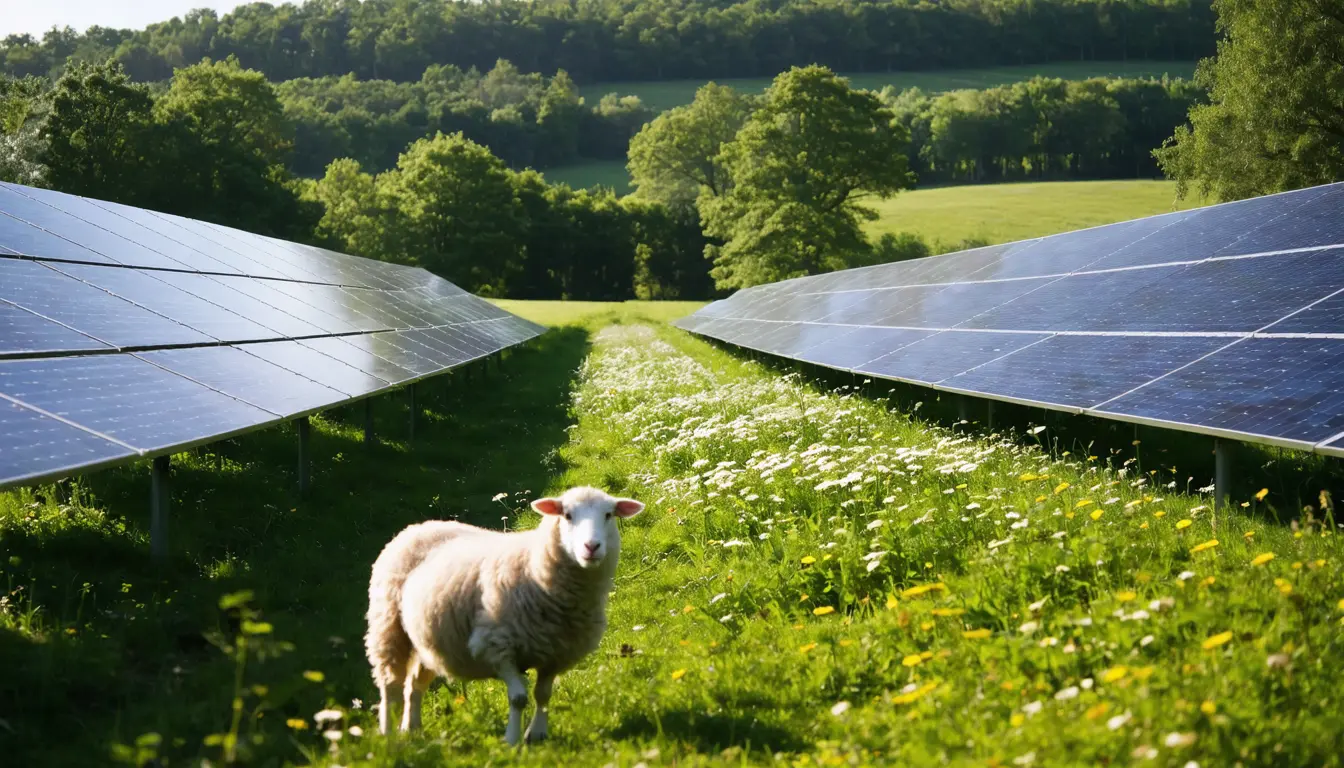
Key figures: an 83% increase in honey bees drove the insect gain; at eight sheep per hectare, honey bee abundance dropped by 45%; at two sheep per hectare, wild bees, honey bees and lady beetles rose 38% compared with a mowed control plot.
| Figure | Value | Note | Claim |
|---|---|---|---|
| Honey bee increase that drove the insect gain | 83% increase | 2 | |
| Honey bees, 8 sheep/ha | 45% drop | 6 | |
| Insects at 2 sheep/ha | 38% vs mowed plot | 1 |
What happened
- At four sheep per hectare, vegetation management was more effective than at two, while insect abundance was similar to the mowed control.
- At eight sheep per hectare, vegetation management was maximized and flock health stayed high, but honey bee abundance dropped by 45%.
- A separate Cornell team published "Flock Management for Solar Grazing" on Sept. 28 in Manufacturing & Service Operations Management, describing a spreadsheet-based model.
Why it matters
- constraint Among the three stocking rates reported, the one that helped insects was the weakest on vegetation control, so a site cannot get both from these results.
- decision Stocking rate is the lever developers, municipalities and farmers can set, and the paper gives them insect and vegetation outcomes at 2, 4 and 8 sheep per hectare to weigh.
- exposure The result rests on one solar farm over three years, and the 38% leans on honey bees, so applying two sheep per hectare elsewhere is an extrapolation.
According to the paper, the combined 38% increase was driven primarily by an 83% increase in honey bees alone [2]. The comparison is a mowed control plot [1]. The team ran it for three years with Cornell's teaching sheep at the Cascadilla Community Solar Farm in Dryden, New York [4]. It is one site; the study does not show whether another farm would respond the same way.
The stocking-rate results are where the trade-off shows. Eight sheep per hectare is four times the density that raised insect counts [13]. At that density vegetation management was maximized and flock health stayed high, but honey bee abundance dropped by 45% [6]. At four sheep per hectare, insect abundance was similar to the mowed control, and vegetation management was more effective than at two [5]. Of the three rates the summary reports, the one that helped insects was the weakest on vegetation. We think the paper's title, "Low solar-grazing densities support beneficial insects in agrivoltaic systems" [3], is the right summary, with the condition that "low" costs vegetation control.
Steve Grodsky, the paper's senior author, said the team chose stocking rate as its variable for a practical reason: "We zeroed in on stocking rates because that's a concrete number that sheep farmers understand and work with every day, and we want this research to be useful." [7]
The second paper comes from another Cornell team, based in the College of Business, and not from the group that ran the insect study [12]. Its authors built a spreadsheet-based model [9], described in "Flock Management for Solar Grazing," published Sept. 28 in Manufacturing & Service Operations Management [8]. The tool is meant to help farmers whose sheep graze in solar arrays make better decisions about their operation, including how to profitably grow their herds [10]. First author Vincent Slaugh started on the problem after meeting Caleb Scott by chance; Scott raises sheep in Ithaca and founded United Agrivoltaics [11].
The two papers share a topic and a release date. The published descriptions include no plot counts for the insect study and no account of the model's inputs, or of whether it draws on the insect results. A farmer who wants a herd sized for both bees and margin would, on this evidence, be joining two separate analyses.
What to watch
- Replication of the two-sheep-per-hectare result at other solar sites with different vegetation and surroundings.
- A breakdown of the 38% into wild bees, honey bees and lady beetles, since honey bees drove most of it.
- Whether the Flock Management for Solar Grazing model is extended to include insect outcomes alongside herd economics.
Clarity's read
What the record supports and how the coverage leans. The claims behind it follow.
Reality
- Evidence55
- Adoption10
- Hype gap+10
- Incentives
- Insufficient
- Confidence60
Claim ledger
Ranked by verification strength, evidence, and original report placement.
- [1]
When two sheep per hectare grazed around solar arrays, the abundance of wild bees, honey bees and lady beetles jumped by 38% compared with a mowed control plot.
- [2]
The increase was driven primarily by an 83% increase in honey bees alone, according to the team's findings.
- [3]
The paper, "Low solar-grazing densities support beneficial insects in agrivoltaic systems," was published Oct. 7 in Environmental Research Letters.
- [4]
For three years the team tested various stocking rates using Cornell's teaching sheep at the university-owned Cascadilla Community Solar Farm in Dryden, New York.
- [5]
At four sheep per hectare, beneficial insect abundance was similar to the mowed control site, while vegetation management effectiveness was greater than at two sheep per hectare.
- [6]
At eight sheep per hectare, vegetation management was maximized and sheep flock health remained high, but honey bee abundance dropped by 45%.
- [7]
"We zeroed in on stocking rates because that's a concrete number that sheep farmers understand and work with every day, and we want this research to be useful," said Steve Grodsky.
- [8]
A second Cornell team described its tool in "Flock Management for Solar Grazing," published Sept. 28 in Manufacturing & Service Operations Management.
- [9]
Vincent Slaugh, Linwei Xin and Shane Henderson together developed a spreadsheet-based model.
- [10]
The tool helps farmers whose sheep graze in solar arrays make better decisions about their operation, and is described as a decision-making support tool to help farmers profitably grow their solar grazing herds.
- [11]
After a chance encounter with Caleb Scott, an Ithaca-based sheep farmer and founder of United Agrivoltaics, Vincent Slaugh, first author of the paper, began thinking through the economics and logistics of solar grazing.
- [12]
The tool was developed by another Cornell research team, from the Cornell SC Johnson College of Business, separate from the CALS team that ran the insect study.
- [13]
Eight sheep per hectare is four times the two sheep per hectare density that raised insect abundance.
Get this ledger inside ChatGPT. Ask about any of our stories and the answer brings its figure, each claim’s verdict and the sources. Free, no account.
Sources
1 independent publisher whose own reporting we read for this story.
- phys.orgSheep grazing in solar fields offers farmers economic, ecological gains
1 article · October 14, 2026
Topics and entities
Follow any of these and your For You feed starts watching them — no settings page required.
Topics
Entities
- Cornell UniversityFollow
- Environmental Research LettersFollow
- United AgrivoltaicsFollow
- Steve GrodskyFollow