Science1 publisherNot yet confirmed elsewhere2 min readPublished
About 70% of gas restaurant kitchens in a US study topped the EPA's outdoor NO2 standard
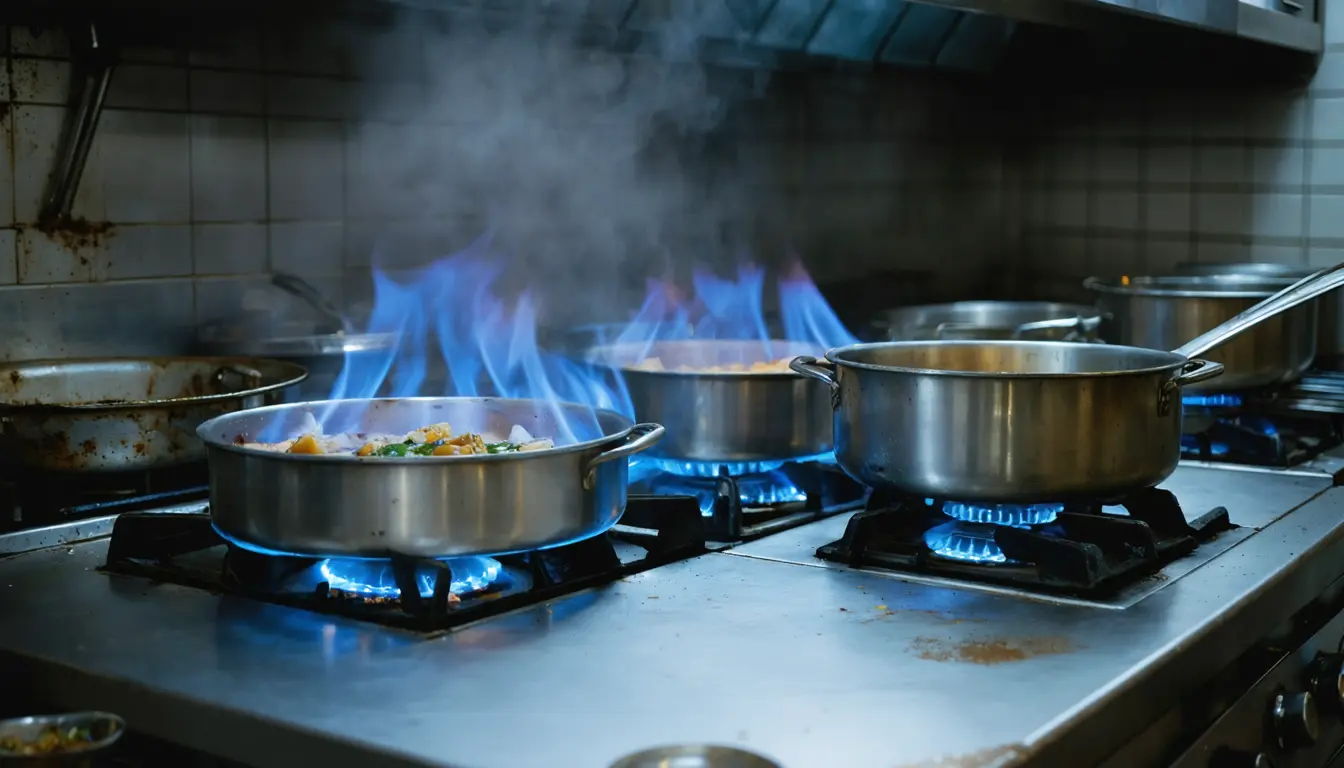
Researchers from PSE Healthy Energy, Stanford and NYU found NO2 above the EPA's outdoor one-hour limit in about 70% of gas restaurant kitchens they measured. The three all-electric kitchens stayed within every pollution guideline during cooking hours, so the choice of appliance also determines how much pollution kitchen workers breathe.
The Scientist · Science desk
What happened
- The team monitored 21 gas, three propane and three all-electric commercial kitchens in California, Pennsylvania and New York, during service and overnight.
- Benzene, a known human carcinogen, topped California's one-hour exposure guideline in five gas kitchens, and carbon monoxide did so in three.
- About 71% of gas kitchens monitored overnight had higher NO2, carbon monoxide, carbon dioxide, methane and benzene after closing than during service.
- The US restaurant and food industry employs an estimated 15.7 million people, about 5 million of whom spend all their working hours in the kitchen.
Compiled by The ScientistSomething wrong?How this is made
Why it matters
- decision Restaurant operators choosing a new cooking line now have measured evidence that the fuel affects the air their staff breathe, which they can weigh alongside energy and equipment costs.
- exposure Cleaning crews and early-arriving staff work in a closed, unventilated kitchen while pilot lights burn, so air checks taken only during service would miss them.
- constraint Any attempt to regulate kitchen NO2 as a workplace hazard first has to decide whether the outdoor standard or NIOSH's much higher short-term limit applies.
The researchers report the 70% figure against the EPA's one-hour standard for outdoor air, which is 100 ppbv [3]. The workplace benchmark is NIOSH's recommended short-term limit of 1,000 ppbv averaged over 15 minutes [11]. That is ten times higher [20]. Only one kitchen crossed it [11]. So most of the case for treating kitchen NO2 as an occupational hazard rests on an outdoor-air standard, for a pollutant associated with a higher risk of asthma [3].
The study is described as the first US analysis to compare gas and all-electric commercial kitchens under real-world working conditions [6]. It is observational, and its comparison group is small. Of the 27 kitchens [21], three were all-electric [8]. That is enough to show that gas and propane kitchens can exceed health guidelines during an ordinary service. It is too few to say how much of the gap comes from the fuel and how much from other differences between restaurants, such as ventilation, size and menu. Rob Jackson, a Stanford co-author, stated the comparison directly. "All-electric kitchens emitted none of the pollution we saw in kitchens burning gas," he said [4].
I think the overnight readings are the strongest evidence in the paper, because nothing was being cooked. After closing, ventilation was off and the pilot lights stayed lit [15]. Seven kitchens exceeded the 100 ppbv NO2 standard during off-work hours, and none of the all-electric kitchens crossed a pollutant threshold overnight [16]. "Some of the highest indoor pollution levels we measured came when no one was cooking at all," said Drew Michanowicz, a principal scientist at PSE Healthy Energy and a co-author [17]. He added: "Overnight, continuously burning pilot lights and shut-off ventilation pushed levels above what we saw during service in some restaurants." [18]
The thing this doesn't tell you is whether anyone got sick. The team logged NO2, benzene, carbon monoxide, carbon dioxide, methane and air temperature in the areas where employees work [7]. The results are exposures compared with guidelines. "Very few studies have measured what cooks and chefs breathe during a normal shift," said lead author Yannai Kashtan, an air quality scientist at PSE Healthy Energy [10]. Heat is part of the study's headline finding [19], and Kashtan said that "the all-electric kitchens ran cooler and cleaner than those using gas or propane appliances." [1]
The work is part of PSE Healthy Energy's Methane + Health Initiative [14]. Jackson is faculty director of Electrification for Health, a Stanford program that works on clean electric systems to reduce air pollution [13]. The paper is peer-reviewed and appeared in Environmental Research Letters [5].
What to watch
- Whether occupational regulators set indoor NO2 or benzene limits for commercial kitchens, and which benchmark they choose.
- A larger sample of all-electric kitchens, matched to gas kitchens on ventilation and size, to test whether the gap holds.
- The heat data in the full paper, showing how far kitchen temperatures went above health guidelines.