Finger coral from cooler Ulupau withstood more lab heat than Kaneohe finger coral or either bay's rice coral
Two Hawaiian reef corals both showed lab bleaching thresholds above NOAA's 4-degree-heating-week level, Florida Atlantic University researchers report. A tolerance score from one coral population cannot be assumed to hold for another species or bay.
The Scientist · Science desk
What happened
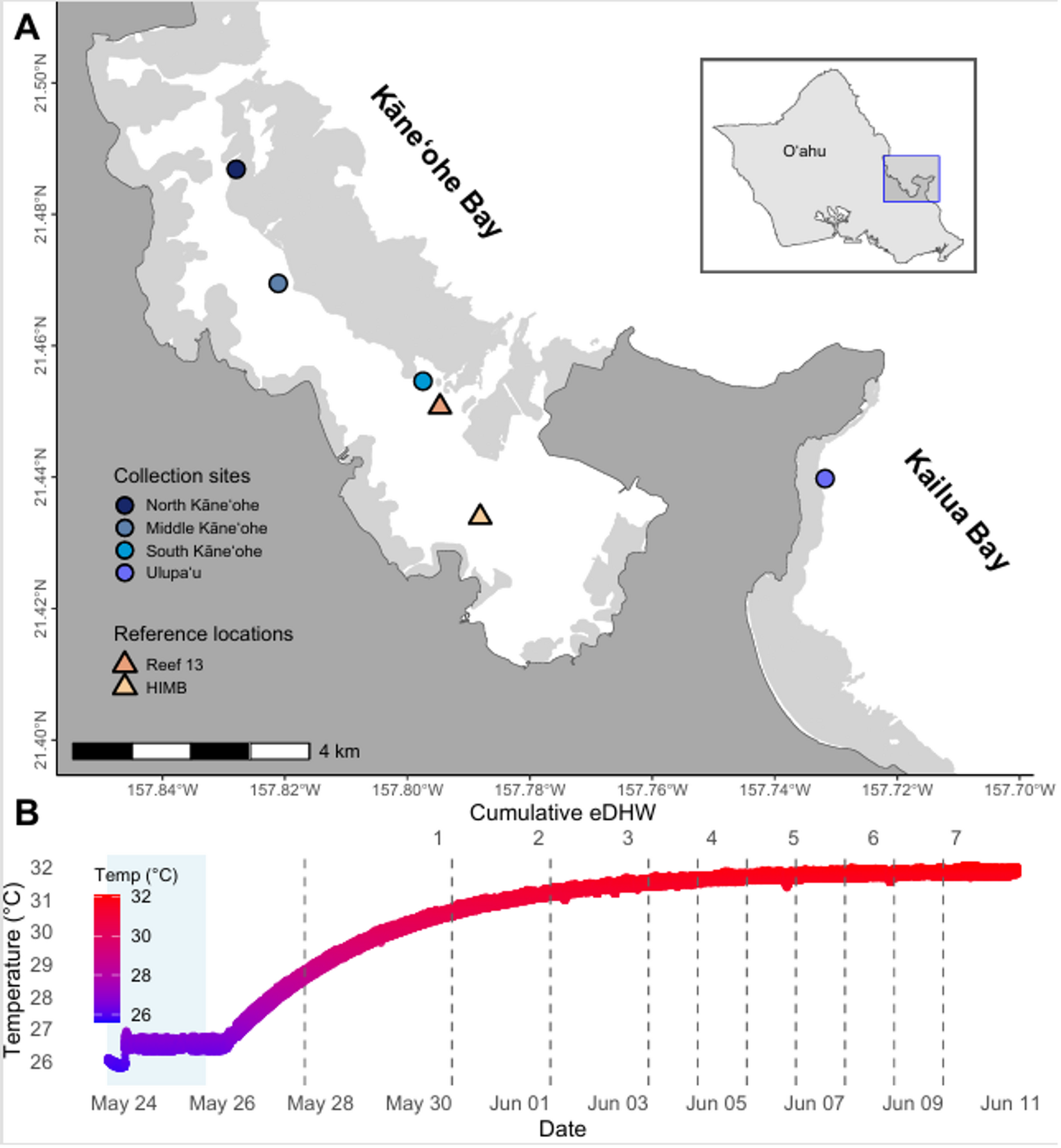
- Fragments of both corals were collected in Kaneohe Bay and Kailua Bay and exposed to controlled thermal stress in the laboratory.
- Photosynthetic efficiency, measured by pulse amplitude modulation fluorometry, was the indicator of each fragment's physiological response to warming.
- Finger coral also bleached more slowly than rice coral, and the researchers suggest the species rely on distinct physiological strategies.
Why it matters
- constraint Monitoring or restoration that samples a single species at a single site will misjudge the other species, because a site effect appeared in finger coral and not in rice coral.
- decision Anyone choosing source colonies for restoration has to ask species by species whether the collection site matters, since it did for finger coral here.
- constraint The cool-site advantage cannot yet be pinned on Ulupau's variable conditions, and predicting which other sites would yield tolerant finger coral depends on knowing that.
The design gives four groups to compare: two species from two sites [15], each put through the same controlled laboratory stress [2]. Identical stress for every fragment keeps field conditions out of the comparison. Allison M. Klein, first author and a postdoctoral fellow at FAU Harbor Branch, said: "By exposing corals from distinct environmental histories to a standardized thermal stress experiment, we were able to directly compare differences in thermal tolerance across species and populations." [10]
Kaneohe Bay is the warmer, more sheltered of the two sites and Kailua Bay the cooler, more exposed [14]. One of the four groups stood out [15][5], and the authors say the differences were not simply a matter of one bay producing universally tougher corals [11]. Within Kaneohe Bay the two species had similar thermal thresholds [12]. Despite its warmer home, Kaneohe finger coral scored below its Ulupau counterpart in this test and level with rice coral [5][12].
The researchers offer a hypothesis for the Ulupau result. Its cooler, more variable and wave-exposed environment may give repeated exposure to changing conditions that helps prepare some corals for heat stress, but the study did not directly test the underlying mechanisms [13].
Joshua D. Voss, senior author and a research professor at FAU Harbor Branch, said: "Our findings highlight that coral resilience to ocean warming is not uniform, even among species living in close geographic proximity." [8] He added: "What works for one species or population may not work for another, so conservation strategies need to account for both the biological and the environmental diversity that exists within coral reef ecosystems." [9]
The study did not test corals on a reef during a real heatwave. The assay is photosynthetic efficiency in fragments under laboratory stress [3]. The summary says the gap was significant, but gives neither how many colonies were tested nor how large the gap was [5]. Both species cleared the 4-degree-heating-week mark, which NOAA uses as an indicator of accumulated heat stress associated with the onset of significant bleaching [4].
What to watch
- Field data on whether laboratory thresholds like these track actual bleaching and survival on Hawaiian reefs during marine heat events.
- A test of the mechanism: whether repeated exposure to variable, wave-exposed conditions produces the Ulupau finger coral advantage.
- The same two-species, two-site comparison repeated with more species or more sites, to see how often a home-site effect appears.
Clarity's read
What the record supports and how the coverage leans. The claims behind it follow.
Reality
- Evidence58
- Adoption
- Insufficient
- Hype gap+10
- Incentives
- Insufficient
- Confidence60
Claim ledger
Ranked by verification strength, evidence, and original report placement.
- [1]
A Florida Atlantic University Harbor Branch Oceanographic Institute study, in collaboration with the University of Hawaii, compared the thermal tolerance of two abundant reef-building corals: Montipora capitata (rice coral) and Porites compressa (finger coral).
- [2]
Coral fragments from both species were collected in Kaneohe Bay and Kailua Bay and exposed to controlled thermal stress in the laboratory.
- [3]
Researchers used pulse amplitude modulation fluorometry to measure photosynthetic efficiency as an indicator of physiological response to warming.
- [4]
In the study published in Scientific Reports, both species showed substantial thermal tolerance, with bleaching thresholds above the 4-degree heating week level that NOAA uses as an indicator of accumulated heat stress associated with the onset of significant coral bleaching.
- [5]
P. compressa from the cooler, more exposed waters of Ulupau had significantly higher thermal tolerance than P. compressa from warmer, more sheltered Kaneohe Bay and than M. capitata from either location.
- [6]
For M. capitata, thermal tolerance was remarkably similar between the two bays.
- [7]
The researchers found that P. compressa bleached more slowly than M. capitata, suggesting that different coral species may rely on distinct physiological strategies to cope with warming.
- [8]
"Our findings highlight that coral resilience to ocean warming is not uniform, even among species living in close geographic proximity."
- [9]
"What works for one species or population may not work for another, so conservation strategies need to account for both the biological and the environmental diversity that exists within coral reef ecosystems."
- [10]
"By exposing corals from distinct environmental histories to a standardized thermal stress experiment, we were able to directly compare differences in thermal tolerance across species and populations."
- [11]
The researchers found that the differences were not simply a matter of one bay producing universally tougher corals.
- [12]
Within Kaneohe Bay, the two species had similar thermal thresholds, while at Ulupau, P. compressa had a clear advantage.
- [13]
Ulupau's cooler, more variable and wave-exposed environment may provide repeated exposure to changing conditions that helps prepare some corals for heat stress, although the study did not directly test the underlying mechanisms.
- [14]
Kaneohe Bay is warmer and more sheltered, and Kailua Bay is cooler and more exposed.
- [15]
The comparison had four species-by-site groups.
Sources
1 independent publisher whose own reporting we read for this story.
- phys.orgHawaiian coral tests reveal heat tolerance varies by species and location
1 article · October 13, 2026
Topics and entities
Follow any of these and your For You feed starts watching them — no settings page required.
Entities
- Montipora capitataFollow
- Porites compressaFollow
- University of HawaiiFollow
- Scientific ReportsFollow
- NOAAFollow
- Joshua D. VossFollow
- Florida Atlantic University Harbor Branch Oceanographic InstituteFollow