Science1 publisherNot yet confirmed elsewhere2 min readPublished
Dried teaching specimen in Tübingen turns out to be a new giant isopod species
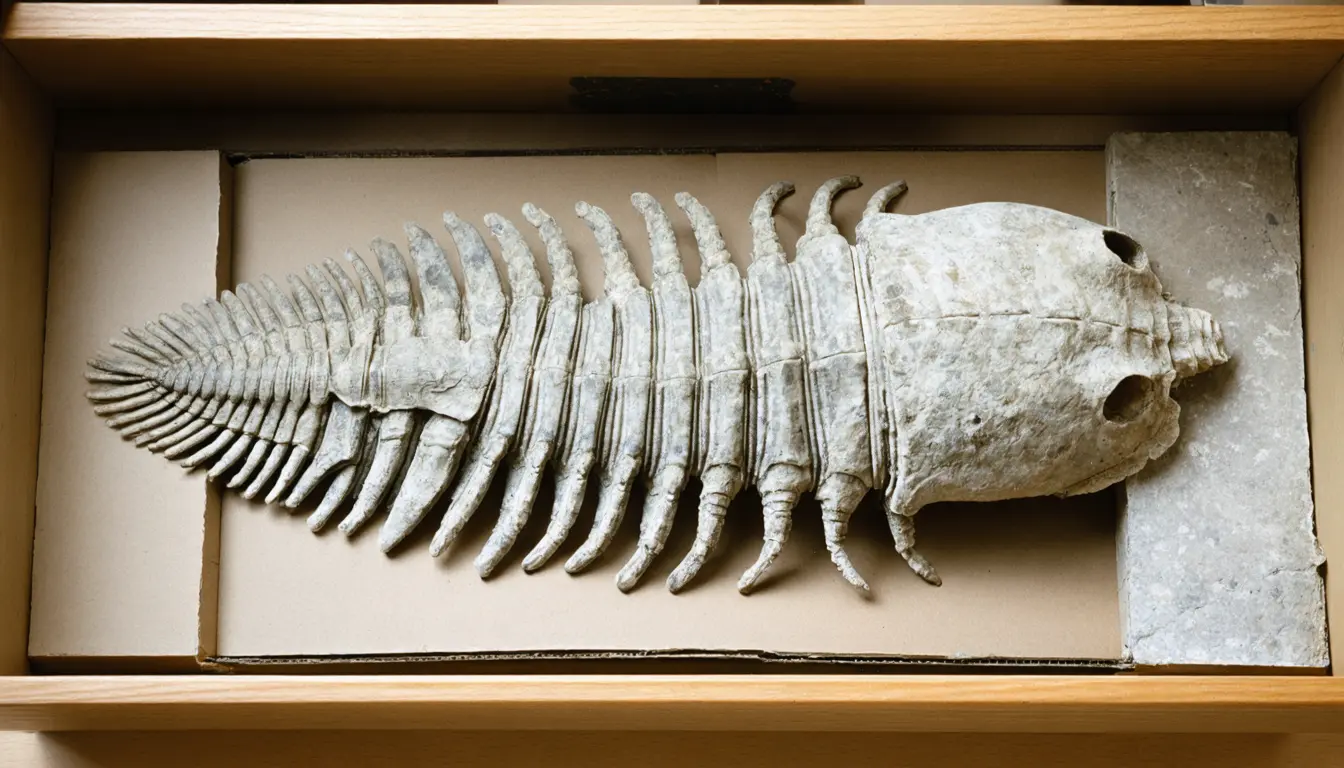
Tübingen researchers named Bathynomus tuebingoborikensis, a giant isopod kept unrecognized in their university's paleontology collection since the 1980s. Working from that one dried animal, the team traces the genus to the Miocene Gulf of Mexico more than 15 million years ago.
The Scientist · Science desk
What happened
- The late paleontologist Dolf Seilacher acquired the animal at a research station in Puerto Rico and brought it to Tübingen as teaching material.
- Student Benedikt Kästle and curator Ingmar Werneburg imaged the specimen and compared its anatomy with giant isopods from around the world.
- The species name, published in Scientific Reports, combines Tübingen with Boríken, the Indigenous Taíno name for Puerto Rico.
- Bathynomus isopods live in every ocean at depths down to 2,500 meters and can reach 50 centimeters and several kilograms.
Compiled by The ScientistSomething wrong?How this is made
Why it matters
- capability The reconstruction attaches places and dates to each step of the genus's spread, so a fossil or specimen turning up in the wrong place or time could falsify specific parts of it.
- precedent Unstudied teaching specimens of living animals, including those kept in paleontology collections, now have a documented case for taxonomic review, though one find sets no rate.
- constraint Any later work that borrows the 15-million-year Gulf of Mexico origin inherits the authors' own 'likely' and a tree built from anatomical comparison.
At 32.2 centimeters, Kästle said, the specimen "falls into the category of 'colossogiants'" [14]. The label comes from the team's size classes. Kästle said the genus's spread through the Indian and Pacific oceans "gave rise to the so-called 'giant' isopods that are up to 15 centimeters (5.9 inches) long, and the 'supergiants' with a body length of more than 15 centimeters (5.9 inches)" [10]. A later Indo-Pacific group, Werneburg said, "grew to more than 25.2 centimeters (9.9 inches) in length" [12]. The Puerto Rico animal is 7 centimeters past that threshold [17].
The authors expect the description to help scientists understand the evolution of all deep-sea isopods [20]. Their phylogenetic analysis gives the Gulf of Mexico origin as likely [8]. "At that time, the Isthmus of Panama was open, leaving a strait between North and South America, and the marine animals were able to spread westward, initially as far as Japan," Werneburg said [9]. After diversifying in the Indian and Pacific oceans, the isopods reached Australia, East Africa and, before the Arabian and African plates collided, Europe, where they died out at the end of the Miocene [11]. The colossi evolved in the Indo-Pacific as Earth cooled at the Miocene-Pliocene boundary, 5.333 million years ago [12]. In the team's account they later spread from Australia via Antarctica to South and Central America, meeting smaller relatives left behind by the first westward expansion [13].
On that reconstruction, the Caribbean animal belongs to a group whose ancestors left the Americas heading west and whose descendants came back from the south [18]. The team describes the new species as "very closely related to another giant species found off the Yucatán Peninsula in Mexico" [15].
The gap between the animal's arrival in Tübingen in the 1980s and the 2026 paper is 37 to 46 years [19]. Seilacher, who brought it in, died in 2014 [6]. Werneburg argues the find shows the importance of natural history collections as global archives of nature [16]. As evidence about museum backlogs, it is a single case, and a single case cannot say how often teaching drawers hold new species.
The species itself rests on one dried animal [7]. The press account does not say how many species went into the tree or whether any genetic data were used. One individual cannot show how much a species varies from animal to animal. That variation is what decides how cleanly the Puerto Rico form separates from its Yucatán relative. In my view the name stands on the published anatomy, and the genus-wide route is a dated hypothesis that more specimens, from Puerto Rico and off Yucatán, can test.
What to watch
- Further Bathynomus specimens from Puerto Rican waters that would show how much the new species varies and how sharply it differs from the Yucatán relative.
- Genetic data from fresh giant isopods that could test the anatomy-based tree and its Gulf of Mexico origin.
- Re-examination of other teaching specimens of living animals held in paleontology collections.
Clarity's read
What the record supports and how the coverage leans. The claims behind it follow.
Reality
- Evidence45
- Adoption
- Insufficient
- Hype gap+10
- Incentives
- Insufficient
- Confidence55
Claim ledger
Ranked by verification strength, evidence, and original report placement.
- [1]
A giant isopod from Puerto Rico, rediscovered in the depository of the University of Tübingen's Paleontological Collection, turned out to be a previously unknown species.
- [2]
The discoverers are paleontology student and isopod expert Benedikt Kästle and the collection's curator, Dr. Ingmar Werneburg of the Senckenberg Center for Human Evolution and Palaeoenvironment at the University of Tübingen.
- [3]
The species was named Bathynomus tuebingoborikensis after the university town of Tübingen and Boríken, the Indigenous Taíno name for Puerto Rico.
- [4]
The study was published in the journal Scientific Reports in 2026.
- [5]
Giant isopods of the genus Bathynomus are found in all of the world's oceans, can grow up to 50 centimeters long and weigh several kilograms, and live as omnivores at depths as great as 2,500 meters.
- [6]
The specimen, of a species still living today, was acquired in the 1980s by Tübingen paleontologist Dolf Seilacher (1925-2014) at a research station in Puerto Rico and brought to Tübingen for educational purposes.
- [7]
Kästle and Werneburg examined the dried specimen using state-of-the-art imaging techniques, identified it as a new species and compared its anatomy to that of other giant isopods around the world.
- [8]
A phylogenetic analysis found that the entire Bathynomus genus likely originated in what is now the Gulf of Mexico during the Miocene, more than 15 million years ago.
- [9]
"At that time, the Isthmus of Panama was open, leaving a strait between North and South America, and the marine animals were able to spread westward, initially as far as Japan,"
- [10]
"This gave rise to the so-called 'giant' isopods that are up to 15 centimeters (5.9 inches) long, and the 'supergiants' with a body length of more than 15 centimeters (5.9 inches)," (following diversification in the Indian and Pacific oceans)
- [11]
Having diversified in the Indian and Pacific oceans, giant isopods spread to Australia, East Africa and, before the collision of the Arabian and African plates, Europe, where they became extinct at the end of the Miocene.
- [12]
As Earth cooled at the Miocene-Pliocene boundary 5.333 million years ago, a unique group evolved in the Indo-Pacific: "These veritable colossi grew to more than 25.2 centimeters (9.9 inches) in length and were physiologically perfectly adapted to the new climatic conditions."
- [13]
The researchers say these creatures spread from Australia via Antarctica to South and Central America, where they encountered smaller, more distant relatives that had remained behind after the genus's initial westward expansion.
- [14]
"Our Tübingen specimen from Puerto Rico, measuring 32.2 centimeters (12.7 inches) in length, falls into the category of 'colossogiants',"
- [15]
"The new species is very closely related to another giant species found off the Yucatán Peninsula in Mexico."
ReportedSupportedSource: Quoted in phys.org account from the researchers; speaker not separately identifiedView cited source - [16]
Werneburg points out that the discovery underscores the great importance of natural history collections as global archives of nature.
- [17]
The specimen's 32.2 cm length exceeds the 25.2 cm figure given for the colossi by 7 cm.
- [18]
On the authors' reconstruction, the Puerto Rico colossogiant belongs to a group whose ancestors spread westward from the Gulf of Mexico region, evolved in the Indo-Pacific, and re-entered the Americas via Antarctica.
- [19]
Between the specimen's acquisition in the 1980s and its description in 2026, 37 to 46 years passed.
- [20]
The study and description of the new species are expected to help scientists understand the evolution of all deep-sea isopods.
Sources
1 independent publisher whose own reporting we read for this story.
- phys.orgPuerto Rico specimen reveals new giant isopod species that went unrecognized for decades
1 article · October 8, 2026
Topics and entities
Follow any of these and your For You feed starts watching them — no settings page required.
Topics
- TaxonomyFollow
- Deep-sea biologyFollow
- Natural History Collections and Holotype CustodyFollow
- Evolutionary BiologyFollow
Entities
- Bathynomus tuebingoborikensisFollow
- BathynomusFollow
- University of TübingenFollow
- Senckenberg Center for Human Evolution and PalaeoenvironmentFollow
- Ingmar WerneburgFollow
- Benedikt KästleFollow
- Dolf SeilacherFollow
- Scientific ReportsFollow