A single CD19 CAR-T infusion held three of six refractory rheumatoid arthritis patients drug-free
The Berlin phase 1 trial was built to measure cytokine release syndrome rather than remission, and its six-patient denominator carries no comparator, so the ten-patient second phase against an approved B-cell drug is the one that settles anything.
The Scientist · Science desk
What happened
- Six patients with severe rheumatoid arthritis were treated with a CD19 CAR T-cell therapy at Charite-Universitaetsmedizin Berlin, in what the publisher describes as the first clinical trial of the approach in the disease.
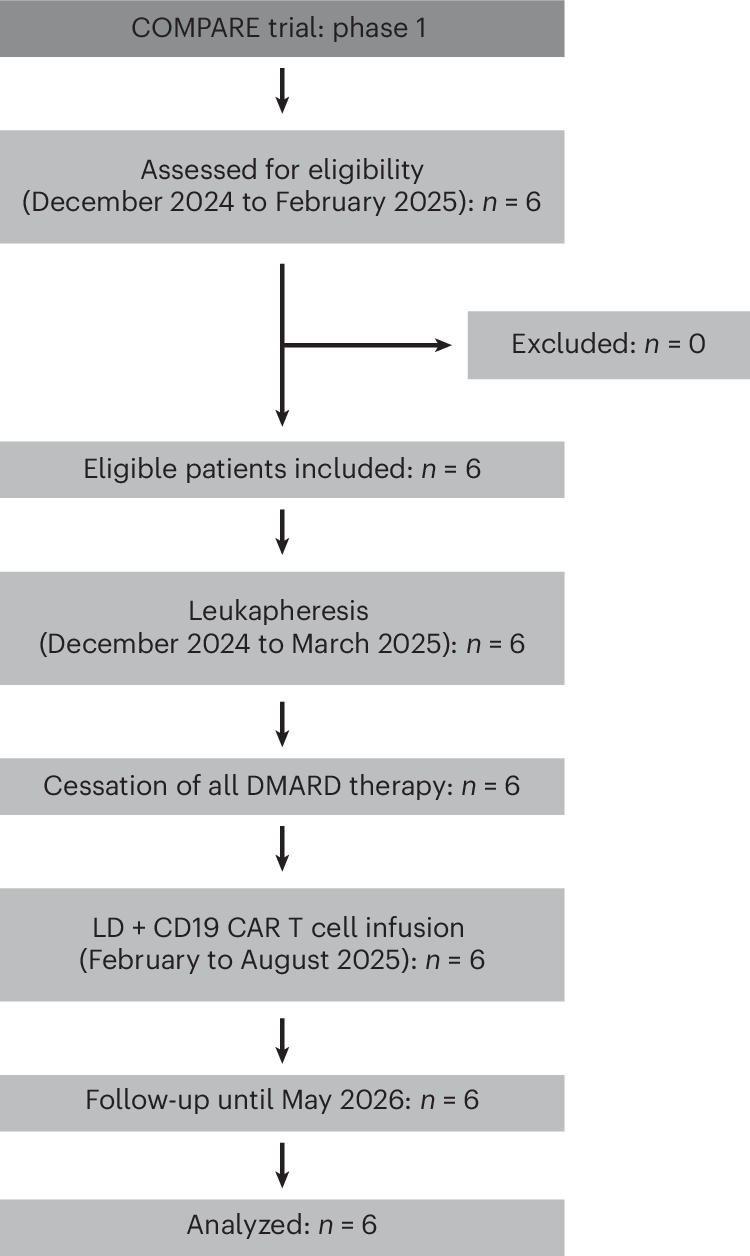
- The three women and three men, aged 31 to 69, had already been through up to eight targeted or biologic therapies over ten years without adequate benefit.
- Disease activity fell markedly in all six after one infusion, and three were in sustained remission on no rheumatoid arthritis medication at all through follow-up of up to a year.
Why it matters
- constraint Delivering this outside a trial means a rheumatology service acquiring apheresis, per-patient manufacturing, lymphodepletion and CRS surveillance, none of which lives in an outpatient joint clinic.
- decision Anyone budgeting for autoimmune cell therapy is deciding on secondary endpoints from six uncontrolled patients, which argues for waiting on the comparator phase rather than building capacity now.
- exposure The patients carrying the risk are the ones taken off all their drugs and lymphodepleted before infusion, with no long-term experience to tell their clinicians what happens if the reset fails.
- capability If the mechanism holds, refractory seropositive patients gain a one-time option aimed at ending inflammation rather than a lifelong regimen aimed at holding it down.
The trial is testing whether CD19 CAR-T cells can rebuild the B-cell system, not just suppress it more strongly. The Charite group's argument is that CD19 CAR-T cells can hit the B cells keeping the disease persistent, clear the pathological B-cell memory, and let the B-cell system start fresh [21]. The corroborating measurement is the sharp decline in the autoantibodies characteristic of RA after infusion [11], which is what you would expect if the compartment producing them had been emptied. But that decline shows depletion, not durability: a titre can fall and the memory that regenerates it can come back.
Six is the denominator. The endpoint structure matters more than the remission count. The primary endpoints were the incidence and severity of cytokine release syndrome, ICANS and adverse events in the first four weeks [10], which makes every efficacy figure in this trial a secondary or exploratory reading [19]. There was no comparator arm; comparison arrives only in the second phase [20]. Three of six, half the cohort, were off all RA medication at last follow-up [6][15]. Read alongside the single patient whose disease returned after an initial medication-free period [13], that implies at least four of the six reached a drug-free interval and one did not keep it [17]. Follow-up ran 36 to 52 weeks [5], roughly eight months to a year [16], against a disease that otherwise requires lifelong medication [9].
The second phase is the more informative experiment. Ten additional patients, and the comparator is a drug already approved for RA that also depletes B cells [14]. That controls the obvious confound, because anything that removes B cells will help RA for a while; the live question is whether a one-time reset beats continuing depletion on depth and duration, which is precisely what the investigators say they are testing [14]. Sixteen patients across both phases [18] are enough to test whether "reset" is a mechanism or a label, not enough to tell anyone who should get this.
What rheumatology would inherit, if the effect holds up, is an oncology workflow. The product is autologous [3], so every dose is a manufacturing run for one person. Patients stopped all disease-modifying antirheumatic drugs and received standard lymphodepletion before the infusion [5]. All six developed CRS, temporary and mild to moderate, reported as readily manageable, with no severe neurological complications and rare infections [12]. That record was produced at Charite's Hematology Early Clinical Trial Unit, whose medical director, Marie Luise Huetter-Kroenke, described it [12]. How a unit that sees this kind of CRS only a few times a year, rather than most weeks, would manage it is a separate question this record cannot answer. The washout carries its own exposure: a patient off all DMARDs and through lymphodepletion needs somewhere to go if the reset does not take, and there is no long-term experience with this therapy to draw on [5][7].
Gerhard Kroenke, who leads the joint clinical rheumatology group at Charite and the German Rheumatology Research Center [8], keeps the framing narrow, and it is worth keeping it there: selected patients who have not responded adequately to existing treatment, in whom it may in future be possible to reset immune memory rather than suppress inflammation continuously [22].
What to watch
- Whether the ten-patient second phase separates CAR-T from an approved B-cell drug on depth or on duration of response, or on neither.
- Whether autoantibody titres and B-cell counts rebound before clinical relapse, which would give rheumatologists a monitoring signal instead of a surprise.
- Whether any centre infuses outside a hematology early-phase unit, the first real test of whether this pathway travels.
Clarity's read
What the record supports and how the coverage leans. The claims behind it follow.
Reality
- Evidence35
- Adoption
- Insufficient
- Hype gap+30
- Incentives40
- Confidence60
Claim ledger
Ranked by verification strength, evidence, and original report placement.
- [1]
Six patients with severe rheumatoid arthritis received CD19 CAR T-cell therapy at Charite-Universitaetsmedizin Berlin, described by the publisher as the world's first clinical trial of the approach in RA.
- [2]
The work is published in Nature Medicine as "CD19 CAR-T cell therapy for treatment-refractory seropositive rheumatoid arthritis: a Phase 1 trial."
- [3]
The COMPARE study evaluates the safety and efficacy of mivocabtagene autoleucel (miv-cel), an autologous fully human CD19 CAR T cell therapy, in rheumatoid arthritis.
- [4]
The cohort was three women and three men aged 31 to 69 who had received up to eight targeted or biologic therapies over the previous ten years, none of which was sufficiently effective.
- [5]
All six patients had treatment-refractory, anti-citrullinated protein antibody (ACPA)-positive RA and were followed for 36 to 52 weeks after a single infusion of miv-cel, given after stopping all disease-modifying antirheumatic drug treatment and after standard lymphodepletion therapy.
- [6]
Gerhard Kroenke reports that disease activity decreased markedly in all six patients and that during follow-up of up to one year, three patients were in sustained remission without any medication for rheumatoid arthritis.
- [7]
CAR T-cell therapy for autoimmune disease, and for RA in particular, remains experimental, with no long-term experience yet available.
- [8]
Gerhard Kroenke, MD, leads the joint Clinical Rheumatology research group at Charite and the German Rheumatology Research Center (DRFZ), a Leibniz Institute.
- [9]
RA is a chronic disease of recurrent inflammation and joint swelling that can progress to joint damage, and patients require lifelong medication including anti-inflammatory and immunosuppressive drugs.
- [10]
The trial's primary endpoints were the incidence and severity of cytokine release syndrome (CRS), immune effector cell-associated neurotoxicity syndrome (ICANS) and adverse events within the first four weeks after treatment; secondary and explorative endpoints assessed clinical efficacy and cellular and humoral immune responses.
- [11]
The research team found that levels of the autoantibodies characteristic of RA had declined sharply.
- [12]
Marie Luise Huetter-Kroenke, medical director of the Hematology Early Clinical Trial Unit at Charite's Department of Hematology, Oncology and Cancer Immunology, said only temporary, mild-to-moderate CRS was observed in all participants and was readily manageable, with no severe neurological complications or other serious adverse events, and infections rare.
- [13]
Responses varied among patients: some did not achieve a complete response, and in one case the disease returned after an initial medication-free period of remission.
- [14]
In a second phase involving ten additional patients, the researchers will compare the new approach with a drug already approved for RA that also targets B cells, aiming to determine whether CAR T cells have a stronger and longer-lasting effect and whether they can reset immune memory.
- [15]
Three of six patients drug-free at last follow-up is half the cohort.
- [16]
A follow-up window of 36 to 52 weeks is roughly eight months to one year.
- [17]
At least four of the six patients reached a medication-free interval, since the three in sustained drug-free remission at the end of follow-up are separate from the one patient whose disease returned after an initial medication-free remission.
- [18]
Across both phases the trial will have enrolled 16 patients.
- [19]
Because the primary endpoints were safety measures within four weeks, every efficacy result in the phase 1 trial, including the drug-free remissions, comes from secondary or exploratory endpoints.
- [20]
The phase 1 trial had no comparator arm, since the comparison against an approved B-cell-targeting drug is introduced only in the second phase.
- [21]
The stated rationale is that CAR T cells could target the B cells that keep the disease persistent, reset the pathological B-cell memory, and give the B-cell system a fresh start.
- [22]
The researchers state that for selected RA patients who have not responded adequately to treatment, it may in future be possible to reset the pathological immune memory in a targeted way and stop persistent inflammation instead of suppressing it continuously with drugs.
Get this ledger inside ChatGPT. Ask about any of our stories and the answer brings its figure, each claim’s verdict and the sources. Free, no account.
Sources
2 independent publishers whose own reporting we read for this story.
- genengnews.comCAR T-Cell Therapy Puts Severe Rheumatoid Arthritis Into Remission in First Clinical Trial
1 article · August 28, 2026
- sciencedaily.comA cancer therapy put severe rheumatoid arthritis into remission
1 article · August 29, 2026
Topics and entities
Follow any of these and your For You feed starts watching them — no settings page required.
Topics
- Rheumatoid arthritisFollow
- Cell therapy for autoimmune diseaseFollow
- CAR-T cell therapyFollow