ScienceNot yet confirmed elsewhere1 publisher2 min readPublished
Bone, liver and blood-fat markers jump at menopause in lab records from over a million women
Weizmann Institute researchers analyzed more than 300 million lab tests from over a million women and report step-like shifts at menopause. In the Nature Medicine paper the largest changes sit in bone metabolism, liver tests and lipid handling.
The Scientist · Science desk
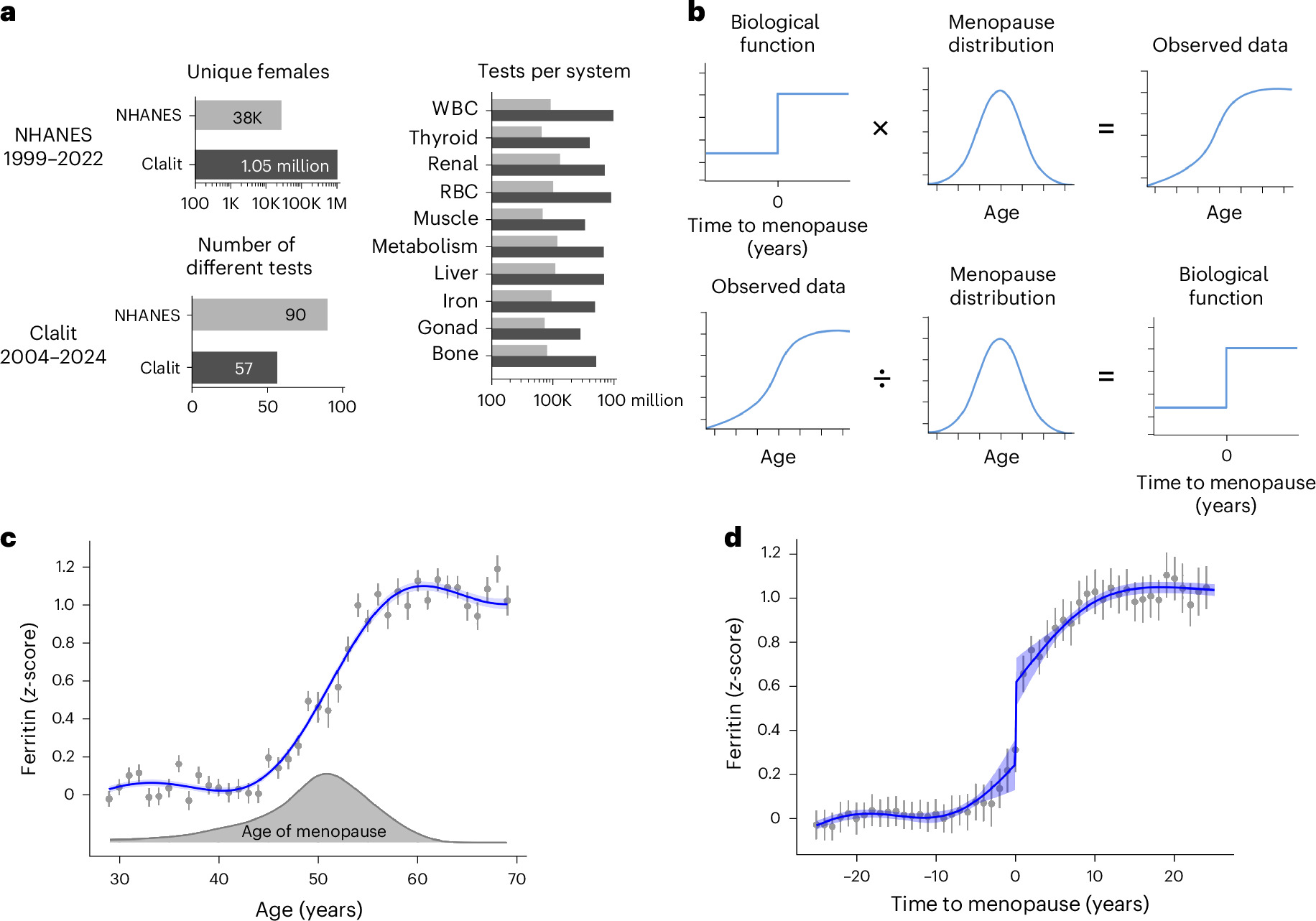
Key figures: 52 of 90 laboratory tests in the US dataset showed a statistically significant sudden change with menopause; AMH showed signs of decline around 15 years before the end of menstruation; the study uses more than 300 million lab tests.
| Figure | Value | Note | Claim |
|---|---|---|---|
| US lab tests with a sudden change at menopause | 52 of 90 tests | 2 | |
| AMH decline signs, around | 15 years before | 9 | |
| Lab tests, more than | 300,000,000 tests | 4 |
What happened
- Pridham's group ran a computational framework on two large cohorts, one in the United States and one in Israel, built to separate chronological age from reproductive timeline, a confound that has complicated earlier population-wide studies.
- Both cohorts showed what the authors call a step-like physiological cliff at the final menstrual period, across nearly all physiological systems.
- In the US dataset, 52 of the 90 laboratory tests showed a statistically significant and sudden change at menopause.
Why it matters
- constraint The study is observational, and Andrew Shelling of the University of Auckland, who was not involved, calls the results interesting but not conclusive.
- contradiction The paper's hormone timeline puts the first signals more than a decade before the final period: AMH and oestradiol fall about 15 and 12 years ahead and FSH rises about 14 years ahead. 'Abrupt' describes the lab markers at that point, not the run-up to it.
- capability Physiologist Mia Schaumberg, an outside commentator, says the hormone timing means systemic changes at menopause could be predicted much sooner than originally thought.
The paper takes on the assumption that menopause is a gradual part of aging [15]. To test that, the comparison group matters most. Anything driven by calendar age alone should turn up in men as well, and the authors report that it does not. In their words, "the cliff is a consequence of the menopausal transition rather than general aging" [7].
The pattern of which tests moved is a second check. In the US data 52 of the 90 tests changed significantly, which leaves 38 that did not [14]. Physiologist Mia Schaumberg of the University of the Sunshine Coast, who was not involved, said "The systems where the most significant changes were seen (e.g. bone health, or the liver) are very sensitive to estrogen, and systems that didn't show detectable changes have a much weaker known link to estrogen" [3].
The thing this doesn't tell you is how large the steps are. ScienceAlert's account of the paper gives the 52-of-90 count for the US cohort only and does not report an effect size for any test, or a test count for the Israeli cohort.
That gap matters because of the objection from Martha Hickey, a professor of obstetrics and gynecology at the University of Melbourne who was not involved. She said the cliff description is "potentially alarming for women and implies a dramatic physical and mental decline, which this study does not demonstrate" [8]. A statistically significant jump in a blood value is a statement about the blood value. Whether it carries a symptom or a loss of function is the step Hickey says the study does not take.
Other work reporting widespread changes at menopause has used a different frame: a sudden "career change" for the body and brain, in place of a "reproductive retirement" [13].
In our view the age-only explanation is hard to hold for the tests that moved, given the male comparison and the estrogen pattern. Andrew Shelling of the University of Auckland, who was not involved, said the study "opens a new way of thinking about menopause and provides a new framework for future research" [12].
What to watch
- Effect sizes for the 52 US tests and the matching test count from the Israeli cohort, which the coverage does not report.
- Longitudinal follow-up of individual women that could test the step against the observational design Shelling flags.
- Work linking any lab step to symptoms or function, the gap Hickey says the study leaves open.
Clarity's read
What the record supports and how the coverage leans. The claims behind it follow.
Reality
- Evidence62
- Adoption
- Insufficient
- Hype gap+25
- Incentives
- Insufficient
- Confidence45
Claim ledger
Ranked by verification strength, evidence, and original report placement.
- [1]
The changes are most pronounced in systems such as bone metabolism, liver tests, and lipid handling.
- [2]
In the US dataset, 52 of 90 laboratory tests showed a statistically significant and sudden change with menopause.
ReportedSupportedSource: ScienceAlert summary of the paper2 sources— create a free account to open themView cited source - [3]
Physiologist Mia Schaumberg of the University of the Sunshine Coast, who was not involved in the study, explains: "The systems where the most significant changes were seen (e.g. bone health, or the liver) are very sensitive to estrogen, and systems that didn't show detectable changes have a much weaker known link to estrogen."
ReportedSupportedSource: Mia Schaumberg, University of the Sunshine Coast, quoted by ScienceAlert2 sources— create a free account to open themView cited source - [4]
The study uses more than 300 million lab tests from over one million women.
- [5]
The authors are led by molecular cell biologist Glen Pridham of the Weizmann Institute of Science in Israel.
- [6]
Pridham and colleagues used a computational framework on two large cohorts of women, one in the United States and one in Israel; the method is designed to disentangle chronological age from reproductive timeline, which has previously complicated population-wide studies.
- [7]
"Notably," the authors add, "we find that male individuals lack these abrupt physiological shifts, suggesting that the cliff is a consequence of the menopausal transition rather than general aging."
- [8]
Martha Hickey, an obstetrics and gynecology professor at the University of Melbourne who was not involved in the study, says the cliff description is "potentially alarming for women and implies a dramatic physical and mental decline, which this study does not demonstrate."
ReportedSupportedSource: Martha Hickey, University of Melbourne, quoted by ScienceAlertView cited source - [9]
In the study, Anti-Mullerian hormone (AMH) and oestradiol show signs of decline around 15 and 12 years before the end of menstruation, and follicle-stimulating hormone (FSH) increases around 14 years before menopause.
- [10]
Schaumberg says the findings show that systemic changes experienced during menopause could be predicted by hormone changes much sooner than originally thought.
- [11]
The study is only observational, and health scientist Andrew Shelling of the University of Auckland, who was not involved, warns that the results are interesting but not conclusive.
- [12]
Shelling said: "The study opens a new way of thinking about menopause and provides a new framework for future research."
ReportedSupportedSource: Andrew Shelling, University of Auckland, quoted by ScienceAlertView cited source - [13]
Other studies showing widespread changes at menopause have reframed the transition not as a step down, like 'reproductive retirement', but as a sudden 'career change' for the body and brain.
- [14]
In the US dataset, 38 of the 90 laboratory tests did not show a statistically significant sudden change with menopause.
- [15]
The study, published in Nature Medicine, argues that the end of menstruation is an abrupt physiological transition, not a gradual part of aging as previously assumed.
ReportedContestedSource: ScienceAlert summary of the Nature Medicine paper2 sources— create a free account to open themView cited source - [16]
According to both cohorts, the final menstrual period is marked by a 'step-like physiological cliff' across nearly all physiological systems.
ReportedContestedSource: Authors, as relayed by ScienceAlert2 sources— create a free account to open themView cited source
Sources
1 independent publisher whose own reporting we read for this story.
- sciencealert.comBones, Liver, And Blood Fats All Shift Abruptly at Menopause, Huge Study Finds
1 article · October 12, 2026
Topics and entities
Follow any of these and your For You feed starts watching them — no settings page required.
Topics
- Menopause researchFollow
- Women's healthFollow