Science1 publisherNot yet confirmed elsewhere2 min readPublished
Oceanside teen with SCN2A epilepsy took his first unassisted steps after a drug made for his mutation
Connor Dalby, who had tried 12 or 13 anti-seizure drugs, took unassisted steps about four months after starting a drug built for his SCN2A mutation. His case, now in Nature Medicine, is a single patient, so how often made-to-order drugs like his work is still unknown.
The Scientist · Science desk
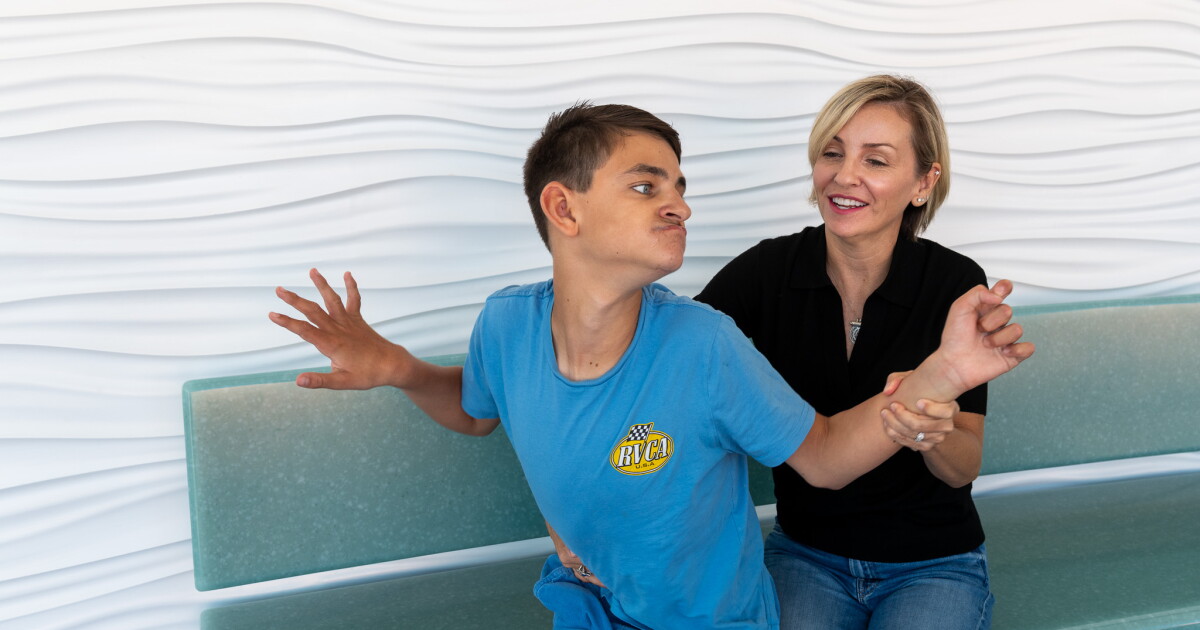
What happened
- Dalby was diagnosed at almost five with SCN2A-related developmental epileptic encephalopathy, a disorder that can also disrupt development, movement and communication.
- At 14 he still could not walk on his own, relied on a stroller or wheelchair, and had no genetic therapy available for his mutation.
- Neurologist Olivia Kim-McManus and her team worked with the nonprofit n-Lorem Foundation to create a treatment designed specifically for his mutation.
- He got the first dose at 14 through the spinal fluid at Rady Children's Hospital and has kept receiving doses of the still-investigational drug.
- His mother says he now walks about 50 or 60 steps alone, sleeps better, behaves better, and has 90 percent fewer seizures.
Compiled by The ScientistSomething wrong?How this is made
Why it matters
- constraint With one patient and no comparison group, the reported 90 percent seizure drop cannot yet be separated from three years of adolescence, so the paper's own measurements will count for more than a parent's account.
- cost Because the molecule was designed for one mutation, the design work has to be repeated for each new variant, and KPBS reported that wider use will need research and funding.
- precedent A nonprofit-designed drug for one child, dosed for years at a children's hospital and written up in Nature Medicine, gives families with untreated variants a published example to bring to their clinicians.
"He carries a more complex variant that requires an allele-selective approach because he has both seizures and autism," said Dr. Olivia Kim-McManus, the UC San Diego neurologist who treated Dalby at Rady Children's Hospital [5]. His particular variant, and the mix of symptoms it produces, set the terms for the drug. His mother, Kelly Del Real, said he was "the first human ever to be treated with this molecule" [15].
The denominator here is one patient, with no comparison group. In place of a control, a single case can offer a long, stable baseline. Dalby was diagnosed when he was almost five [1] and had his first dose at 14 [7], roughly nine years apart [16]. Over his life he tried 12 or 13 anti-seizure medications [3]. "And nothing really helped very much," Del Real said [3].
Against that record, the timing matters. "He started trying to take steps unassisted. So the first time in his entire life," Del Real said [8]. A change that arrives within months of a first dose, after years in which a dozen drugs did little, is harder to put down to ordinary development than a gradual improvement would be. Kim-McManus described the clinical impression. "It's hard to deny what we were seeing at the beginning," she said. "So that was very exciting and hopeful." [12]
The effect sizes need more care. The step count and the 90 percent seizure reduction come from his mother's account to KPBS [9]. The 50 to 100 seizures a day she described date from his early years [2], so the report does not specify the baseline that the 90 percent is measured against. The Nature Medicine paper documents his treatment and progress [11], and its measurements are the figures to set beside hers. A teenager also changes a lot between 14 and 17 for reasons unrelated to any drug. Dalby is now 17 [10], about three years past his first dose [17].
Scale is the open problem. A drug designed specifically for one mutation [6] does not automatically carry over to a different one. Kim-McManus said the question of whether doctors can build treatments for rare mutations with no existing therapy is still being worked out [13]. KPBS reported that bringing such medicines to more patients will require research and funding [14].
I think the case shows that a molecule can be designed for a variant no therapy addressed, given to the patient for years, and documented in a journal [4][7][11]. The thing it doesn't tell you is how often the next molecule, built for the next child's variant, will work as well.
What to watch
- The Nature Medicine paper's measured seizure and motor outcomes, set against the mother's 90 percent and 50-to-60-step figures.
- Whether n-Lorem and Rady Children's treat further SCN2A patients with allele-selective molecules, and whether the results hold across them.
- Whether Dalby's gains persist as he continues receiving doses of the investigational drug.
Clarity's read
What the record supports and how the coverage leans. The claims behind it follow.
Reality
- Evidence40
- Adoption3
- Hype gap+15
- Incentives
- Insufficient
- Confidence45
Claim ledger
Ranked by verification strength, evidence, and original report placement.
- [1]
Connor Dalby of Oceanside was diagnosed, when he was almost 5, with SCN2A-related developmental epileptic encephalopathy (DEE), a rare genetic epilepsy caused by a mutation in the SCN2A gene in which abnormal brain activity can also interfere with development, movement, communication and everyday functioning.
- [2]
"It was around the clock. So 50 to 100 seizures a day, all day, all night." (Kelly Del Real, describing his early years)
- [3]
"He's trialed over 12 or 13 different anti-seizure medications," Del Real said. "And nothing really helped very much."
- [4]
By age 14 Dalby still could not walk on his own and relied on a stroller or wheelchair; no genetic therapy was available that could target the specific mutation causing his disease.
- [5]
"He carries a more complex variant that requires an allele-selective approach because he has both seizures and autism," said Dr. Olivia Kim-McManus, a UC San Diego neurologist who treated him at Rady Children's Hospital.
- [6]
Kim-McManus and her team worked with n-Lorem Foundation, a nonprofit that develops personalized medicines for people with ultra-rare genetic diseases, to create a treatment designed specifically for his mutation.
- [7]
Dalby received his first dose at 14; the treatment was administered at Rady Children's Hospital through the spinal fluid, he has continued receiving doses as researchers monitor progress, and the treatment is still investigational.
- [8]
About four months after his first dose: "He started trying to take steps unassisted. So the first time in his entire life," Del Real said.
- [9]
According to his mother, Dalby can now walk about 50 or 60 steps on his own, is sleeping better, his behavior has improved, and his seizures have been reduced by 90 percent.
- [11]
The research documenting his treatment and progress was published in the journal Nature Medicine in July 2026.
- [12]
"It's hard to deny what we were seeing at the beginning," Kim-McManus said. "So that was very exciting and hopeful."
- [13]
Kim-McManus said the answer to whether doctors could develop treatments tailored to the specific genetic mutations causing rare diseases, even with no existing therapy, is still being worked out.
- [14]
Bringing personalized genetic medicines to more patients will require research and funding.
- [15]
"He was the first human ever to be treated with this molecule," Del Real said.
- [16]
Roughly nine years passed between Dalby's diagnosis and his first dose.
- [17]
Dalby is about three years past his first dose.
Sources
1 independent publisher whose own reporting we read for this story.
- walked for the first time
kpbs.org
1 article · October 7, 2026
Topics and entities
Follow any of these and your For You feed starts watching them — no settings page required.
Topics
Entities
- n-Lorem FoundationFollow
- Olivia Kim-McManusFollow
- Rady Children's HospitalFollow
- University of California San DiegoFollow
- Nature MedicineFollow
- SCN2AFollow