Science2 publishers2 min readPublished
A three-marker blood test flagged 87% of stage 1 and 2 pancreatic cancers in 1,800 patients
A City of Hope team reports catching stage 1 and 2 pancreatic cancer from a three-marker blood score. The trial does not settle what a positive means in the high-risk groups a screening programme would enrol first.
The Scientist · Science desk
What happened
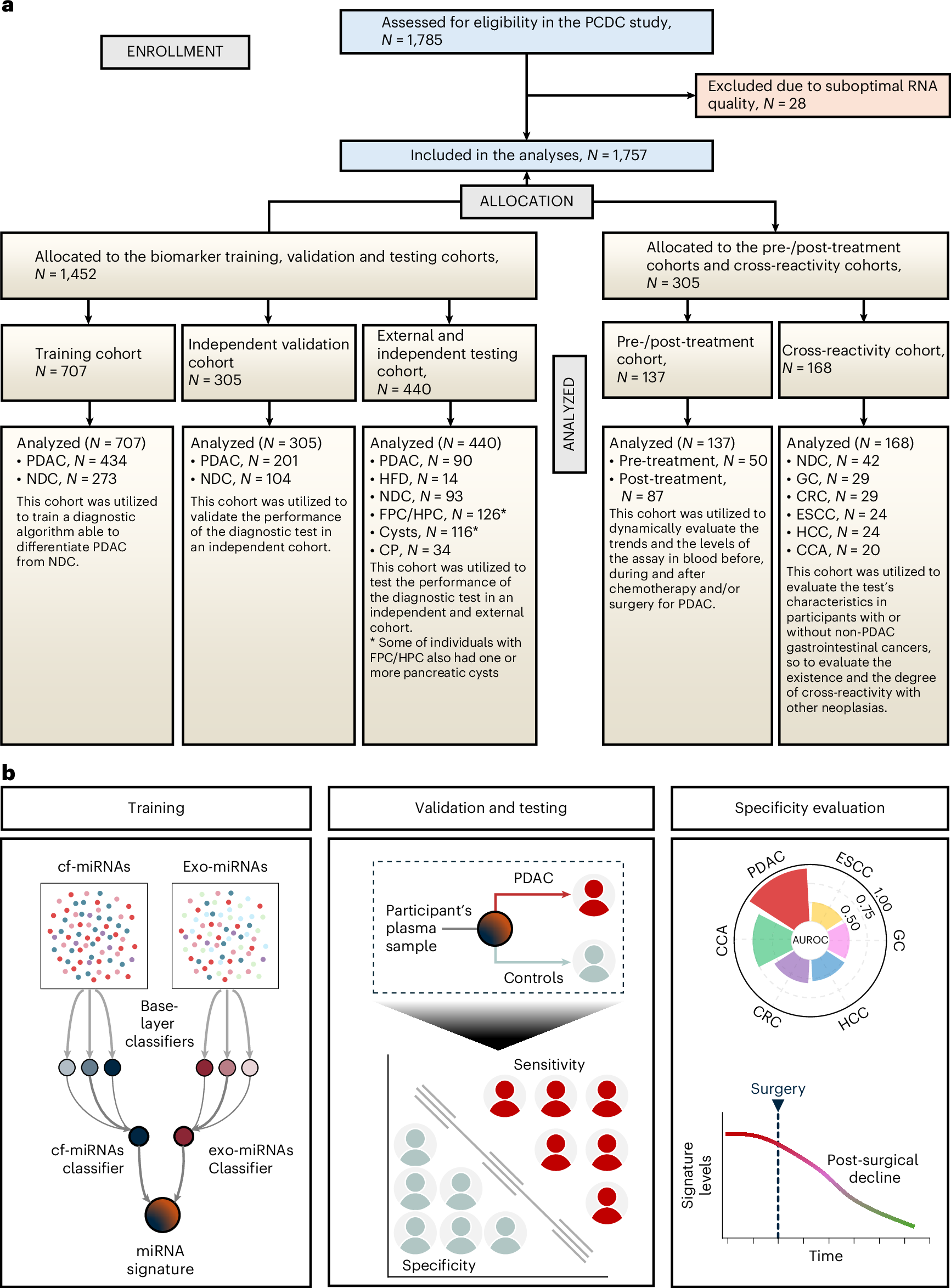
- A liquid biopsy tested in 1,800 patients across the U.S., Europe and Asia identified stage 1 and 2 pancreatic cancer 87 percent of the time, with results published in Nature Medicine.
- The test reads three markers in blood, circulating microRNAs, exosomal microRNAs and the protein CA19-9, and uses artificial intelligence to fold them into a single risk score.
- False positives ran at 3 percent in low-risk groups and 16 percent in high-risk groups, according to the Discover Magazine account of the study.
Compiled by The ScientistSomething wrong?How this is made
Why it matters
- decision Anyone building a programme on this test has to fix eligibility first. The false-positive workload it generates depends on who you enrol.
- capability Pancreatic cyst surveillance gains a molecular reading on the precancerous state itself, so clinicians choosing which cysts to intervene on would have a graded score to work from.
- constraint Clinic use waits on confirmatory trials. Those trials will fix the eligible population, and the eligible population determines how many negatives are worked up for each cancer found.
- contradiction Scientific American summarised the same result as a low rate of false positives while Discover published the rates group by group, and a reader given only the first would not know they differ by risk group.
The false-positive rate scales with who you test. In this trial the high-risk figure was more than five times the low-risk one [5][26]. High-risk people are the ones a screening programme enrols first. Discover Magazine reported that the accuracy gained from combining three biomarkers should especially benefit people at high risk [20][33], and Scientific American reported that doctors would use the score particularly in people with inherited risk or a history of pancreatitis [24]. There is no routine screening test for pancreatic cancer the way there is for breast or colon cancer [14]. A flagged patient goes on to further evaluation [34].
How tolerable that burden is depends on how many people in the screened group actually have cancer. Neither account reports how many cancers were found among the 1,800 enrolled [2][3]. The positive predictive value of a flag cannot be computed from what has been published. The 87 percent covers stage 1 and stage 2 pooled [4].
The test also misses cancers. About 13 of every 100 stage 1 and 2 cancers in the trial went unflagged [27]. For high-grade dysplasia, the precancerous state found in people with high-risk pancreatic cysts, detection ran above 64 percent, meaning under 36 percent were missed [7][8][31]. Discover reported that identifying dysplasia could help physicians monitor cysts and decide which ones might require intervention [21].
Ajay Goel, the study's senior author and chair of molecular diagnostics and experimental therapeutics at City of Hope, framed the result around timing [10]. "For patients, these findings represent progress toward finding pancreatic cancer before symptoms appear and while more treatment options remain available," he said in a statement [11]. "A stage shift is not just a statistic," Goel said [12].
Late-stage treatment shows what a stage shift would be worth. The Food and Drug Administration has approved daraxonrasib for people with late-stage pancreatic cancer who have already been through chemotherapy [17]. It puts survival at 13.2 months against 6.7 months for chemotherapy alone, a gain of 6.5 months [18][28]. Five-year survival after diagnosis is 13 percent in Scientific American's account and 14 percent in Discover's, which cites the National Pancreatic Foundation [15][16].
The enrolment was an early-stage clinical trial, and Scientific American reported that more advanced trials are needed before the test could be used in the clinic [3][19]. The two publishers also spell it differently: Discover writes PANXEON, Scientific American writes PAXEON [29][30].
What to watch
- A stage 1 sensitivity figure reported separately from stage 2. Stage 1 sensitivity is what bears on resectable disease.
- The size and cancer count of the confirmatory trial. Cancers per thousand enrolled set the positive predictive value.
- Whether any guideline body defines an eligible high-risk population, since eligibility rules decide how many negatives get worked up.