ScienceNot yet confirmed elsewhere1 publisher2 min readPublished
Biochar from brewery malt rootlets removed about five times as much E. coli as plain sand
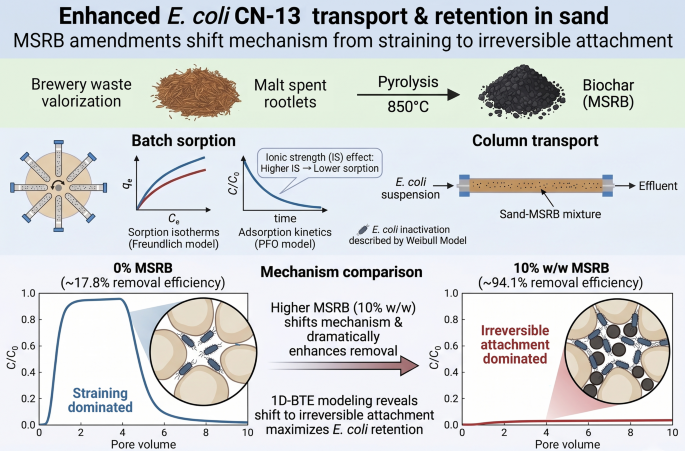
University of Patras researchers found sand mixed with biochar from brewery malt rootlets removed about five times as much E. coli as sand alone. The tests ran in the lab, and the team plans to try the material under less predictable real-world conditions next.
The Scientist · Science desk
What happened
- In the test filter, biochar made up 10 percent of a sand mix and actively attached to bacteria, while plain sand only stopped microbes physically, like a colander.
- Spent malt rootlets are the little sprouts that grow from barley during malting, and the team heated them to make a porous, charcoal-like biochar.
- The same group has also tested whether waste from olive oil and coffee production has similar water-purifying effects.
- Alcina Johnson Sudagar, an independent chemist who studies other brewing by-products and was not involved, called the work a proof of concept.
Why it matters
- constraint On equal loads, a fivefold gain over a sand column that caught at most a fifth of the bacteria cannot yet show whether a blended filter would make water safe to drink.
- constraint A biochar that captures bacteria only once would need replacing after each use, so its claim to be a circular use of brewery waste depends on reuse tests not yet reported.
- cost Making the biochar means heating the rootlets, so a cheap filter needs that energy and handling cost to come in below whatever is saved by starting from brewery waste.
The comparison has a clean control. Nine parts in ten of the test filter were the same sand used in the sand-only column [18], so the difference between the two comes from the biochar. The fivefold figure also says something about that control. If both columns received the same load of bacteria, sand alone removed at most about a fifth of the E. coli [17]. Five times anything above 20 percent would be more than all the bacteria present. The article describing the study does not report absolute removal rates, bacterial loads, flow rates or the cost of making the char.
The team sees soil as the place to use it. Groundwater is always moving through soil, and on the way it can pick up agricultural waste or fecal matter that can infect people who drink it [7]. Ioannis Manariotis, the study's senior author and an environmental engineer at the University of Patras in Greece [6], said adding biochar to certain soils could offer "a sustainable approach for water remediation and the protection of groundwater" [19]. The results were published in the journal Biochar [10].
Sudagar said her most pressing question is whether the material can be used for filtration more than once [12]. If it traps bacteria only once, she said, it quickly becomes waste again. It would then lose its value both as a consistent filter and as a sustainable use of a brewery by-product [12].
Brewers already send some of their waste elsewhere. Leftover grain is frequently made into animal feed, and other research has proposed brewing by-products for sunscreen and electricity [13]. Brewing can run to 11 steps, each leaving organic waste with a different chemical makeup [14]. "It's important to continue because the waste produced will keep increasing, and you would need different applications," Sudagar said [15]. "You cannot just send it to one place and say that we are done with it" [16].
In our view the study supports a narrow claim well: in a lab column, a small share of malt-rootlet char made sand a far better trap for E. coli [3]. Calling it cheap would take a production cost. Calling it circular would take the reuse data Sudagar asked for [12].
What to watch
- Results from the Patras team's tests under real-world conditions, and whether the gain over sand holds outside the lab.
- Data on whether a rootlet-biochar filter keeps removing E. coli across repeated runs, or can be regenerated.
- Published removal percentages, flow rates and production costs that would let the blend be compared with drinking-water treatment standards.
Clarity's read
What the record supports and how the coverage leans. The claims behind it follow.
Reality
- Evidence35
- Adoption
- Insufficient
- Hype gap+15
- Incentives
- Insufficient
- Confidence40
Claim ledger
Ranked by verification strength, evidence, and original report placement.
- [1]
Researchers heated spent malt rootlets, a common waste product from beer making, to produce biochar, a porous material created from burned organic matter.
- [2]
Spent malt rootlets are little sprouts that grow from barley during the malting process.
- [3]
When the biochar was mixed with sand and water was sent through it, it removed around five times as much Escherichia coli bacteria as a filtration system that used only sand.
- [4]
When the team used a sand mix that was 10 percent biochar, the biochar actively glommed on to microbes to slow their passage.
- [5]
Sending water through sand filters bacteria like a colander, by physically stopping microbes from moving through.
- [6]
Ioannis Manariotis is senior author on the study and an environmental engineer at the University of Patras in Greece.
- [7]
Groundwater constantly moves through soil, where it can become contaminated with agricultural waste or fecal matter, potentially infecting humans who drink it.
- [8]
Manariotis and his team have also tested whether waste from olive oil and coffee production can have similar water-purifying effects.
- [9]
Having found the beer by-product can filter out bacteria in laboratory conditions, the researchers plan to test its efficacy under more unpredictable real-life conditions.
- [10]
The results were published in the journal Biochar.
- [11]
Alcina Johnson Sudagar, an independent chemistry researcher who studies other beer-making by-products and was not involved in the study, called using brewery waste for water filtration this way a "proof of concept."
- [12]
Sudagar's most pressing question is whether the material can be used more than once for filtration; if it can trap bacteria only once, it quickly becomes waste again, negating its value as a consistent filtration system or sustainable brewery by-product.
ReportedSupportedSource: Alcina Johnson Sudagar, as reported by Scientific AmericanView cited source - [13]
Leftover brewery grain is frequently used to make animal feed, and other research suggests beer-making by-products can be used for sunscreen and electricity.
- [14]
The brewing process can have up to 11 steps, and each step produces organic waste materials with different chemical makeups.
- [15]
"It's important to continue because the waste produced will keep increasing, and you would need different applications."
- [16]
"You cannot just send it to one place and say that we are done with it."
- [17]
Assuming both filters received the same bacterial load, a removal advantage of around five times implies the sand-only filter removed at most about 20 percent of the E. coli.
- [18]
With biochar at 10 percent of the mix, 90 percent of the test filter medium was sand.
- [19]
Adding biochar to certain soils could offer a public health solution and "a sustainable approach for water remediation and the protection of groundwater."
ReportedInsufficientSource: Ioannis Manariotis, quoted by Scientific American2 sources— create a free account to open themView cited source
Sources
1 independent publisher whose own reporting we read for this story.
- scientificamerican.comThis beer-making waste may offer a new stream for cleaner water
1 article · October 10, 2026
Topics and entities
Follow any of these and your For You feed starts watching them — no settings page required.