Church's lab frees 14 codons by rewriting the ribosome's lock instead of the genome
Harvard's Church lab reports AGENTEX in Nature: engineered tRNAs and ribosomes in a cell-free mix. Nobody has to recode an organism to prototype a genetic code any more.
The Scientist · Science desk
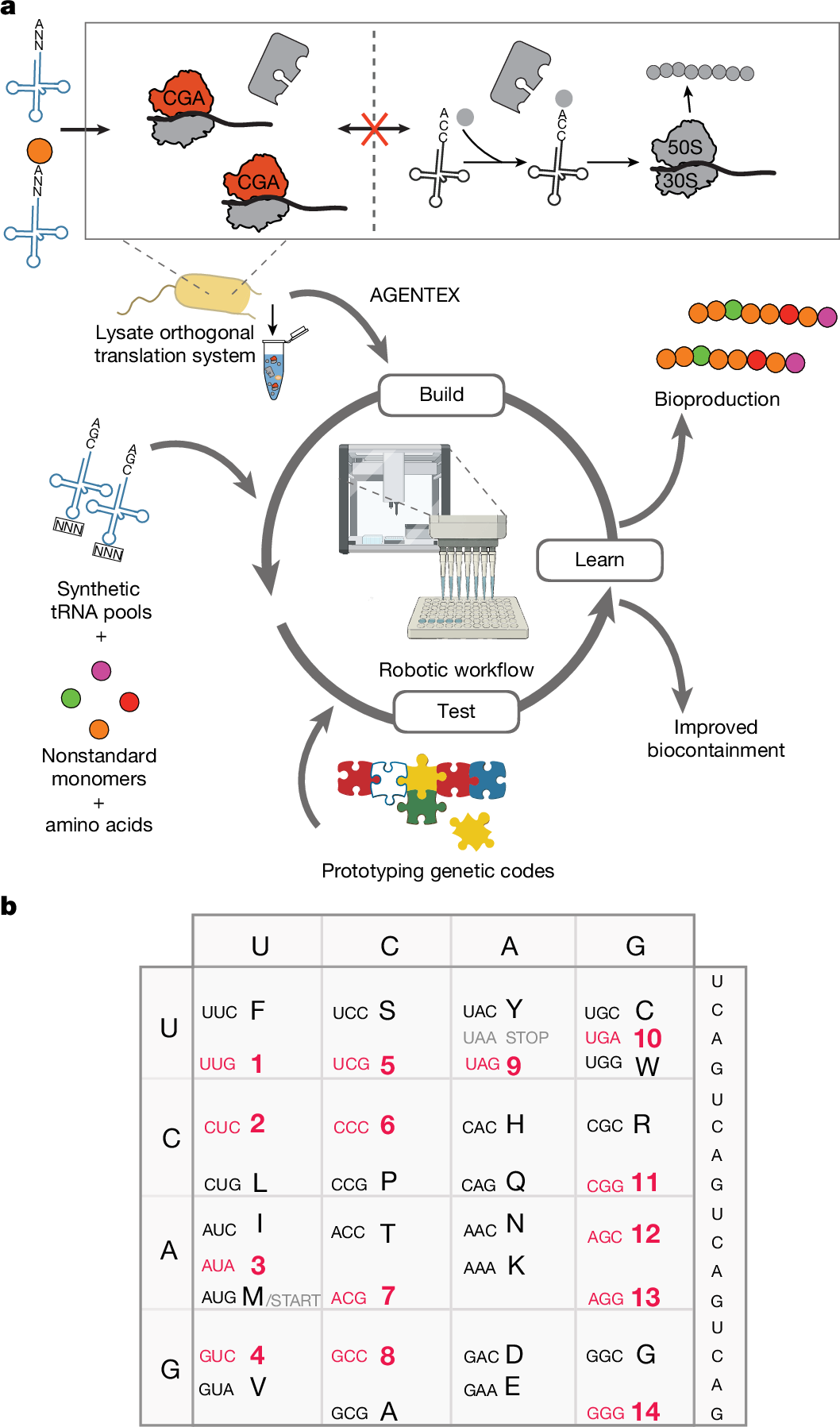
What happened
- George Church's lab at Harvard Medical School and the Wyss Institute published AGENTEX in Nature: engineered tRNAs and ribosomes dropped into a mix of cell components with no cells in it.
- The older route took the same lab nine years to free one E. coli codon by 2013 and ten more to free a second, topping out at 22 amino acids in engineered cells.
- The new cell-free systems run compressed codes that put 34 aminoacyl tRNA synthetases against 34 codons.
- What the paper actually tests is two prototype codes alongside the standard one, with non-standard amino acids and reassignment of up to three codons.
Why it matters
- contradiction The phys.org framing of protein design with up to 34 amino acids is a ceiling the platform is built to reach, not a molecule anyone has reported; the gap between ceiling and demonstration is where...
- capability Prototyping a genetic code becomes a liquid-handling exercise rather than an organism-building one, which puts it inside labs that were never going to rewrite a genome and have no facility for...
- constraint A test tube cannot hand you what recoded organisms hand you, such as virus resistance or reduced horizontal gene transfer, so genome engineering stays on the critical path for anyone who wants...
- precedent Containment scrutiny moves downstream: there is nothing to wall off from natural life until a code is taken out of the lysate and put into cells, so the transfer step is where oversight should now...
Every tRNA ends in the same three bases, and the ribosome checks for them. Bases G2251 and G2553 in the 23S rRNA of the E. coli ribosome pair with that 3' CCA end [6], and those Watson-Crick contacts in the large subunit are what stop a tRNA carrying any other 3' sequence from being accommodated during translation [5]. Change the subunit and you have changed the lock rather than the genome: pools of odd-ended tRNAs can then specify a code of their own on ribosomes built to accept them [8].
The reason to bother is a housekeeping problem in cell-free translation. Lysate systems, made from crude cell extracts, keep the host's translation and modification enzymes and scale for bioproduction, but they also carry the host's complete tRNA set, which crosstalks with any reassigned sense codon [15]. The tidy alternative, PURE, rebuilds the reaction from individually purified components, which is where most proof-of-concept code expansion has been done, and it is the poorer choice at preparative scale [16]. A ribosome that will not accept CCA ends renders the host's own tRNAs invisible to it, so the lysate can stay in the tube.
The load-bearing surprise sits one step upstream, at charging. The team found the tRNA 3' end far more tolerant of mutation than assumed, with most odd-ended tRNAs still aminoacylated by all of E. coli's natural synthetases [1]. Code expansion has until now leaned on engineered synthetases alongside engineered ribosomes and tRNAs [18]. Here the enzymes arrive as found, which is the part that removes work rather than adding a step.
Where 34 comes from is worth doing on paper. The standard code spends 64 codons on 20 canonical amino acids [14]; compress it to 20 sense codons plus one start and one stop, and 14 codons come free for non-standard building blocks [13]. Twenty plus fourteen is the 34 [12]: the natural alphabet kept, with fourteen open slots beside it. Church puts the old rate at a decade per amino acid added [10], and his lab's own record, nine years to free the first codon and ten more for the second, works out at about nine and a half years each [22].
The point of fourteen slots is not one exotic residue in one protein. More than 400 non-standard amino acids have already been installed in proteins in living cells [17]. What has not worked is several of them in a single chain at high purity [19], and that, rather than a slightly decorated enzyme, is what a compressed code and an automated, multiplexed prototyping loop [4] are pointed at.
What to watch
- Whether a follow-up reassigns more than three codons at once, and what purity the resulting polypeptides come out at.
- Whether the altered-large-subunit ribosome and odd-ended tRNAs are ever moved into living cells, which puts the containment question back.
- Whether lysate-based AGENTEX reactions yield material at bioproduction scale rather than prototype-scale readouts.
Clarity's read
What the record supports and how the coverage leans. The claims behind it follow.
Reality
- Evidence78
- Adoption12
- Hype gap+30
- Incentives58
- Confidence74
Claim ledger
Ranked by verification strength, evidence, and original report placement.
- [1]
The team discovered that the tRNA 3' end shows remarkable flexibility to mutation, allowing aminoacylation of most non-CCA-3' tRNAs (otRNAs) by all Escherichia coli aminoacyl tRNA synthetases.
- [2]
The authors developed cell-free translation systems enabling compressed genetic codes of 34 aaRSs for 34 codons.
- [3]
The lab of geneticist George Church at Harvard Medical School and the Wyss Institute for Biologically Inspired Engineering devised AGENTEX, published in Nature; it lets researchers custom-engineer tRNAs and ribosomes and insert them into a standard lab concoction containing cell components but no actual cells, where they make new proteins without requiring genome recoding or any organisms, and without interfering with natural protein-making machinery.
- [4]
AGENTEX stands for automated genetic tRNA expansion, a method for multiplexed robotic prototyping of genetic codes in cell-free translation systems.
- [5]
Two Watson-Crick interactions in the ribosomal large subunit mediate recognition of the 3' CCA end of tRNAs, preventing tRNAs with alternative 3' sequences from being accommodated during translation.
- [6]
The interaction is between the 3' CCA sequence of all tRNAs and bases G2251 and G2553 in the 23S rRNA of the Escherichia coli ribosome.
- [7]
Using AGENTEX, the authors evaluated two genetic codes alongside the standard genetic code, with non-standard amino acid incorporation and reassignment of up to three codons.
- [8]
The approach uses pools of otRNAs to specify unique genetic codes using ribosomes with altered large subunit.
- [9]
According to phys.org, AGENTEX makes 34 codons customizable, allowing researchers to design proteins using up to 34 amino acids rather than the 20 naturally occurring ones, in test tubes without touching an organism's natural DNA.
- [10]
Church said: "It took us a decade per new amino acid added to the code, so this remarkably opens the door to 34 at once and with almost none of the usual collateral damage to the genome."
- [11]
Progress in codon reprogramming has been slow and fraught, including because codon reprogramming hampers other normal cell functions and because genetically engineered organisms need to be kept safely walled off from natural life.
- [12]
The 34-codon figure is arithmetically the 20 canonical amino acids plus the 14 codons that compression liberates.
- [13]
Compressing the 64-codon near-universal genetic code to only 20 sense codons, one start codon and one stop codon liberates 14 codons for non-standard building blocks.
- [14]
The standard genetic code uses 64 codons to encode 20 canonical amino acids across domains of life.
- [15]
Lysate cell-free systems are produced from crude cell extracts and retain both translational machinery and enzymes for RNA and post-translational modifications, support native tRNA modifications and scale for bioproduction, but contain the complete tRNA set of the host, which can exhibit crosstalk with reassigned sense codons and obscure synthetic genetic code designs.
- [16]
PURExpress (PURE) uses individually purified components combined in defined ratios; proof-of-concept genetic code expansion studies and directed evolution have largely been performed in PURE, although PURE is less suitable for preparative-scale bioproduction.
- [17]
Genetic code expansion has enabled the introduction of more than 400 non-standard amino acids into proteins in living cells.
- [18]
Genetic code expansion to date has used engineered ribosomes, tRNAs and aminoacyl tRNA synthetases.
- [19]
Reassigning more than a handful of sense codons across an entire genome remains challenging, as does incorporation of multiple non-standard amino acids into polypeptides with high purity.
- [20]
After nine years of effort, the Church Lab demonstrated in 2013 that a codon could be freed in E. coli so the microbes could make a new amino acid; it took another 10 years to free a second codon, after which engineered cells could make proteins containing up to 22 different amino acids.
- [21]
Synthetic genetic codes have enabled construction of organisms with new properties such as increased virus resistance and reduced horizontal gene transfer, as well as genetically encoded materials, therapeutics and biocatalysts.
- [22]
The two freed codons took 19 years of Church Lab work between them, about nine and a half years per codon.
- [23]
First author Felix Radford, HMS research fellow in genetics in the Church Lab, said AGENTEX lets researchers generate entirely new genetic codes on demand in test tubes and use them at scale, and that it is more rapid and safe than existing methods because it does not rely on handling living cells or altering their genomes.
Sources
2 independent publishers whose own reporting we read for this story.
- nature.comAutomated prototyping of genetic codes
1 article · August 25, 2026
- phys.orgReworked tRNAs enable protein design with up to 34 amino acids
1 article · August 26, 2026
Topics and entities
Follow any of these and your For You feed starts watching them — no settings page required.
Topics
- Protein and Enzyme EngineeringFollow
- Genetic Code ExpansionFollow
- Lab Automation and Multiplexed ScreeningFollow
- Cell-Free Protein SynthesisFollow
- Synthetic BiologyFollow
Entities
- Harvard Medical SchoolFollow
- AGENTEXFollow
- Escherichia coliFollow
- tSCANFollow
- Church LabFollow
- Felix RadfordFollow
- George ChurchFollow
- Wyss Institute for Biologically Inspired EngineeringFollow
- PURExpressFollow
- NatureFollow