Science1 publisher2 min readPublished
KIT's freeze-dried millimetre beads use enzymes as both catalyst and structure
Karlsruhe Institute of Technology researchers made millimetre-sized beads whose structural material is the enzymes themselves, with no inert carrier. The format aims to make biocatalysts as easy to store, ship and dose as industrial chemistry requires.
The Scientist · Science desk
What happened
- Hybrid beads that also contain E. coli cells stayed catalytically active after more than four weeks of dry storage at room temperature, with functions still confirmed at five months.
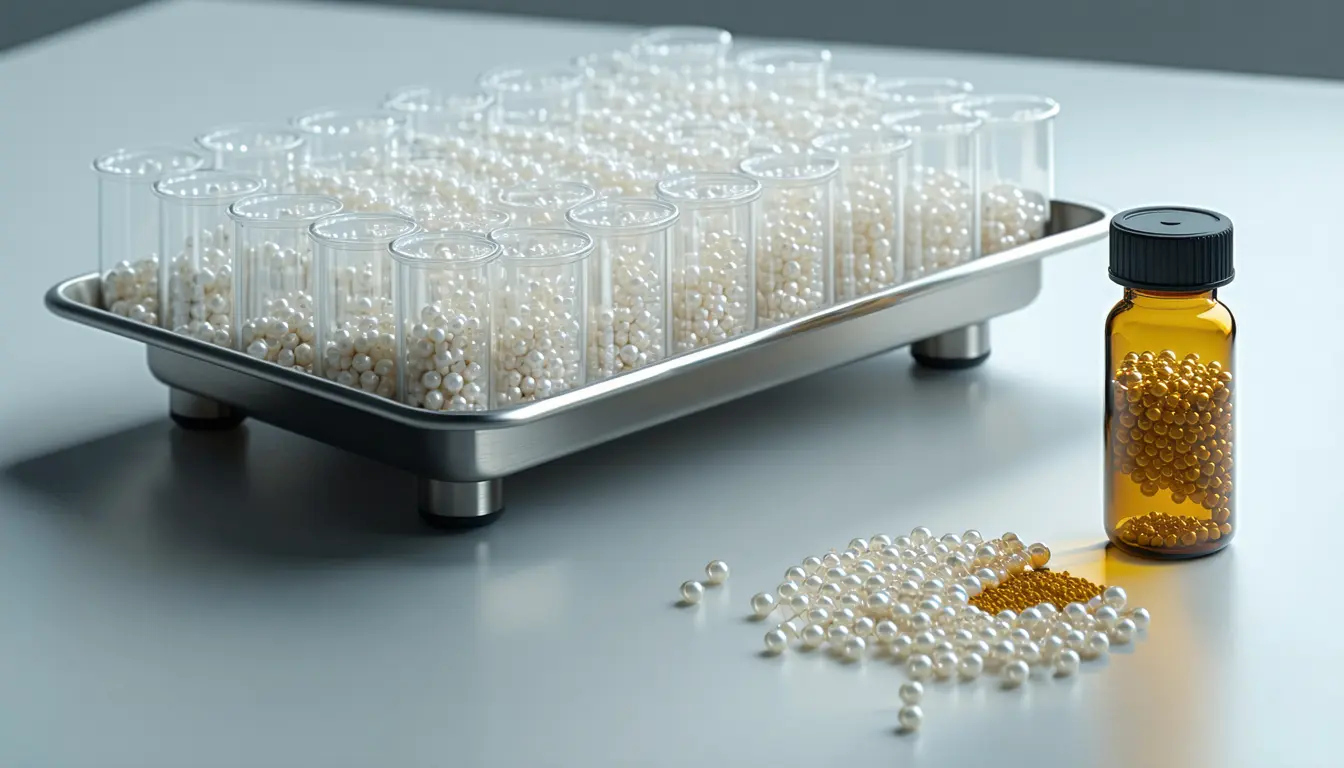
- The beads form when enzyme building blocks mixed in liquid droplets are flash-frozen in liquid nitrogen and freeze-dried into porous, robust particles of a defined size.
- The team built beads from a wide variety of enzymes and reaction types, holding single catalytic functions or multi-enzyme systems, with or without additives.
- KIT has filed a patent application covering the bead technology.
Compiled by The ScientistSomething wrong?How this is made
Why it matters
- capability If the enzyme-only beads keep as well as the hybrids do, biocatalysts could be stocked and shipped dry without refrigeration.
- cost Each enzyme must first be fitted with complementary binding modules, so every new process carries protein-engineering work before a single bead is made.
- constraint Continuous flow has been shown over hours, so a plant planning weeks-long production campaigns or industrial volumes would be relying on performance the published tests do not cover.
The design choice is to drop the carrier [1]. In the Karlsruhe beads the enzymes do the catalysis and also form the solid [1]. Christof Niemeyer, who led the team at KIT's Institute for Biological Interfaces 1 [6], called that dual role "a great advantage over conventional methods" [9]. "We avoid inactive support material, increasing the efficiency of the desired chemical reaction," he said [8].
The solid holds together through an approach known as all-enzyme hydrogels, which the team refined. Each enzyme is fitted with complementary molecular binding modules [6]. "When the complementary building blocks come together, they organize themselves into three-dimensional protein networks," Niemeyer said [7]. Once dried, the beads can be returned to a liquid and used for reactions [11].
The environmental case for enzymes is familiar: they replace chemical catalysts that are often toxic, and they save raw materials and energy [2]. The release also lists what wider use in the chemical industry would demand. Biocatalysts would have to be available continuously and in large quantities, and they would have to be storable, transportable and easy to dose [5].
Storage is where the evidence is firmest, with one condition [16]. The dry-storage results belong to the hybrid beads, which carry E. coli cells alongside the enzymes [15][16]. The cells supply things isolated enzymes cannot, such as chemical energy or intermediates [15]. The team also recovered viable cells from the material with their genetic functions intact [17]. "With the hybrid beads, we link two forms of biocatalysis, which are usually considered separately," Niemeyer said [18].
Niemeyer describes the system as modular. "The composition of the material can be customized to suit the desired reaction," he said [13]. Effect size is harder to judge. The release does not report conversion rates, activity per gram of bead, shelf-life figures for the enzyme-only beads, or a test against the same enzymes on a conventional carrier. Without that control, the release gives no way to size the efficiency gain Niemeyer attributes to dropping the support [8].
The paper, "Programmable Carrier-Free All-Enzyme Beads for Modular Continuous-Flow Biocatalysis", appeared in Advanced Materials [4]. The group lists fine chemicals, flavouring agents and building blocks for pharmaceutical active ingredients as possible applications [19].
What to watch
- A side-by-side test of the beads against the same enzymes on a conventional carrier, reporting activity per gram of catalyst.
- Continuous-flow runs measured in weeks, and storage data for the enzyme-only beads to match the hybrid results.
- Whether KIT licenses its patent application to a producer of fine chemicals or pharmaceutical building blocks.