ScienceNot yet confirmed elsewhere1 publisher2 min readPublished
Diamond electron spins push a levitated centimeter-scale plate about 100 nanometers
OIST physicists used electron spins in a diamond to push a levitated 128-milligram assembly about 100 nanometers, they report in Science Advances. The motion was classical, so any quantum test at this scale still needs the object itself in superposition.
The Scientist · Science desk
What happened
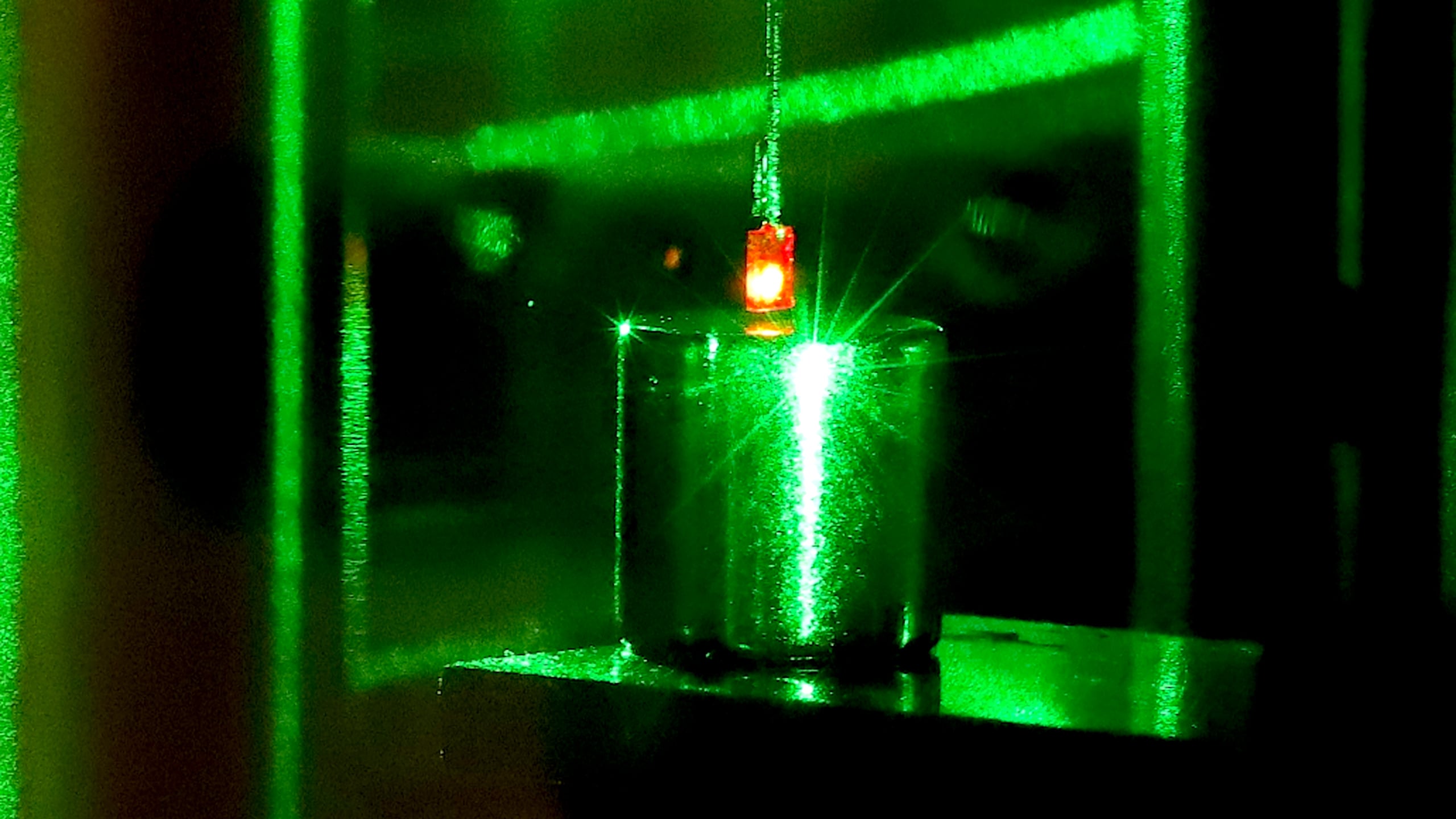
- The object was a centimeter-sized graphite plate floating above a checkerboard of magnets that levitated it.
- A 3-millimeter diamond with nitrogen-vacancy centers hung from the plate, laser light set its electron spins, and a second magnet turned those spins into motion.
- Theoretical physicist Jason Twamley said the object is eight to nine orders of magnitude more massive than the objects in current state-of-the-art spin-mechanical experiments.
Why it matters
- capability Attempts at macroscopic superposition now have a working testbed at this mass: a levitated object that laser-set spins can move, built on NV centers that Kim says hold coherence unusually long at room temperature.
- contradiction ScienceAlert says spin forces had moved only individual atoms before, but Twamley's comparison puts the earlier record objects at about 0.13 to 1.3 nanograms, so the size of the jump depends on which baseline a reader accepts.
- precedent Twamley has said the remaining gap is one more order of magnitude, a specific target the group's next result can be checked against.
On a plate about a centimeter across, a 100-nanometer push is a displacement of roughly one part in 100,000 [12]. Physicist Anshuman Nayak described the group's approach as going "from large to small" [9]. "Just as diamagnetic levitation can lift maglev trains, it can also be used to levitate centimeter-wide objects holding diamonds, where the effect of gravity can be extremely strong, but quantum effects have not been observed," he said [10].
Physicist Daehee Kim explained the choice of spin source. "NV diamonds are well understood and easy to control," he said [7]. He added that the long coherence times of NV centers make them "particularly attractive for generating macroscopic superposition of the motion or object in future research" [8].
The thing this doesn't tell you is whether quantum mechanics holds for an object this size. Twamley described that problem himself. "There have been many efforts to test whether quantum mechanics holds for anything larger than a few tens of nanometers, so far without success," he said [5]. His description of the new result is narrower. "We've shown a large classical response from a small quantum effect," he said [11]. ScienceAlert links the work to the question of whether gravity follows quantum rules, because the object is heavy enough for gravity to act on it [18]. The researchers describe putting larger objects into superposition as a goal for later work [6].
How large a step this is depends on the baseline. ScienceAlert's account says spin forces had previously been enough only to nudge individual atoms [14]. Twamley's comparison [15] implies a different starting point: dividing 128 milligrams by 10^8 and by 10^9 puts the earlier state-of-the-art objects at roughly 0.13 to 1.3 nanograms [13].
The published account does not describe how the displacement was measured or what control runs tied the motion to the spin state.
We think the claim the evidence supports is a platform result: laser-set spins moving a levitated object of more than a hundred milligrams [4], with the quantum test of that object still to come. Twamley is more confident. "It's no longer a question of whether such technology is possible, but of how we can refine experimental conditions to achieve quantum superposition within the regime of Einstein's general relativity," he said [16].
What to watch
- Whether the OIST group reports a superposition of the levitated object's motion, the step Twamley put one order of magnitude away.
- Detail in the Science Advances paper on how the 100-nanometer displacement was measured and what controls tied it to the spin state.
Clarity's read
What the record supports and how the coverage leans. The claims behind it follow.
Reality
- Evidence45
- Adoption
- Insufficient
- Hype gap+35
- Incentives
- Insufficient
- Confidence45
Claim ledger
Ranked by verification strength, evidence, and original report placement.
- [1]
A team from the Okinawa Institute of Science and Technology (OIST) published a study in Science Advances detailing how a centimeter-sized object can be nudged by electron-spin forces.
- [2]
The centimeter-sized object was a graphite plate placed above a checkerboard of magnets that levitated it.
- [3]
A 3-millimeter diamond with nitrogen-vacancy (NV) centers hung from the plate; the electron spins were manipulated by laser light, and another magnet turned those spins into movement.
- [4]
The whole assembly weighed around 128 milligrams and was pushed by about 100 nanometers.
- [5]
"There have been many efforts to test whether quantum mechanics holds for anything larger than a few tens of nanometers, so far without success," said theoretical physicist Jason Twamley.
- [6]
The movement was classical; the quantum effect triggered it. The researchers hope their approach can later help put larger objects into quantum states such as superposition.
- [7]
"NV diamonds are well understood and easy to control," said physicist Daehee Kim.
- [8]
"That, and the fact that NV centers have some of the longest known coherence times, allowing them to maintain quantum superposition at room temperature much longer than other systems, makes them particularly attractive for generating macroscopic superposition of the motion or object in future research," Kim said.
- [9]
"We're in the opposite camp - going from large to small," said physicist Anshuman Nayak.
- [10]
"Just as diamagnetic levitation can lift maglev trains, it can also be used to levitate centimeter-wide objects holding diamonds, where the effect of gravity can be extremely strong, but quantum effects have not been observed," Nayak said.
- [11]
"We've shown a large classical response from a small quantum effect," Twamley said.
- [12]
A 100-nanometer displacement of a roughly 1-centimeter object is about one part in 100,000 of its size.
- [13]
Twamley's eight-to-nine-orders-of-magnitude comparison implies earlier state-of-the-art spin-mechanical objects of roughly 0.13 to 1.3 nanograms.
- [14]
According to ScienceAlert, the force of electron spins had previously only proved enough to nudge individual atoms.
- [15]
"Now, we have observed a classical mechanical response to a quantum force on an object that is eight to nine orders of magnitude more massive than the current state-of-the-art spin-mechanical experiments," Twamley said.
- [16]
"It's no longer a question of whether such technology is possible, but of how we can refine experimental conditions to achieve quantum superposition within the regime of Einstein's general relativity," Twamley said.
- [17]
"We're pushing the bar from nanometers to centimeters. All we need is another order of magnitude, and we can finally observe Schrodinger's cat in real life," Twamley said.
- [18]
The object is big enough to be subject to gravity, a force that has not always sat well with quantum theories; ScienceAlert says milestones like this will help answer whether gravity follows quantum rules.
Sources
1 independent publisher whose own reporting we read for this story.
- sciencealert.comFor The First Time Ever, Quantum Spins Shift a Centimeter-Scale Object
1 article · October 10, 2026
Topics and entities
Follow any of these and your For You feed starts watching them — no settings page required.
Topics
- Quantum GravityFollow
- Macroscopic quantum mechanicsFollow
- Diamagnetic levitationFollow
- Nitrogen-vacancy centersFollow