Science1 publisher2 min readPublished
Plasma-activated water at 62.5% strength left twice as many live E. coli as controls
EPFL researchers found that E. coli in nutrient broth with 62.5% plasma-activated water reached about twice the control's viable count. For anyone using the water as a disinfectant, the lethal dose has to be measured in the liquid actually being treated.
The Scientist · Science desk
What happened
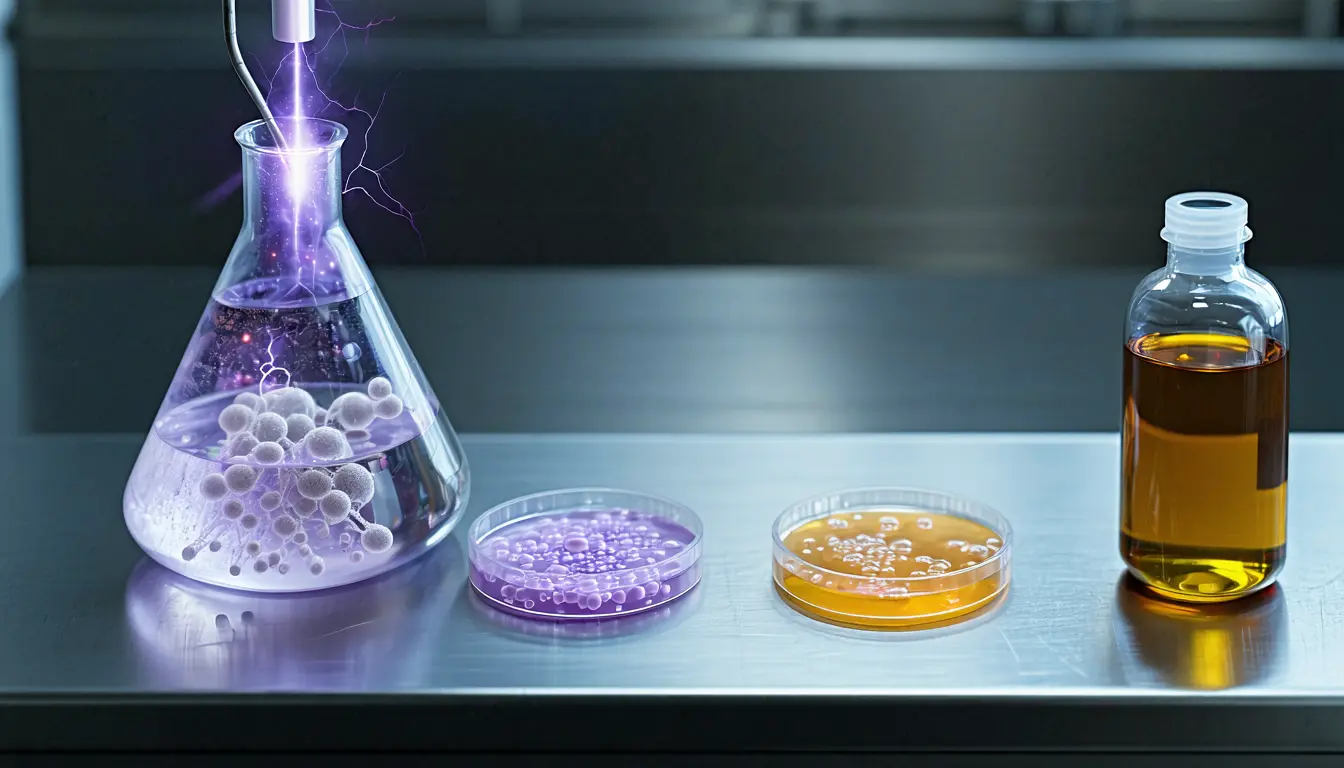
- Plasma-activated water is made by exposing water to a low-temperature plasma, a process that generates reactive oxygen and nitrogen species that dissolve into it.
- The EPFL team, publishing in npj Clean Water, exposed E. coli to rising concentrations of the water diluted in lysogeny broth, a nutrient-rich growth medium.
- At the highest concentration the bacteria were completely inactivated, a fall of more than eight orders of magnitude from the starting population.
- Nanomotion sensing, which picks up nanoscale oscillations of active cells, showed bacterial activity rising at intermediate concentrations before dropping sharply at higher ones.
Compiled by The ScientistSomething wrong?How this is made
Why it matters
- exposure Under-dosing in nutrient-rich water risks more than an incomplete kill, since the authors warn it may briefly increase bacterial activity.
- constraint Until the stress and broth-chemistry explanations are separated, a dose curve measured in lysogeny broth cannot be assumed to hold in another liquid.
- capability Labs tuning plasma treatment settings get a real-time readout of bacterial activity to run beside culture counts, which report only the end result.
The intermediate-dose result rests on two methods that measure different things. Colony counting records how many bacteria went on to proliferate, while nanomotion sensing tracks the physiological activity of the cells in real time [3][9]. Each method showed the same biphasic response independently [9]. A rise seen only on agar plates might be put down to plating or handling. A matching rise in a physical signal from living cells is much harder to dismiss.
The two effects differ in size by a wide margin. At the highest concentration, fewer than one cell in 100 million stayed viable [1]. At 62.5%, with broth making up the remaining 37.5% of the mixture [2], the excess was a factor of about two [5]. A doubling is small beside that kill. It still went the wrong way, in a liquid that was mostly treated water.
Fabio Avino, a researcher at the Swiss Plasma Center and the study's corresponding author, framed the result in terms of dose. "This shows that the interaction between bacteria and plasma-activated water is not simply a matter of increasing inhibition with increasing concentration," he said [7]. "At sublethal concentrations, bacteria can display an enhanced physiological response, whereas higher concentrations ultimately lead to their inactivation," he said [8].
The thing this experiment doesn't tell you is why the cells did better. The authors say the response fits a stress-adaptation or hormesis-like effect, in which moderate exposure to reactive species stimulates cellular activity [10]. They also point out that the treated water can change the broth itself, by oxidising organic compounds or shifting pH and redox conditions, and that the present experiments cannot fully separate the two explanations [11]. If the cells are responding to stress, I would expect a similar bump wherever E. coli meets a sub-lethal dose. If the treated water is changing what the cells feed on, the size of the bump would depend on what is dissolved in the liquid being treated.
The press account does not give exposure times, the full set of concentrations tested or the number of replicates. The technology is being studied for sterilization, agriculture and biomedicine as well as disinfection [14]. I think the intermediate-dose result is firm enough to design around. A dose-response test in any of those settings should include concentrations below the lethal one, because the excess growth and the rise in activity both appeared there [5][6].
What to watch
- An experiment that pre-treats the broth with plasma-activated water before adding E. coli would show whether the doubling comes from the cells or from altered nutrients.
- Tests in other organisms and in real wash water, wastewater or biofilms would show whether the sub-lethal rise appears outside lysogeny broth.
- Longer time courses would show how long the transient rise lasts and whether cells exposed to sub-lethal doses tolerate a later lethal one.