Science1 publisher2 min readPublished
Detectrons turn a fleeting RNA signal into a lasting DNA barcode in living cells
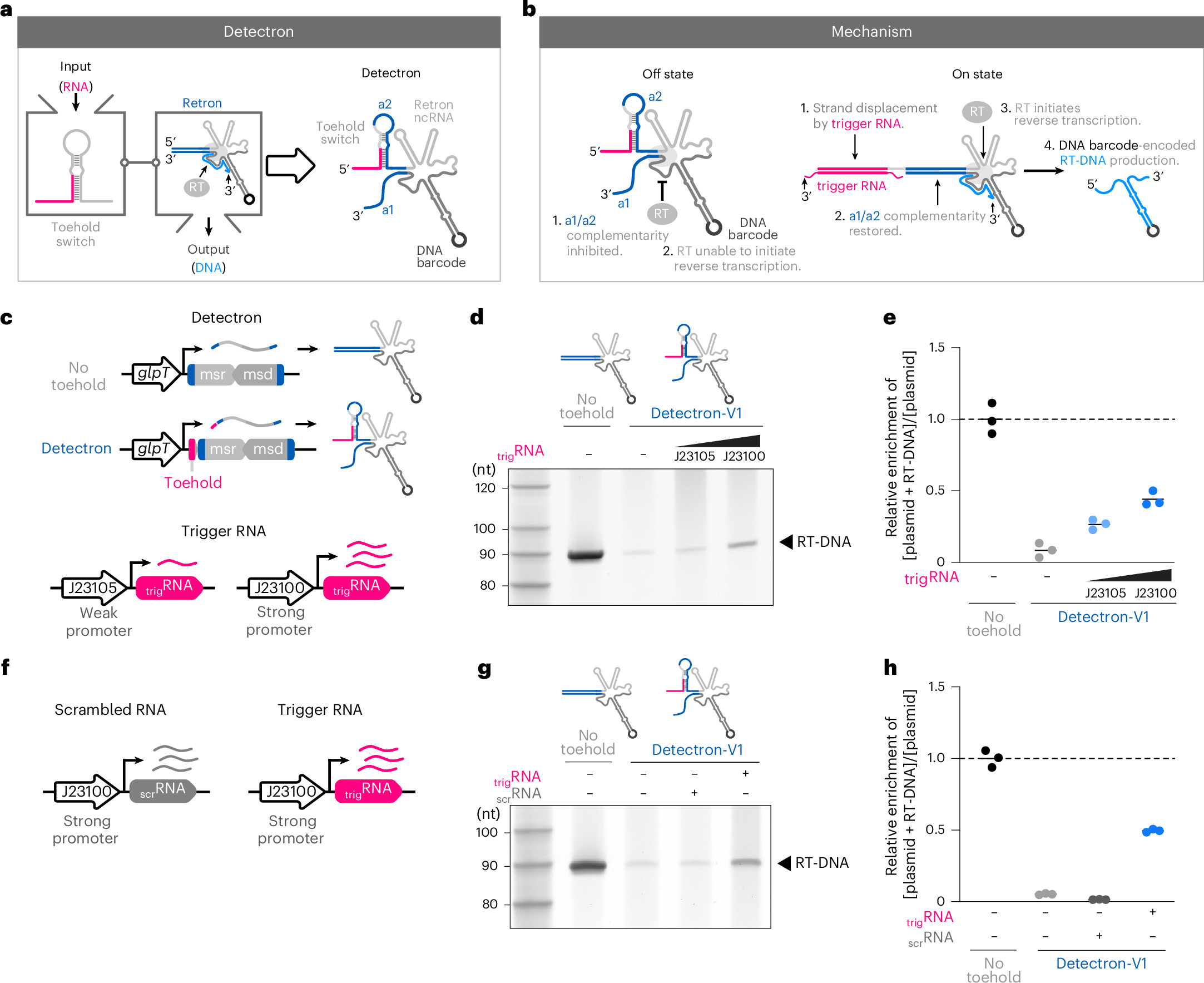
Researchers reporting in Nature introduced Detectrons, biosensors that convert a transient RNA signal into a durable DNA barcode inside a living cell. The barcode is a permanent record of a transcript event that would otherwise leave no trace.
The Scientist · Science desk
Drafted by a language model from the sources cited here and checked against its claim ledger before publication. How we use AISend a correction
What happened
- The team built a synthetic toehold retron library and ran machine learning across it to find design rules for stronger, more specific signals.
- In pooled bacterial populations, Detectrons recorded which phages infected which cells, giving a quantitative profile of host susceptibility.
- The study's sequencing data are deposited in NCBI's Sequence Read Archive under BioProject PRJNA1366125.
Compiled by The ScientistSomething wrong?How this is made
Why it matters
- capability A DNA-barcode output can be read by bulk sequencing, so one pooled run can screen many sensors at once.
- precedent The authors cast Detectrons as a general way to log transcription in complex bacterial communities, so uses beyond phage screening are the stated aim.
- constraint Viral infection detection is on the listed applications, but the working system here runs in bacteria on phage, so mammalian viral sensing is not demonstrated.
A toehold switch is an engineered RNA that detects one target sequence, and because it is programmable the same framework can be aimed at many different transcripts. [1] Its usual readout is a protein or another RNA, which does not multiplex well or feed cleanly into sequencing. [2] The retron is what makes the record permanent: its reverse transcriptase writes a short DNA barcode when the switch fires on its target. [3] So the signal stops being transient. The barcode sits in the cell as DNA, and the triggering transcript can rise and fall while the record waits to be counted at the end of the run. [4]
A DNA record can be amplified and sequenced in bulk. In the Nature paper, each phage infection prompts the infected cell to write its barcode, and the whole pool is sequenced together afterward, so the readout is a table of barcode counts. [7][10]
The gains in signal strength and specificity are described, but not quantified. [6] The paper does not report a false-positive rate, an effect size, or a count of barcodes that stay distinguishable in a single pool.
The condition that decides how far this scales is the no-target case: how often a barcode gets written when no target RNA is present. That rate sets how deep a pool can run before barcodes from different sensors blur together.
What to watch
- Published false-positive rates and barcode counts would show how deep a Detectron pool can go before signals blur together.
- A demonstration beyond bacteria, into the mammalian viral detection the paper lists as an application but does not show.
- Other groups using the deposited data under PRJNA1366125 to reproduce the pooled phage host-range screen.