ScienceNot yet confirmed elsewhere1 publisher2 min readPublished
Chains of up to 35 strontium atoms show the energy ladder Cardy predicted in 1984
A Caltech-led team has measured, in chains of up to 35 strontium atoms, the energy ladder John Cardy predicted for critical points in 1984. Because those predictions are exact, the match gives the researchers a calibration for aiming the same simulator at systems where no exact answer exists.
The Scientist · Science desk
Bar comparison of atom counts: the chains used to measure the energy ladder had up to 35 atoms; a related quantum platform in the same lab trapped 6,100 atoms in an array.
Number of atoms in each setup, as reported In atoms
| Item | Value | Claim |
|---|---|---|
| Ladder-measurement chains, up to | 35 atoms | 6 |
| Related platform's array | 6,100 atoms | 8 |
What happened
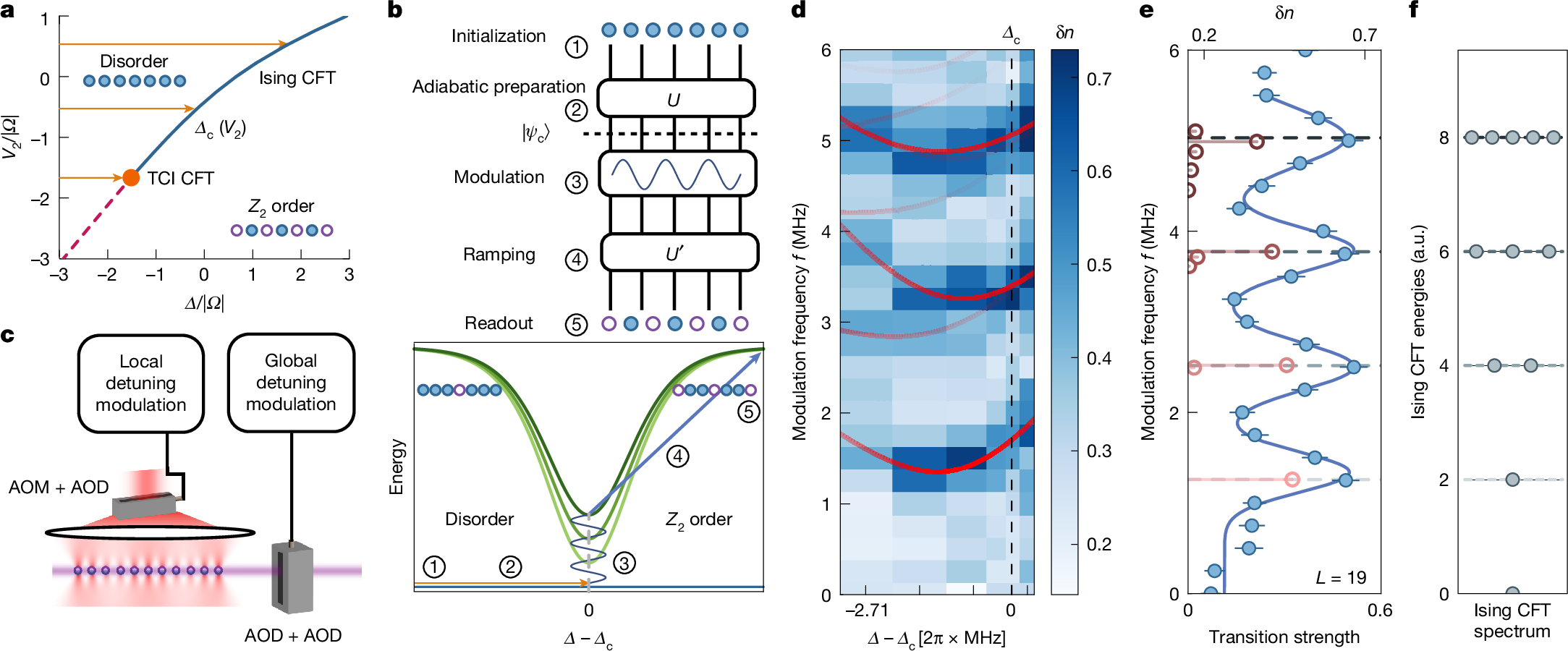
- The ladder had been theorized for decades but never observed or measured before this study, according to ScienceAlert's report of the Nature paper.
- The simulator holds strontium atoms in place with laser light, and separate lasers excite them into Rydberg states that strengthen the interaction between neighbouring atoms.
- With the chain tuned close to a tipping point, the team shook the atoms by modulating the lasers at different frequencies, and the rungs of the ladder appeared.
- The measured energy patterns matched theory at both the Ising point and the tricritical point, the two tipping points the team chose to investigate.
Why it matters
- capability ScienceAlert says the result shows that quantum-computing components can already do measurement work in physics, before any full-scale quantum computer exists.
- constraint The ladder was measured on chains of at most 35 atoms. The same lab's separate array of 6,100 atoms is about 174 times larger, so scaling the measurement is the open step.
- precedent The researchers say the approach could suit other quantum tipping points where the theory is less precise. At those points there will be no exact prediction to serve as the control this experiment had.
Two critical points matter more than one here. The team tested the Ising point and the tricritical point, and each has its own predicted spectrum [5].
The Ising result is the cleaner of the two. "We repeated the experiment on chains of up to 35 atoms, and the rungs came out as predicted by the Ising conformal field theory: the spectra collapsed onto a single universal curve once rescaled for size," Xiangkai Sun said [6]. The tricritical result is thinner. Sun said the team "measured the lowest levels of its distinct spectrum," and that these came out in the different ratios theory predicts [7].
The design is a check against known answers. Jason Alicea, a theorist, said: "Even though we believed these theories to be true, it's important to have an experimental realization, something you can poke and prod." [11] Manuel Endres put the control in one line: "Here we could check our measurements against exact predictions." [12] With the answer fixed in advance, a match shows the simulator reads the ladder correctly. Endres added: "What excites me is that the technique doesn't require knowing the answer in advance." [13]
ScienceAlert describes the work as an experimental test of two theories [1]. What it documents is one feature of them, the spectrum of rungs. The report of the Nature paper does not include error bars or the number of levels resolved at each point. Without those figures, it does not show how closely the rungs matched or how hard the test was.
The physical setting is also narrower than the opening examples suggest. Water boiling and a magnet losing its pull illustrate universality, the tendency of different materials to behave alike near tipping points [9]. The work is expected to inform how materials behave at quantum tipping points, at temperatures close to absolute zero [17]. The system itself is a single line of atoms, and the researchers list grids as later work [16].
What to watch
- Whether the Nature paper's error bars and level counts show a tight match at the tricritical point, where only the lowest levels were measured.
- Whether the group repeats the shaking protocol on the 6,100-atom platform or on grids of atoms instead of a single line.
- The first spectrum measured in a regime classical computers can't reach, which Endres named as the next step, and what stands in for the exact-prediction control there.
Clarity's read
What the record supports and how the coverage leans. The claims behind it follow.
Reality
- Evidence60
- Adoption
- Insufficient
- Hype gap+15
- Incentives
- Insufficient
- Confidence55
Claim ledger
Ranked by verification strength, evidence, and original report placement.
- [1]
An international team led by researchers from the California Institute of Technology used a quantum simulator to observe the energy patterns, compared to rungs on a ladder, that John Cardy predicted in 1984 using conformal field theory for systems at critical tipping points; the study was published in Nature and described as an experimental test of two theories.
- [2]
Before this study, the energy ladder had been theorized but never actually observed or measured.
- [3]
The simulator used strontium atoms trapped and arranged by laser light, and separate lasers excited the atoms into high-energy Rydberg states, which increase atom-to-atom interaction.
- [4]
With the chain of atoms behaving as a single entity, it was tuned close to a tipping point and the atoms were shaken by modulating the lasers at different frequencies, which revealed the rungs of the energy ladder.
- [5]
The energy patterns matched predictions for both the Ising point and the tricritical point, the two tipping points the team investigated.
- [6]
"We repeated the experiment on chains of up to 35 atoms, and the rungs came out as predicted by the Ising conformal field theory: the spectra collapsed onto a single universal curve once rescaled for size," said Xiangkai Sun of Caltech.
- [7]
Sun said: "We then tuned to the tricritical point and measured the lowest levels of its distinct spectrum, which came out in the different ratios theory predicts."
- [8]
A related quantum platform in the same lab was recently able to trap 6,100 atoms in an array.
- [9]
Universality happens when different materials start behaving in similar ways near crucial tipping points, like water boiling or a magnet losing its pull.
- [10]
The 6,100-atom array is about 174 times the 35-atom maximum chain used in the measurement.
- [11]
Jason Alicea of Caltech said: "Even though we believed these theories to be true, it's important to have an experimental realization, something you can poke and prod."
- [12]
Manuel Endres of Caltech said: "Here we could check our measurements against exact predictions."
- [13]
Endres said: "What excites me is that the technique doesn't require knowing the answer in advance."
- [14]
ScienceAlert says the study demonstrates that components of quantum computers can be useful for scientific research even before full quantum computers arrive.
- [15]
The researchers think the same approach could be useful at many other quantum tipping points, perhaps where conformal field theories aren't so precise about what to expect.
- [16]
Future research could look at atoms in grids, not just a single line of atoms.
- [17]
The work will help in the study of how materials behave at quantum tipping points, at temperatures close to absolute zero.
- [18]
Endres said the next step is to point the technique at systems where nobody knows the response quantitatively, including regimes that classical computers can't reach.
Sources
1 independent publisher whose own reporting we read for this story.
- sciencealert.comAfter 40 Years, Physicists Finally Observe The 'Energy Ladder' at Quantum Tipping Points
1 article · October 13, 2026
Topics and entities
Follow any of these and your For You feed starts watching them — no settings page required.
Topics
- Quantum SimulationFollow
- Conformal Field TheoryFollow
- Neutral-atom quantum computingFollow
- Quantum Phase TransitionsFollow
Entities
- California Institute of TechnologyFollow
- ScienceAlertFollow
- John CardyFollow
- NatureFollow
- Manuel EndresFollow
- Jason AliceaFollow
- Xiangkai SunFollow