Science2 publishersIndependently confirmed2 min readPublished
Late-arriving Hurricane Isaias halts 63% of Gulf of Mexico oil output ahead of landfall
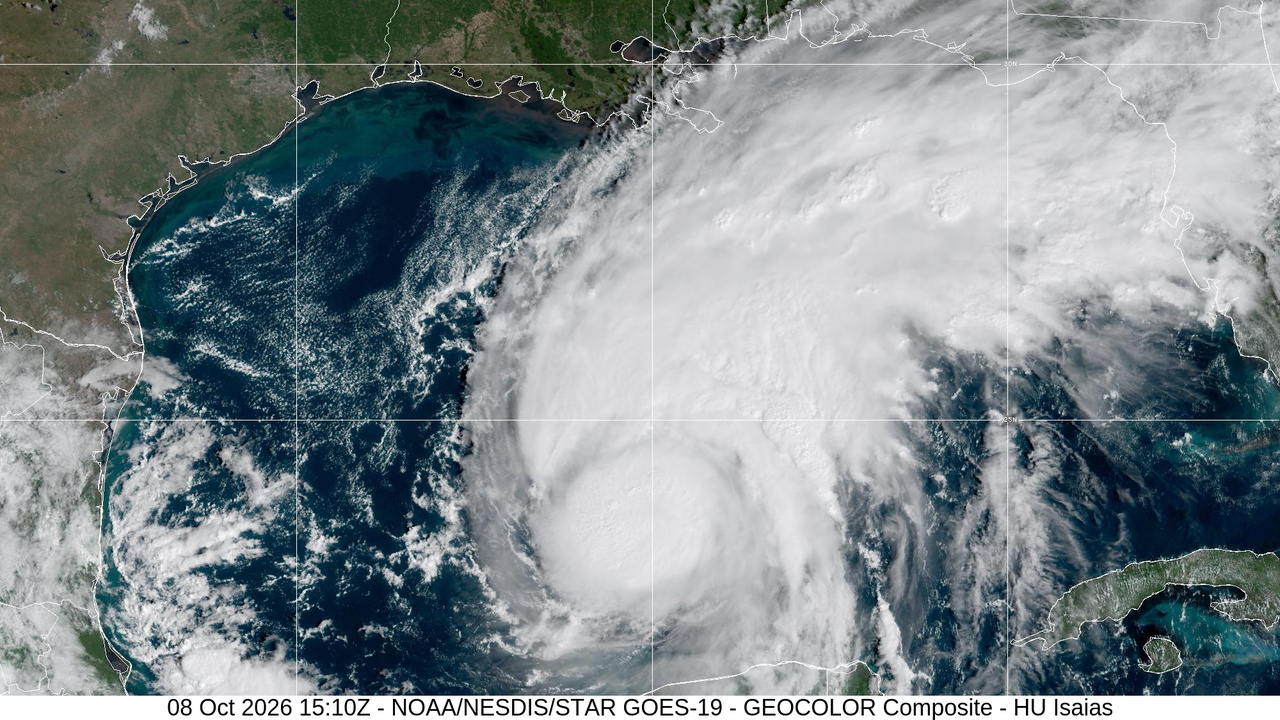
Hurricane Isaias, the first of the 2026 Atlantic season, is heading for a Friday-night landfall on the northern US Gulf Coast. Evacuated rigs had taken about 63% of Gulf oil output offline by Thursday, AFP reported, in a season a strong El Niño has held back.
The Scientist · Science desk
What happened
- Isaias strengthened to a Category 2 hurricane on Thursday with 105 mph sustained winds, about 230 miles south of the Mississippi River delta, the National Hurricane Center said.
- Mandatory evacuation orders cover coastal areas of four Florida counties, and states of emergency are in place in parts of Alabama, Florida and Georgia.
- The BBC reported that Isaias ties the record for the latest first hurricane of an Atlantic season, set in 1905.
Compiled by The ScientistSomething wrong?How this is made
Why it matters
- cost Gulf producers lose close to 1.3 million barrels of oil for every day crews stay ashore, so the cost depends on how long the evacuation lasts as well as how hard the storm hits.
- decision El Niño shear lowered the odds of Atlantic storms forming, yet one late storm still forced the shut-in, so a quiet season is harder to cite as a reason to relax Gulf hurricane readiness.
- exposure With the surge warning running from the Mississippi River mouth to the Suwannee River, onshore coastal assets along that whole stretch face what the NHC calls life-threatening inundation.
If nearly 1.3 million barrels a day is 63% of Gulf oil production, as the Marine Minerals Administration reported for Thursday [12], the region normally produces roughly 2.1 million barrels a day [16]. About 37% of that is still flowing [17]. The shut-in counts platforms and rigs evacuated ahead of the storm [11], and the MMA figures describe the suspension as temporary [12]. Evacuated capacity is different from damaged capacity. How long crews stay ashore depends on a landfall the NHC still places in Florida, Alabama or Mississippi, on Friday night or early Saturday [2].
AFP attributes the late start partly to a strong El Niño, the warming phase of a tropical Pacific cycle that comes along every two to seven years [3][14]. Over the Atlantic, El Niño brings strong vertical wind shear, dry air and sinking air, conditions that make it harder for storms to form and intensify [6]. The Pacific is the comparison case. There, El Niño leaves little vertical shear, and the basin has already seen several hurricanes, including Polo, which at one point reached Category 5 [15].
One cause pushing two neighbouring basins in opposite directions, each the way the physics predicts, is about as close to a control as a single season offers. It is still a single season. The BBC reports that Isaias ties the record for the latest first hurricane of an Atlantic season, set in 1905 [4]. A tied record shows how rare this is. The thing it doesn't tell you is how much of the delay El Niño accounts for, and AFP's own word is "partly" [3].
Suppression lowers the odds of a storm forming. Isaias formed anyway and kept strengthening on its approach [5]. The NHC told residents in the likely impact zone that emergency preparations to protect lives and property "should be rushed to completion" [9]. Two airports in northwestern Florida were scheduled to suspend operations [10].
I think the planning case for anyone with Gulf exposure follows from the physics AFP describes. El Niño made Atlantic storms harder to form and strengthen, and once one did, it still shut in most of the Gulf's oil output before landfall [6][12]. Neither source includes a forecast for the rest of the season. On the physics alone, a late and quiet start is weak grounds for standing down hurricane plans.
What to watch
- The MMA's post-landfall shut-in figures: a quick fall from 63% oil and 57% gas would point to a precautionary pause, while figures that stay high would point to damage.
- Where in Florida, Alabama or Mississippi the NHC's final track puts landfall, relative to the surge warning zone and the hurricane warning from Ocean Springs to the Gulf County line.
- Whether a second Atlantic hurricane forms after Isaias despite the shear and dry air that El Niño brings to the basin.
Clarity's read
What the record supports and how the coverage leans. The claims behind it follow.
Reality
- Evidence62
- Adoption
- Insufficient
- Hype gap0
- Incentives
- Insufficient
- Confidence60
Claim ledger
Ranked by verification strength, evidence, and original report placement.
- [1]
Hurricane Isaias, the first hurricane of the 2026 Atlantic season, is intensifying as it heads toward the northern Gulf Coast and is expected to make landfall Friday night in parts of Mississippi, Alabama and Florida.
- [2]
Isaias is forecast to make landfall in Florida, Alabama or Mississippi on Friday night or early Saturday, according to the NHC.
ReportedSupportedSource: AFP via phys.org, citing the NHC2 sources— create a free account to open themView cited source - [3]
Isaias comes unusually late in the season, which began on June 1, partly due to a strong El Niño.
ReportedSupportedSource: AFP via phys.org2 sources— create a free account to open themView cited source - [4]
Isaias ties the record for the latest first hurricane of an Atlantic season, set in 1905.
- [5]
Isaias strengthened to a Category 2 hurricane on Thursday with maximum sustained winds of 105 mph, about 230 miles south of the Mississippi River delta, the U.S. National Hurricane Center said.
- [6]
El Niño causes strong vertical wind shear, dry air and sinking air over the Atlantic Ocean, hampering storm formation and intensification there.
- [7]
Mandatory evacuation orders have been issued for coastal areas in four Florida counties, and states of emergency are in place in parts of Alabama, Florida and Georgia.
- [8]
A hurricane warning was in effect from Ocean Springs, Mississippi, to the Gulf County line in Florida, and a storm surge warning, which signals the danger of "life-threatening inundation," was in effect from the mouth of the Mississippi River to the Suwannee River.
- [9]
The NHC warned residents in the likely impact zone that emergency preparations to protect lives and property from high winds and storm surges "should be rushed to completion."
ReportedSupportedSource: National Hurricane Center, as reported by AFP via phys.orgView cited source - [10]
Two airports in northwestern Florida were scheduled to suspend operations.
- [11]
Isaias has disrupted oil and gas production in the Gulf of Mexico, as platforms and rigs were evacuated.
- [12]
As of Thursday, about 63% of oil production in the Gulf region had been temporarily suspended, taking nearly 1.3 million barrels a day off the market, according to the Marine Minerals Administration.
ReportedSupportedSource: Marine Minerals Administration, as reported by AFP via phys.orgView cited source - [13]
About 57% of Gulf gas production had been suspended, the Marine Minerals Administration said.
ReportedSupportedSource: Marine Minerals Administration, as reported by AFP via phys.orgView cited source - [14]
El Niño is the warming phase of a natural cycle in the tropical Pacific known as the El Niño-Southern Oscillation and comes along every two to seven years.
- [15]
In the Pacific, El Niño leaves little vertical wind shear, creating favorable conditions for hurricanes to intensify; the Pacific has already seen several hurricanes, including Polo, which at one point reached Category 5.
- [16]
Implied normal Gulf oil production is roughly 2.1 million barrels a day.
- [17]
About 37% of Gulf oil production remained online as of Thursday.
Sources
2 independent publishers whose own reporting we read for this story.
- bbc.co.ukBBC on Hurricane Isaias and its expected Gulf Coast landfall
1 article · October 8, 2026
- phys.orgHurricane Isaias strengthens en route to US Gulf Coast
1 article · October 9, 2026
Topics and entities
Follow any of these and your For You feed starts watching them — no settings page required.
Topics
- Gulf of Mexico oil and gas productionFollow
- Atlantic hurricane seasonFollow
- El NinoFollow