Science1 publisher2 min readPublished
CONAF says seasonal rain topped 180 millimetres in parts of the Atacama for the first time
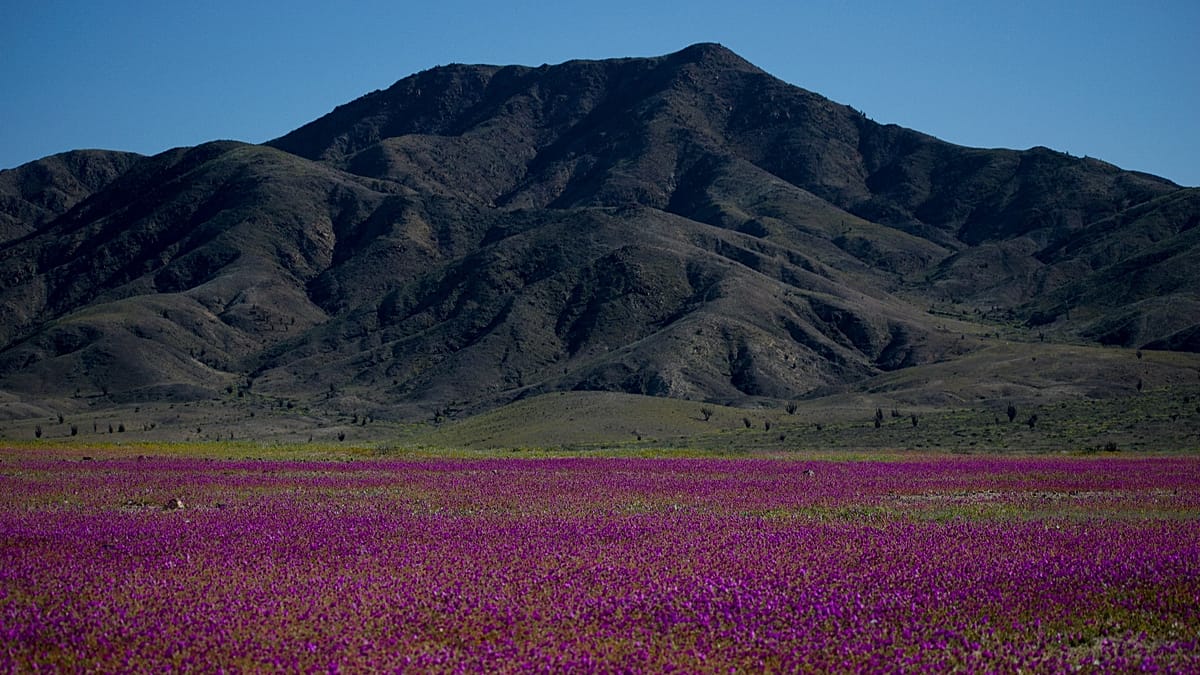
Chile's forestry body says parts of the Atacama took the heaviest seasonal rain in its records. The desert's dormant seed bank has responded with a bloom that is drawing tourists north of Santiago.
The Scientist · Science desk
What happened
- Flowers have bloomed across Chile's Atacama Desert, one of the driest places on Earth, after El Nino brought heavy rain to the north of the country.
- Millions of seeds and bulbs from around 200 species sit under the normally parched ground waiting for water, and the rain brought them up.
- CONAF says the flowering will peak in October and estimates that 15,000 hectares will bloom, with dozens of tourists already stopping to photograph it.
- The torrential rains that hit Chile in July killed 13 people and destroyed or severely damaged around 4,000 homes.
Compiled by The ScientistSomething wrong?How this is made
Why it matters
- cost The same climate pattern CONAF credits for the bloom cost Chilean households lives and homes in July, so the north's flowering year is an expensive one for Chile.
- exposure Visitor pressure now falls on ground that is germinating, and the controls Pizarro named are established footpaths and a request that people leave pets at home.
- capability Beetles fertilising the soil with nitrogen-rich excrement before the next rainfall means this season's output feeds a future bloom as well as the flowers now in the ground.
- precedent A season CONAF logs as a first in its records sets the comparison for the next wet year, and forecasters expect this El Nino to be the strongest in four decades of comparable records.
The rain went deeper into the sand than usual, CONAF says, at the reserve about 800 kilometres north of Santiago [6]. Violet flowers now cover long stretches of ground, and white buds are coming up through cracks in the surface [3].
The rainfall figure is the one measurement in the account. Cesar Pizarro told AFP that seasonal totals above 180 millimetres in some areas "had never been recorded before" [5]. That is a statement about CONAF's own series. The report names no stations and gives no start date for the series [3]. To express the total as a share of normal, or as a return period, a reader would need both.
A depth of 180 millimetres is 180 litres of water on every square metre. The area CONAF expects to flower comes to 150 square kilometres [1], so if that depth had fallen across all of it, the season would have delivered roughly 27 million cubic metres [2]. Pizarro's figure applies to some areas only [5], so the true delivery is smaller than that, and how much water the plants actually used is a separate question.
There is more than flowers, Pizarro said, with insects, snails, birds, reptiles and mammals proliferating too [12].
He also acknowledged the devastating effects of the same climate pattern elsewhere in Chile [17]. "Although there is great concern ... about the impacts it is causing in many places, it also generates life," he said [11]. El Nino raises surface temperatures in the central and eastern equatorial Pacific and changes winds and rainfall globally [9]; this one is predicted to be the strongest since comparable records began four decades ago [8].
"Although there are several deserts that bloom when it rains, the territorial extent and the diversity of species we have here are unique," Pizarro said [16].
What to watch
- Whether CONAF's October count matches its 15,000-hectare estimate, and whether the agency publishes the station data behind the 180 millimetre figure.
- Whether visitor numbers leave measurable damage on germinated ground once the peak passes.
- Whether forecasters verify this El Nino as the strongest in four decades of comparable records.