Zircon fractures put Oklahoma's Ames crater 97 million years later than its Ordovician date
Researchers dated Oklahoma's Ames crater to 370 million years ago, 97 million years after the Ordovician impacts it was grouped with. That is about 2 million years after the Late Devonian extinction began, though the authors say the impact did not cause it.
The Scientist · Science desk
Three figures: zircon fracture analysis dates the Ames impact to 370 million years ago; the Frasnian-Famennian extinction began around 372 million years ago; researchers had placed the crater in the Ordovician event around 467 million years ago.
| Figure | Value | Note | Claim |
|---|---|---|---|
| Ames impact age from zircon fractures | 370 million yrs ago | 6 | |
| Extinction began, around | 372 million yrs ago | 9 | |
| Ordovician date, around | 467 million yrs ago | 3 |
What happened
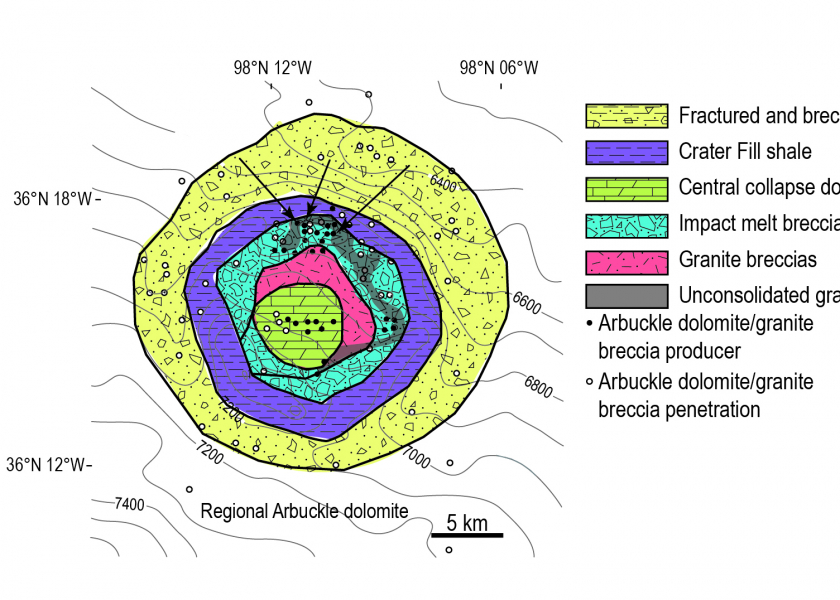
- The crater lies under layers of seafloor sediment with no visible surface sign, and oil prospectors found it in 1991 when they drilled into it by accident.
- Until this study, researchers placed the crater in the Ordovician impact episode about 467 million years ago, and marine fossils in and around it date to roughly that time.
- The Frasnian-Famennian extinction began around 372 million years ago and ran for several million years, with as much as half of marine life lost as oceans ran short of oxygen.
Why it matters
- contradiction Two lines of evidence now disagree: fossils near the crater fit the Ordovician episode, while the zircon fractures give 370 million years ago.
- precedent Zircon dating has already moved other craters, including Australia's North Pole Dome by about 500 million years, so other North American impact ages may be next.
- constraint Ames cannot be counted among the extinction's drivers on this evidence: the authors say its dust may have added to regional cooling that volcanism most likely set off.
Zircon suits the problem. The mineral is close to indestructible, it is scattered through most rock formations, and its internal structure preserves evidence of exposure to high temperatures and intense pressures [8]. The Ames team read fracture patterns in zircon crystals embedded in the buried crater [5]. Elizabeth Catlos, the study's first author and a University of Texas at Austin geologist who also works in planetary science, put it this way in a statement: "No matter what technique we used, it was coming back to this younger signal" [7].
The earlier Ordovician assignment had a reason behind it. That interval saw an unusually high number of large impacts, likely from the fragmentation of a single parent body [16].
Subtract the study's 370 million years from the extinction's start at about 372 million years ago and the gap is roughly 2 million years [18]. Live Science reports that the new age places the crater inside the Frasnian-Famennian event, also called the Kellwasser event [17], which lasted several million years [9].
The thing this doesn't tell you is the order of events. Both dates are given as "around" figures, and Live Science's account of the paper does not state an uncertainty on either [6][9].
Danny Stockli, a co-author, is a geologist and the dean of UT Austin's Jackson School of Geosciences. "It would be great to do this for more of the meteor impact sites across the continent so we could get a more accurate timeline for these major events," he said [15].
What to watch
- Whether the paper reports an age uncertainty on the 370-million-year figure, and how the fossils near the crater are reconciled with it.
- Whether other laboratories or methods reproduce the Devonian date for Ames.
- Whether Stockli's group or others apply zircon dating to more North American impact sites.
Clarity's read
What the record supports and how the coverage leans. The claims behind it follow.
Reality
- Evidence68
- Adoption
- Insufficient
- Hype gap+25
- Incentives
- Insufficient
- Confidence60
Claim ledger
Ranked by verification strength, evidence, and original report placement.
- [1]
Ames crater in northern Oklahoma is around 10 miles (16 km) wide and is the fourth-largest impact structure in the U.S.
- [2]
The crater was buried beneath layers of seafloor sediment, so there are no visible signs of it at the surface; it was discovered in 1991 when oil prospectors accidentally drilled into it.
- [3]
Until now, researchers thought Ames crater dated to the Ordovician meteor event around 467 million years ago.
- [4]
Scientists found fossils of marine animals in and around the crater that date to around the time of the Ordovician event.
- [5]
In the new study, published July 7 in Meteoritics and Planetary Science, researchers analyzed fracture patterns within zircon crystals embedded in the underground crater.
- [6]
The analysis showed the impact occurred 370 million years ago, around 97 million years after the Ordovician meteor event.
- [7]
"No matter what technique we used, it was coming back to this younger signal," said study first author Elizabeth Catlos, a geologist and planetary scientist at the University of Texas at Austin, in a statement.
- [8]
Zircon crystals are near-indestructible, are scattered throughout most of Earth's rock formations, and their internal structure preserves evidence of exposure to extreme conditions such as high temperatures and intense pressures.
- [9]
The Frasnian-Famennian event began around 372 million years ago and lasted for several million years; as much as half of all marine life went extinct as Earth's oceans were depleted of oxygen.
- [10]
The Frasnian-Famennian die-off was most likely triggered by global cooling due to increased volcanic activity.
- [11]
The researchers emphasized that the Ames impact was not the cause of the Frasnian-Famennian event, but noted that fallout from the impact, which would have injected huge clouds of dust into the air, may have contributed to atmospheric cooling in the region.
- [12]
Analyzing zircon crystals is now one of the primary methods of dating ancient meteor craters, and the technique has led to several other impact dates being revised.
- [13]
In July, researchers in Australia revealed that the North Pole Dome crater was around 500 million years younger than initial studies predicted.
- [14]
In 2025, experts found that the impact that created Scotland's Stac Fada Member structure happened around 200 million years later than earlier research estimated.
- [15]
"It would be great to do this for more of the meteor impact sites across the continent so we could get a more accurate timeline for these major events," said study co-author Danny Stockli, a geologist and dean of the Jackson School of Geosciences at the University of Texas at Austin.
- [16]
During the Ordovician period an unusually high number of large space rocks smashed into Earth, likely due to the fragmentation of a single parent body.
- [17]
The crater's new age takes it out of the Ordovician meteor event and places it into the Frasnian-Famennian mass extinction event, also known as the Kellwasser event or the Late Devonian mass extinction.
- [18]
The new impact age of 370 million years ago falls about 2 million years after the start of the Frasnian-Famennian event, around 372 million years ago.
Get this ledger inside ChatGPT. Ask about any of our stories and the answer brings its figure, each claim’s verdict and the sources. Free, no account.
Sources
1 independent publisher whose own reporting we read for this story.
Topics and entities
Follow any of these and your For You feed starts watching them — no settings page required.
Topics
- Impact cratersFollow
- GeochronologyFollow
- Mass extinctionsFollow
Entities
- Ames craterFollow
- Elizabeth CatlosFollow
- University of Texas at AustinFollow
- Meteoritics & Planetary ScienceFollow
- Live ScienceFollow