Science1 publisher3 min readPublished
Zircon crystals make Oklahoma's buried Ames crater nearly 100 million years younger
UT Austin geologists dated zircons from Oklahoma's Ames crater to about 370 million years ago, nearly 100 million years younger than believed. That pulls the buried crater out of the Ordovician impact cluster some researchers cited as evidence of a debris ring around the ancient Earth.
The Scientist · Science desk
Drafted by a language model from the sources cited here and checked against its claim ledger before publication. How we use AISend a correction
What happened
- The team worked with NASA to image the zircons and confirm they had recrystallized in the distinctive way impact conditions produce in the mineral.
- The new age falls close to the Frasnian-Famennian mass extinction about 372 million years ago, an event that wiped out a large share of marine life.
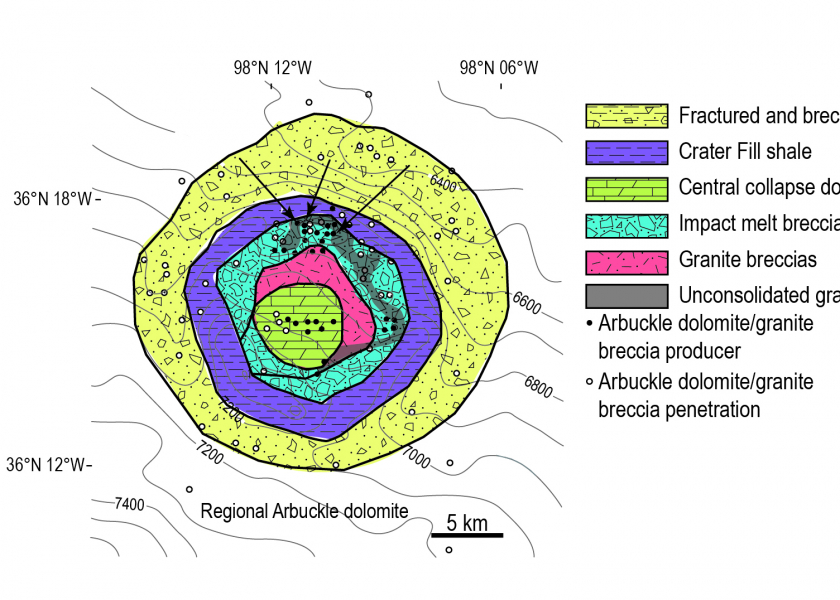
- The buried Ames structure stretches for miles beneath the Oklahoma town and is a major producer of oil and gas.
Compiled by The ScientistSomething wrong?How this is made
Why it matters
- constraint Anyone citing the Ordovician impact cluster as evidence for a debris ring now has to recount the cluster without Ames in it.
- precedent Stockli's call for zircon dates across the continent's impact sites points toward site-by-site re-dating, in which the Ordovician cluster could gain or lose members.
- constraint Ames cannot yet be counted as a trigger for the Frasnian-Famennian die-off, since on central values it struck after the extinction and its error bars are unpublished in this account.
Until this study, Ames had been dated only with biological evidence: teeth from conodonts, eel-like animals of the Ordovician, preserved in the crater's rock [7]. A fossil gives a maximum age. The rock holding it cannot be older than the animal, but it can be far younger, especially when an impact churns up old sediment and buries it again. Catlos's account of Ames fits that pattern, with teeth already millions of years old mixed into the impact rocks intact [8].
Zircon offers a direct date. The grains came from granite the impact altered [5]. Danny Stockli, dean of UT's Jackson School of Geosciences and a co-author, said zircon uranium-lead dating is one of the most accurate ways to determine when events happened deep in Earth's past [12]. The step in the design I find most persuasive is the screening. A zircon in granite might simply record when the granite itself crystallized, so the team imaged the grains with NASA, using cathodoluminescence and electron backscatter diffraction, to find the distinctive recrystallization an impact produces [11]. "No matter what technique we used, it was coming back to this younger signal," Catlos said [6].
The revision moves the impact by about 97.5 million years, from roughly 467.5 million years ago to about 370 [1]. The Frasnian-Famennian extinction is placed at about 372 million years ago [10]. Taken at face value, the central figures put the impact about 2 million years after the die-off [2]. The release does not give the uncertainty on the zircon age, the number of grains dated, or what the revision means for the oil and gas field. Without error bars, this account cannot settle whether those 2 million years are a real gap. Even an exact match would show only that two events were close in time. The open question, as the release puts it, is whether extinctions were triggered mainly from space, by impacts, or from within Earth, by episodes such as massive volcanism [14].
Ames had been one of the craters whose shared age, about 467.5 million years, made the Middle Ordovician look crowded with impacts [3]. That crowding is why some researchers proposed a Saturn-like ring of asteroid debris around Earth at the time [4]. Removing one crater does not dispose of the ring idea. The larger effect is on method. If a fossil age at Ames was wrong by nearly 100 million years [1], any other cluster crater dated only by fossils is open to the same error. "It would be great to do this for more of the meteor impact sites across the continent so we could get a more accurate timeline for these major events," Stockli said [13].
For Oklahoma, the producing field at Ames now sits in a Late Devonian crater [2][1]. The study was published in July in Meteoritics & Planetary Science [9].
What to watch
- Zircon ages for other craters in the roughly 467.5-million-year Ordovician cluster, the re-dating Stockli has called for.
- The uncertainty on the 370-million-year age in the Meteoritics & Planetary Science paper, which determines whether Ames could precede the 372-million-year extinction.